
When Jay Clayton, Donald Trump’s nominee for the next director of national intelligence, appeared before the Senate on Wednesday, Jon Ossoff of Georgia had a simple question for him: Who won the 2020 election? Clayton dodged and squirmed. “I’m not gonna engage in the theater,” he insisted, at one point simply going silent when Ossoff repeated the question.
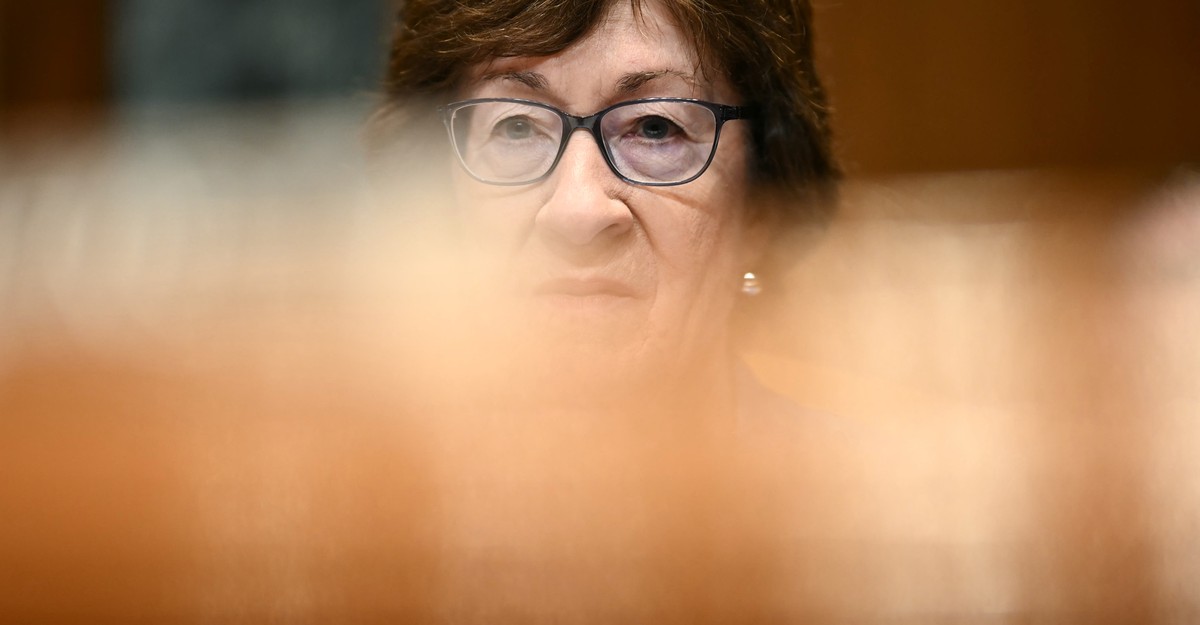
Susan Collins, a Republican senator from Maine, took in the exchange and seems to have concluded that Clayton performed rather well. Buttonholed in the Senate hallway by CNN’s Manu Raju, Collins said, “The Office of the Director of National Intelligence does not certify elections, and he made very clear over and over again that Joe Biden had been certified as the winner of the election.” Clayton, she continued, “did a good job.”
Stating that Biden was certified as the winner of the 2020 election, as Clayton and other Trump supporters have done, does not in any way contradict Trump’s blizzard of falsehoods. Trump does not claim that he actually served as president from 2021 to 2025. His specific lie is that Joe Biden stole the election, a plot that, had it been carried out, would have required Biden to be certified as its winner. If Biden were not certified as the winner, he couldn’t have stolen the election.
More important, the Office of the Director of National Intelligence has played a crucial role in Trump’s antidemocratic maneuvers. As Maggie Haberman and Jonathan Swan report in *Regime Change*, their new book on the Trump presidency, Trump counted on Tulsi Gabbard, his previous DNI, “for using intelligence in personal-revenge missions.” Gabbard participated in an extraordinary raid to seize ballots in Georgia, a task unrelated to the ODNI’s formal mission but intimately connected to the one Trump chose for it.
The ODNI supplied the intelligence findings, such as they are, for the president’s strange speech about election security last night. Employing a peculiar combination of hysteria, innuendo, and lifeless delivery, the president asserted that “our elections were left vulnerable to being rigged and stolen, and the trust of the American people was lost,” and that “we can never watch a stolen election again.”
Toward the end of his address, Trump made gestures of bipartisanship. “Every American, whether you’re a Republican, Democrat, independent, or otherwise, should be able to agree that we deserve the most secure, honest, and fair election system anywhere in the world,” he said. This offers little reassurance, given that Trump has, at other points in time, basically defined a fair election system as one in which his party would never lose.
Republican officials are treating this chilling rant as little more than an annoying distraction. Trump, they complained to reporters before the speech, ought to be focusing on the cost of living. Afterward, they felt comfortable that he came off, relative to the deranged standard to which they’ve grown acclimated, fairly sober. “It was as on the rails as possible,” a White House official told Politico. “The senior team just talked and prepped him. I think they explained the way to be taken seriously is not to be crazy.”
Concern, of course, is Collins’s signature response to Trump-era abuses. One can almost imagine Soviet officials - in the wake of Joseph Stalin’s 1953 allegation of a Zionist doctors’ plot - expressing reassurance that the general secretary had limited the targets of his wrath while expressing concern that he had missed an opportunity to share tips on improving the potato harvest.
The amazing thing is that Collins’s reaction to Clayton’s nomination, and to his disciplined refusal to contradict Trump’s election lies, did not even rise to the level of concern. Her position indicates more about the state of the Republican Party than her reaction to Trump’s speech does. Of all Trump’s illiberal impulses, his refusal to accept the legitimacy of election defeats is the most dire. And of all the Republican members of the Senate, Collins is, at least historically, the most moderate. She is faced with the risk of a career-ending reelection defeat in four months.
Despite all of this, she apparently finds it an easy call to place an official who refuses to accept the obvious reality of Trump’s 2020 defeat in a position that he could use to help undermine American elections. More than a decade into the Trump era, Republicans such as Collins are still treating mortal threats to the republic as a sideshow that distracts from the main business of cutting taxes, confirming judges, and deregulating industries.
In his speech, Trump seemed to plead with his fellow Republicans to recognize the seriousness of his accusations. “No country can be great without fair and honest elections,” he said.
Although Trump is wrong about the nature of the threat to free and fair elections, he is correct about their importance. Maintaining free and fair elections is a foundational condition for the United States. A threat to elections supersedes any other matter in importance. A party that met its democratic responsibilities would treat a failure to accept electoral defeats as automatic disqualification for any office. Collins’s untroubled support for Clayton reveals how far below this simple baseline her entire party has sunk.