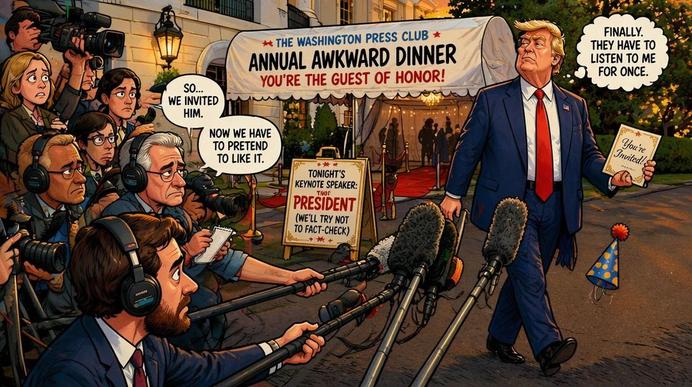
President Who Called Press 'Enemies' Accepts Invitation to Their Party
After years of calling journalists 'enemies,' President Trump will attend their annual awkward dinner, where he'll be the keynote speaker and they'll have to listen.
Even in its most functional form, the annual White House Correspondents' Dinner is an ethically fraught spectacle where journalists mingle with the very officials they're meant to scrutinize. The ratio of non-journalists to journalists is typically about 10 to 1, making the event's stated purpose - celebrating journalism and the First Amendment - a bit of an annual embarrassment.
These are not functional times. After declining all invitations throughout his years in office, President Trump informed the White House Correspondents' Association last month he would attend this year's gala. This sets up the bizarre scene of the president breaking bread with the same people he's spent a decade labeling "fake" and "enemies of the people."
Trump easily qualifies as the most anti-press president in the dinner's 105-year history. In just the past 15 months, he has sued news organizations, threatened to jail journalists, and suggested taking broadcast licenses away from TV networks. His administration has defunded NPR and PBS, hobbled Voice of America, and driven mainstream journalists out of the Pentagon. Weeks after taking office last year, his administration seized control of the White House press pool, dictating who covers him in the Oval Office, on Air Force One, or at Mar-a-Lago - a role the WHCA held for decades.
This raises two questions: why was he invited, and why did he accept? The first is easy: the WHCA has always invited the president, a tradition since Calvin Coolidge in 1924. Trump's motives are murkier. He posted his acceptance on Truth Social in early March, claiming the correspondents asked him "very nicely" and "admit that I am truly one of the Greatest Presidents." The correspondents said no such thing.
He might have been encouraged by the WHCA's choice of after-dinner entertainment. The organization usually hires a comedian to roast the president, but this year it announced it would feature the "renowned mentalist" Oz Pearlman, whose act is safely apolitical. The prospect of being mocked has been an issue for Trump before, notably during Michelle Wolf's 2018 set and after the WHCA unhired comedian Amber Ruffin last year following criticism.
Despite public disparagement, Trump has privately been intrigued. In his 2021 book 'Betrayal,' ABC's Jonathan Karl recounts being summoned in 2020 to discuss Trump's role. "Am I supposed to be funny up there?" Trump asked, expressing interest if the WHCA would drop booked comedian Hasan Minhaj. Karl declined, and the dinner was later canceled due to the pandemic.
A former WHCA board member suggested Trump may realize "he only has so many more chances to do the things a president can do." Trump will be both guest of honor and keynote speaker, with the press corps seated below him. He could use the occasion to mend fences for the nation's 250th birthday - but, of course, he won't. As former WHCA president George Condon noted, Trump is determined to 'own' every organization that opposed him. The dinner has never been known for its food, but for the reporters in attendance, this year's meal might be particularly hard to stomach.
The Good Times
News in your inbox.
One sardonic roundup, delivered on your schedule. Free. Unsubscribe whenever your tolerance for wit runs out.
Already subscribed but we never reach your inbox? Check your spam folder and hit 'Not spam' (or 'Remove from spam') to bust us out of junk-mail purgatory. You'll be helping everyone else too.
Don't open any of our emails for a month and you'll be automatically removed from the mailing list.
Rewrite Article
Select parts to regenerate with a fresh AI pass. Translations will be updated automatically.
Generate AI Image
Creates a sardonic version of the article image using OpenAI.