Scientists Confirm Uranus and Neptune Are Even Weirder Than We Thought
New simulations suggest the deep interiors of Uranus and Neptune contain a bizarre 'quasi-one-dimensional superionic' form of carbon hydride, because of course they do.
In a development that will surprise absolutely no one who has ever looked at a picture of Uranus, scientists have confirmed the deep interiors of ice giant planets are likely hiding a bizarre new state of matter. This revelation comes courtesy of new computer simulations by Carnegie scientists Cong Liu and Ronald Cohen, published in *Nature Communications*, which suggest carbon hydride (CH) gets up to some truly strange stuff under pressure.
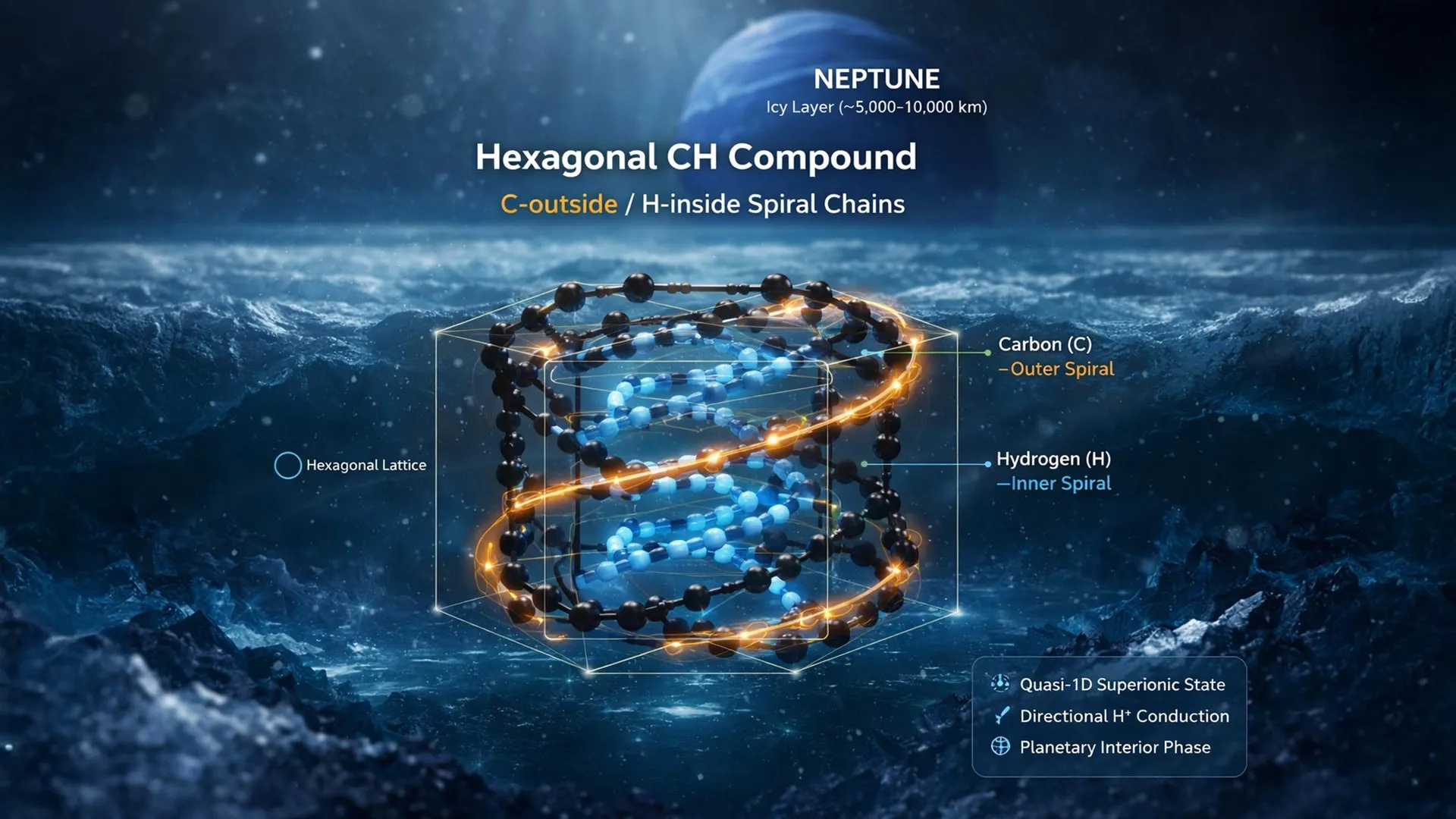
Their study posits that under the intense pressures and temperatures found far beneath the surfaces of these distant planets - think 500 to 3,000 gigapascals and 4,000 to 6,000 Kelvin - carbon hydride could enter a "quasi-one-dimensional superionic state." This is a fancy way of saying the atoms start behaving like they're in a cosmic subway system designed by M.C. Escher.
The simulations revealed a structure where carbon atoms form an ordered hexagonal framework, while hydrogen atoms move through it along spiral-like paths. "This newly predicted carbon-hydrogen phase is particularly striking because the atomic motion is not fully three-dimensional," Cohen explained. "Instead, hydrogen moves preferentially along well-defined helical pathways embedded within an ordered carbon structure." So, the hydrogen is basically doing a very organized, very hot, very pressurized conga line.
This discovery matters because the directional movement of these hydrogen atoms could significantly influence how heat and electricity are transported in the planets' deep layers. These properties are key to understanding the generation of Uranus and Neptune's famously odd magnetic fields, which are already the planetary equivalent of wearing your pants on your head.
The research underscores a simple truth: put enough pressure on anything, even basic elements like carbon and hydrogen, and it will start acting in ways you never expected. "Carbon and hydrogen are among the most abundant elements in planetary materials, yet their combined behavior at giant-planet conditions remains far from fully understood," Liu concluded, in what might be the understatement of the astrophysical year.
Beyond helping us understand why our outermost planets are such cosmic weirdos, this work could also inform advances in materials science here on Earth. It turns out the secrets to new types of directional behavior in matter might be hiding in the last place anyone wants to look.
The Good Times
News in your inbox.
One sardonic roundup, delivered on your schedule. Free. Unsubscribe whenever your tolerance for wit runs out.
Already subscribed but we never reach your inbox? Check your spam folder and hit 'Not spam' (or 'Remove from spam') to bust us out of junk-mail purgatory. You'll be helping everyone else too.
Don't open any of our emails for a month and you'll be automatically removed from the mailing list.
Rewrite Article
Select parts to regenerate with a fresh AI pass. Translations will be updated automatically.
Generate AI Image
Creates a sardonic version of the article image using OpenAI.