NASA Meteorite Study Reveals Ancient Space Brine, Because Even Asteroids Had a Salty Phase
NASA scientists study a pristine meteorite that fell in New Jersey, finding ancient salty brines and organic compounds - proof that even asteroids had a flavorful past and maybe delivered life's ingredients to Earth.
A meteorite that crash-landed in New Jersey on July 16, 2024, was scooped up so fast by an amateur astronomer that NASA scientists actually got to study it before Earth's grubby atmosphere ruined everything. The astronomer, spotting the space rock on his property, donned protective gloves and stashed the fragments in aluminum foil and glass containers, preserving delicate minerals and organic compounds that usually get wrecked by moisture and contamination.
Cameras across New Jersey captured the fireball's descent, allowing scientists to reconstruct its trajectory and, in a study published Wednesday in Science Advances, trace the rock back to the asteroid belt. The Hillsborough meteorite, named after the township where it landed, is a carbon-rich CM carbonaceous chondrite - basically a fossilized cosmic time capsule from over 4.5 billion years ago.
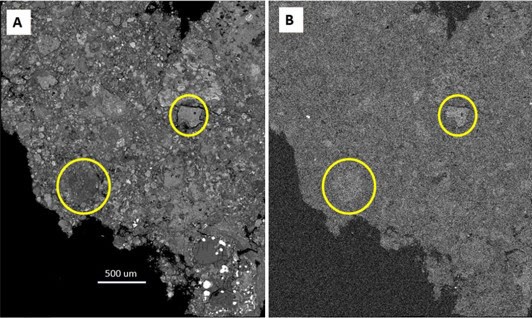
Under powerful electron microscopes, researchers found microscopic fractures filled with sodium-rich remnants of ancient brines. These brines, essentially salty asteroid juice, altered the rock's minerals and left behind fragile sodium-carbonate salts that normally react with Earth's moisture before anyone can study them. Similar salts have been found in samples from asteroids Bennu and Ryugu, but this is the first time they've turned up in a CM chondrite, suggesting that salty water was more common among primitive asteroids than previously thought.
The meteorite also boasts a complex mix of amino acids and other organic compounds, rivaling the famous Murchison meteorite that fell in Australia in 1969. "It's just more proof that the chemical building blocks of life could have been delivered - and are still being delivered - to Earth today," said Danny Glavin, a NASA astrobiologist and co-author of the study.
Astronomers determined the meteorite likely came from the Erigone asteroid family in the inner belt, home to the asteroid Donaldjohanson visited by NASA's Lucy spacecraft in 2025. The research team, spanning disciplines from astronomy to organic chemistry, is piecing together how primitive asteroids evolved over billions of years.
"If you follow the water through the solar system, you're actually following life," said co-author Mike Zolensky. So, in a nutshell: space is salty, and that's how we got here.
The Good Times
News in your inbox.
One sardonic roundup, delivered on your schedule. Free. Unsubscribe whenever your tolerance for wit runs out.
Already subscribed but we never reach your inbox? Check your spam folder and hit 'Not spam' (or 'Remove from spam') to bust us out of junk-mail purgatory. You'll be helping everyone else too.
Don't open any of our emails for a month and you'll be automatically removed from the mailing list.
Rewrite Article
Select parts to regenerate with a fresh AI pass. Translations will be updated automatically.
Generate AI Image
Creates a sardonic version of the article image using OpenAI.