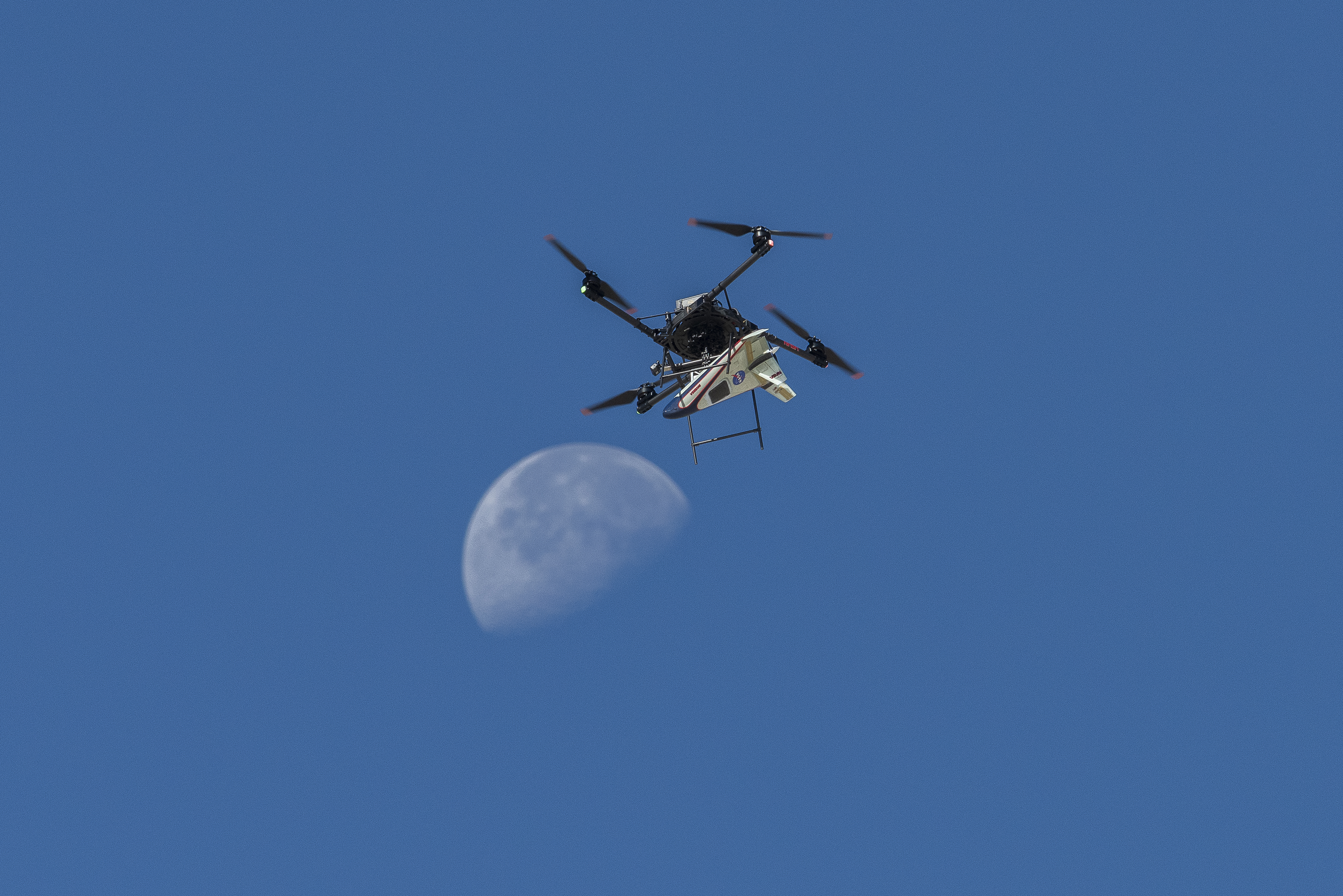
NASA has long believed that the best way to learn how to fly is by, well, flying. And crashing. Preferably something small and cheap. Enter the Dale Reed Subscale Flight Research Laboratory at NASA’s Armstrong Flight Research Center in Edwards, California, where a fleet of remotely piloted and autonomous aircraft serve as cost‑effective guinea pigs for innovative ideas.
Among the available platforms: the Alta‑X quadrotor; the Dryden Remotely Operated Integrated Drone (DROID) with a 10‑foot wingspan; the Multi‑Use Cub, a 14‑foot‑span fixed‑wing aircraft with expandable payload capacity; and the HQ‑90 quadrotor for electric vertical takeoff and landing tests. Each piloted by certified subscale aircraft pilots who are apparently unfazed by flying one-of-a-kind or modified commercial aircraft.
NASA’s FireSense project recently deployed an Alta‑X drone to the Geneva State Forest, about 100 miles south of Montgomery, Alabama. The drone carried a sensor to gather localized weather data influencing smoke movement and fire behavior. The goal: help operational agencies improve wildfire decision‑making and allocate firefighters and resources. Because nothing says “firefighting” like a quadcopter.
Closer to home, the Enhancing Parachutes by Instrumenting the Canopy (EPIC) project involved air‑launching a capsule containing a parachute and flexible sensor from the Alta‑X. The tests demonstrated that flexible sensors could help study supersonic parachutes, potentially making them safer for delivering science instruments and payloads to Mars. So yes, NASA is perfecting Mars parachutes with a drone in California.
NASA also tested its Automatic Ground Collision Avoidance System on the DROID, a simplified version of technology already saving lives in high‑performance U.S. military jets. The system performed well, and NASA’s Technology Transfer Office is now working to license it to U.S. businesses. Because if your Cessna could avoid plowing into a mountain, that’d be nice.
Then there’s the Prandtl‑D flying‑wing glider, designed and flown at Armstrong. Its twisted wing reduces drag and generates thrust at the wingtips, concepts that could improve fuel economy. The original now resides in the Smithsonian National Air and Space Museum, and the Prandtl‑D3 is at the California Science Center. Researchers continue developing the next generation, presumably named Prandtl‑D4: The Search for More Lift.
The lab also boasts rapid prototyping with 3D manufacturing, composite fabrication, and a team of engineers who apparently enjoy turning wild ideas into flight-ready test structures. All in service of NASA’s aeronautics and exploration goals, proving that big things really do come in small, remotely piloted packages.
The Good Times
News in your inbox.
One sardonic roundup, delivered on your schedule. Free. Unsubscribe whenever your tolerance for wit runs out.
Already subscribed but we never reach your inbox? Check your spam folder and hit 'Not spam' (or 'Remove from spam') to bust us out of junk-mail purgatory. You'll be helping everyone else too.
Don't open any of our emails for a month and you'll be automatically removed from the mailing list.
Rewrite Article
Select parts to regenerate with a fresh AI pass. Translations will be updated automatically.
Generate AI Image
Creates a sardonic version of the article image using OpenAI.