
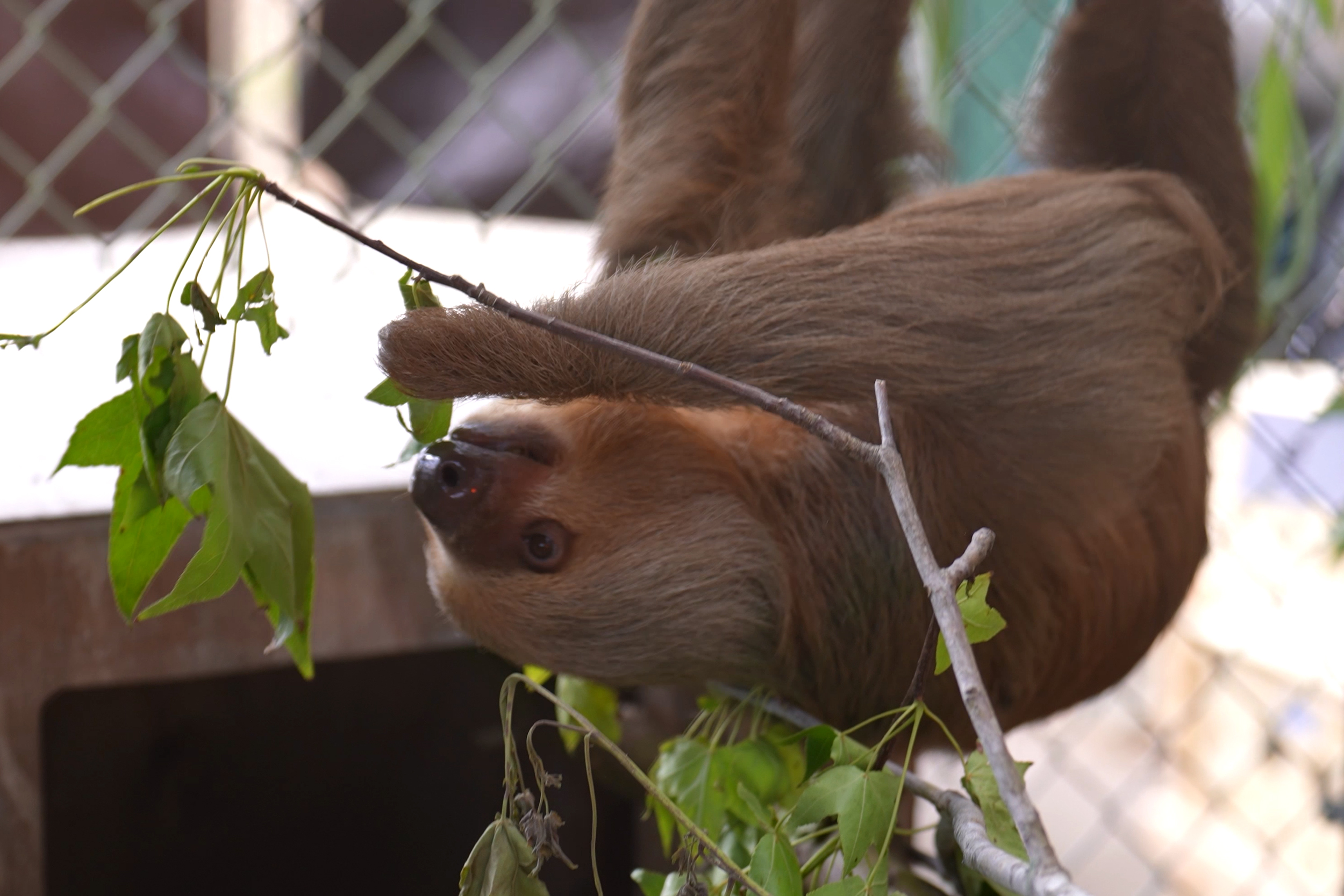
When pathologists cut open dead sloths from a planned Florida tourist attraction, they found a plethora of pathogens. Parasites, bacteria and viruses were all lurking in animals weakened by grueling international transport and stressful conditions at the warehouse that received them, according to necropsy records and a state inspection report obtained by Inside Climate News through an open records request. The sloths had distended stomachs, diarrhea matted into fur and lungs congested with pneumonia.
The Orlando business where they died, called Sloth World, closed before ever opening to the public amid a backlash after an April investigation by Inside Climate News. But wildlife scientists, epidemiologists and veterinary pathologists say the details of the mass deaths spotlight broader public-health concerns with the multi-billion-dollar legal wildlife trade in an era where three-quarters of new infectious diseases originate in animals. The industry creates a pipeline for viruses, parasites and fungi to mutate, spread and threaten humans and animals alike - helped along by major gaps in government protections.
“Wildlife trading is inherently a system that can amplify pathogen risk,” said Dr. Neil Vora, a physician and epidemiologist who spent nearly a decade working with the U.S. Centers for Disease Control and Prevention, including on the frontlines of Ebola outbreaks. As a person, Vora said he’s heartbroken about the suffering of the animals Sloth World imported from the forests of Peru and Guyana - more than 50 have died. As an epidemiologist, he is deeply concerned by the movement of wild animals into commercial settings. Vora pointed to the 2002 SARS outbreak in China, sparked by live animal markets, and the 2003 Mpox outbreak in Wisconsin, linked to the exotic pet trade, as clear historical warnings of what happens when species are artificially commingled under intense stress.
“It is like conducting a dangerous genetic experiment,” Vora said of the trade. “It’s just a ticking time bomb that has huge risk - it’s like pandemic roulette.” Pathogens crossing species barriers have driven many of the world’s most consequential outbreaks, including HIV/AIDS, influenza and West Nile virus. Two recent outbreaks of infectious diseases originating in animals, Ebola and hantavirus, have sparked international concern.
The Trump administration withdrew the United States from the WHO, which coordinates pandemic responses, in January. Experts said many other pandemic protections are weak or missing in the U.S., and the trend isn’t going in the right direction. The Trump administration has reduced staffing at federal agencies involved in aspects of exotic wildlife oversight, including the CDC, U.S. Department of Agriculture and the U.S. Fish and Wildlife Service. The White House did not respond to questions about that.
“We do not have strong enough regulations in the United States or internationally to address this threat,” Vora said. Laws, he added, “need to be rooted in public health, not just the conservation status of the animals.” The exotic wildlife industry is fragmented, with a wide variety of businesses and institutions importing animals. But two groups representing portions of the sector, the Exotic Wildlife Association and the Pet Advocacy Network, did not respond to requests for comment.
Containing a pathogen once it breaks out is brutally difficult, even within highly regulated, heavily screened systems like domestic food networks that feature routine monitoring, warned Meghan Davis, a veterinarian and associate professor at the Johns Hopkins Bloomberg School of Public Health. She pointed to the ongoing spread of H5N1 avian influenza, known as bird flu, in U.S. dairy cattle as a prime example of such containment challenges.
Jérôme Gippet, an interdisciplinary ecologist who has studied the wildlife trade’s relationship to pathogen spread, called the industry “very dangerous.” In April, he co-published findings in the journal Science from an analysis of 40 years of international trade records, revealing that species involved in the global wildlife trade are 50 percent more likely to share pathogens with humans than those that aren’t traded. The longer a species was traded, the more pathogens it shared.
“The problem isn’t just the pathogen,” Gippet said. “The trade creates the opportunities for these viruses to become zoonotic,” jumping from animals to humans. The volume of wild animals legally moved around the world each year is eyewatering. The United States alone imports more than 90 million wild animals annually just for the pet trade - many more are imported for medical research, roadside attractions, the fashion industry and trophy hunting. Less is known about the illegal wildlife trade, though in Brazil alone, officials estimate that tens of millions of animals are illegally taken from the wild each year.
While most animal pathogens won’t make the jump to humans, the movement of so many wild animals and the mixing of species that would never come into contact otherwise is setting the stage for new pandemics, according to Gippet, a postdoctoral researcher at the University of Fribourg in Switzerland. “To facilitate logistics or maximize profits, they [exporters] put several species in the same place that shouldn’t be put together,” Gippet said. Sloths, for instance, could be held in the same export facility as capybaras and monkeys - conditions that can encourage pathogens to jump between species.
“We can expect that pathogens that are good at jumping between species are also good at jumping to humans,” Gippet added. Christian Walzer, a veterinarian and executive director of health at the Wildlife Conservation Society, spent years working alongside law enforcement during raids on illegal exotic wildlife trade facilities. “Many of these facilities have virtually no meaningful biosafety measures in place,” he said.
The Science study found that transmission risk was present across the entire trade - legal and illegal. Animals moved illegally are only slightly more likely to share pathogens with humans. That shows legality doesn’t make something safe or sustainable, Gippet noted. The more than 60 sloths imported by Sloth World did not enter the United States through smuggling routes - they cleared customs legally. Yet in terms of zoonotic disease and biosecurity risk monitoring, the sloths effectively entered a regulatory vacuum the moment they crossed the federal import threshold at the Miami airport en route to an Orlando warehouse.
That was made abundantly clear when Inside Climate News asked multiple Florida and U.S. government agencies who is responsible for zoonotic disease oversight of imported wildlife. The CDC directed inquiries to the U.S. Fish and Wildlife Service. A spokesperson for the Department of Interior, which oversees the Fish and Wildlife Service, referred questions back to CDC as well as the USDA and state agencies. The Florida Fish and Wildlife Conservation Commission (FWC) referred inquiries about zoonotic disease to USDA and also to the Florida Department of Agriculture and Consumer Services. Officials with this state agency said the FWC likely referred to them in error and that “FWC has the primary role in overseeing the importation of exotic wildlife into Florida.” A spokesperson for USDA’s Animal and Plant Health Inspection Services, meanwhile, said the agency is “only involved in addressing certain zoonotic diseases that have the potential to affect livestock and are reportable to USDA APHIS or to the World Organisation for Animal Health.” Other animal diseases, the spokesperson said, should be reported to state officials.
Julie Lockwood, director of the Rutgers Climate and Energy Institute, who has spent years studying wildlife trade dynamics, said the lack of inter-agency and inter-state coordination is a problem. After import, “we have no idea what happens.” “They’re not organized. They’re not coordinated in any way,” Lockwood said of states, describing an uneven matrix of laws governing what species can be possessed and under what conditions. Imported wild animals are frequently transferred between owners or across state borders with little more than a quick visual evaluation by a veterinarian - if that even occurs. For some species, trade within the United States is exceedingly easy. It’s entirely legal to stick frogs and fish directly into the mail and ship them, though the shipper is supposed to guarantee the animals are not “injurious,” according to federal law.
“We can’t just look at a wild animal and know what it’s carrying.” In some states, including Texas and Florida, large volumes of exotic wildlife change hands at massive colosseum-style wildlife trade expos. The U.S. does have precedent for shutting down certain sectors of the exotic wildlife trade when the risk is too high, though experts say those interventions are rare. Early last year the federal government finalized import bans on salamanders to block the introduction of a deadly fungal pathogen. There have also been regional bans on large constrictor snakes. More recently, Florida announced a temporary ban on sloth imports following Inside Climate News’ investigation into Sloth World. The order noted “systemic disease” in the Sloth World animals, and the “unique physiology of sloths and their susceptibility to severe illness caused in part by stress and inadequate husbandry practices.” However, experts warn that reactive bans do not fix a fundamentally blind system.
Davis, with the Johns Hopkins Bloomberg School of Public Health, said some safeguards meant to prevent the spread of disease from imported wildlife are inadequate. Testing for pathogens, for example, can be expensive for rare or unusual diseases, meaning regulators operate in the dark in some cases. The necropsy reports on Sloth World’s animals noted an “unknown virus” that has yet to be identified. “We can’t just look at a wild animal and know what it’s carrying,” Davis said. She said that a gammaherpesvirus identified in some of the Sloth World animals likely poses relatively low risk to humans. Gammaherpesviruses are generally less likely to jump across species barriers than some other viral families. But Davis cautioned that other pathogens, like influenza viruses, are getting very good at jumping between species and circulate in birds, pigs and humans. “They can exchange genetic information that lets them switch things up quickly, and when they switch things up, it can be things we haven’t seen before and that can pose challenges,” Davis said.