
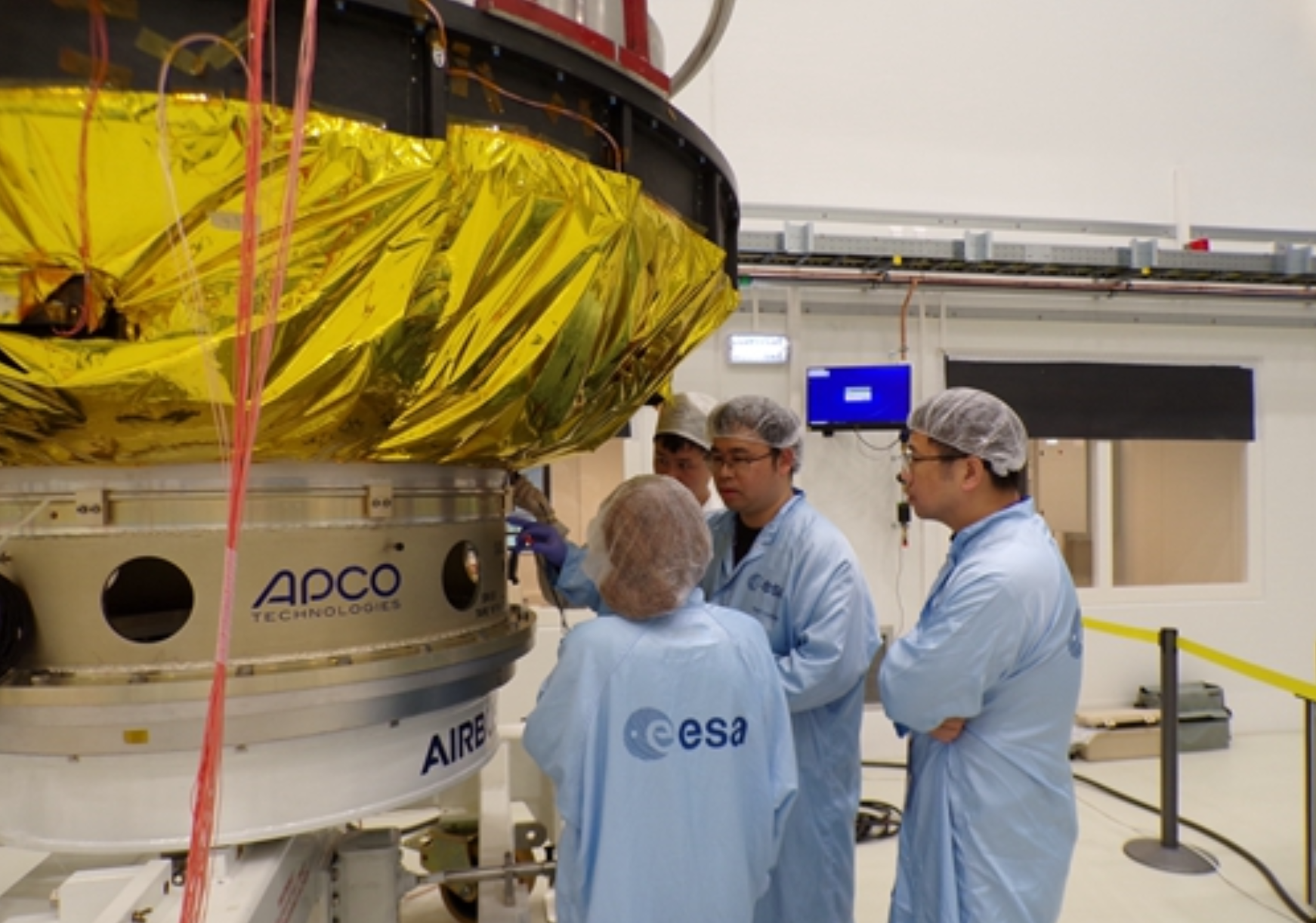
HELSINKI - The European Space Agency and China successfully launched the SMILE (Solar wind Magnetosphere Ionosphere Link Explorer) mission on May 19 from Kourou, French Guiana, aboard a Vega C rocket. The spacecraft is now headed for a unique orbit high above the North Pole where it will use soft X-ray and UV imagers to study how Earth’s magnetosphere interacts with the solar wind. It was selected from 13 proposals by joint teams from ESA and the Chinese Academy of Sciences (CAS), establishing a new framework for cooperation on space science.
But don't get too misty-eyed. Despite the champagne popping and back-patting over the decade-long journey to launch, senior officials from both organizations refused to commit to any deeper future collaboration - even though their interests and activities overlap like a Venn diagram drawn by a very confused mathematician.
“We asked the European and the Chinese scientists to work together to build SMILE, and I think that that mechanism for me has been proven with this mission to be very effective,” ESA science director Carole Mundell told SpaceNews ahead of launch, describing the process as a bottom-up joint call for proposals. “I’m very hopeful that we will deliver compelling new science that will also then be very important for operational space weather prediction.”
Wang Chi, director general of CAS’s National Space Science Center (NSSC), noted that SMILE built on the earlier Double Star mission - another joint ESA/China project that launched in 2003 and 2004 to study the Sun’s effects on Earth’s environment. “Broadly speaking, the SMILE mission and the Double Star mission, they study space weather. This is related to habitability and why the Earth is suitable for the sustainable development of human beings,” Wang said.
Neither Mundell nor Wang presented a concrete plan for what comes next, despite SMILE being selected and approved a full decade ago. The main obstacle? The eternal enemy of all great ideas: money. “We both have to secure our budgets, which is the biggest challenge for both of us. We have lots of lovely ideas, but we need the money,” Mundell said. “We both agreed when we discussed this in China [in March] that we would like to find a way to do a new call like this, but we need that money in the budget.”
Both ESA and China share strong interests in habitability, within the solar system and beyond, and both have ambitious future missions - but with only limited nods toward cooperation. ESA’s Plato will launch next spring to search for Earth-like planets around sun-like stars, and Ariel will follow a few years later to study the atmospheric history of over 1,000 exoplanets. “We’ll be moving to the point where we’re looking at climate change on other worlds,” said Mundell. ESA is also sending EnVision to Venus to study why it’s so different from Earth, while JUICE is already en route to Jupiter’s icy moons. The agency is even planning a mission to Saturn to tour its icy moons and land the first astrobiology mission on Enceladus, complete with flybys through its water plumes.
China, meanwhile, will launch its first exoplanet-hunting mission, Earth 2.0, in 2029 - an observatory at Sun-Earth Lagrange point 2 that will scan 2 million stars in the Kepler field. Its Tianwen-4 Jupiter mission, set for around 2030, will study Jupiter’s satellites before entering orbit around a Galilean moon, possibly with a lander to Callisto. “We’ve been talking to our Chinese colleagues about their Jupiter mission,” said Mundell. “We will tour past Callisto, so we will already have some information about Callisto, which may be useful for them. So I think there’s some organic collaboration in terms of helping one another to make our own missions better.” ESA could also assist with China’s Solar Polar Orbit Observatory mission scheduled for 2029.
China’s space science program has come a long way from its modest beginnings a decade ago. It now has a successful strategic priority program, two interplanetary missions under its belt, samples from both hemispheres of the moon, a modular Tiangong space station it plans to expand, and a Mars sample return mission (Tianwen-3) launching in 2028. Yet ESA confirmed in 2023 that it no longer plans to send its astronauts to Tiangong - citing neither the budget nor the political will. The first international astronaut to visit the station will instead be from Pakistan later this year. Europe has been pivoting to strategic autonomy amid geopolitical shifts.
One telling development: CAS chose one of the 12 proposals that lost out to SMILE for its next round of strategic space science missions. Discovering the Sky at Longest wavelengths (DSL), also known as Hongmeng, will send an array of 10 small satellites into lunar orbit before the end of the decade. Using the moon as a shield against Earth’s electromagnetic interference, it will pick up faint, ultra-long wave signals from the early universe. China thus appears to have the budget and direction to go it alone for DSL, despite it being born of a collaborative setting.
The SMILE model showed that deep ESA-China cooperation in space science can work. That it has not yet produced a successor - while both parties are developing parallel paths - suggests there are still serious barriers to further collaboration. Sometimes even a successful date doesn’t lead to a second one.