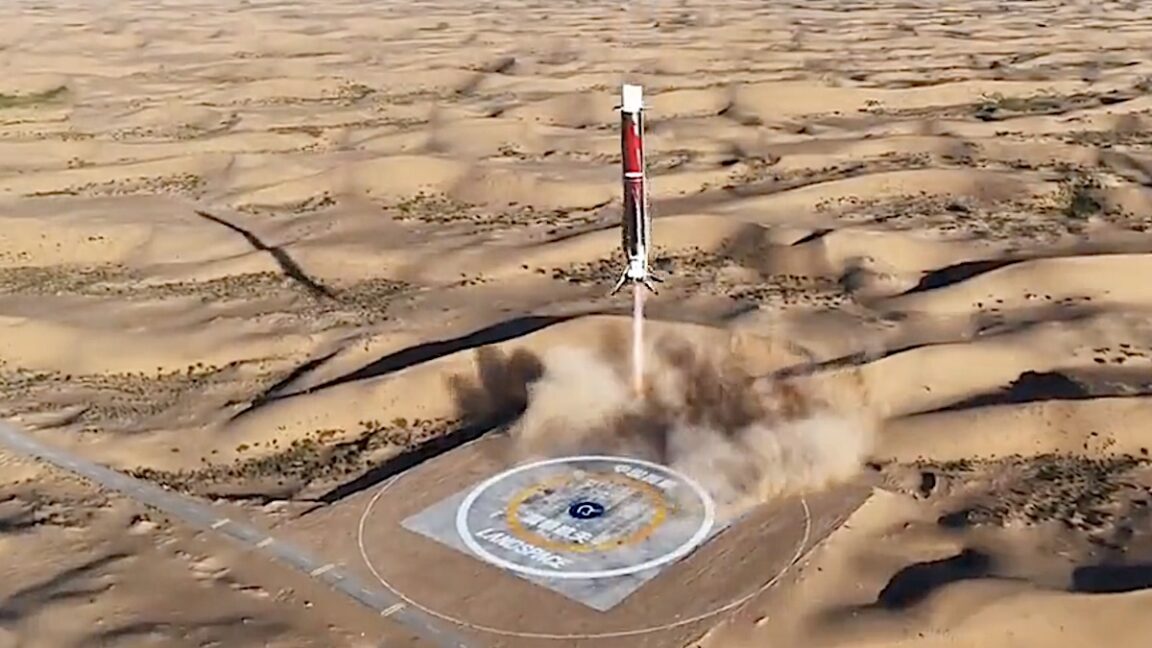
It's been a little over a month since China first recovered an orbital-class rocket booster, and already a second company has pulled it off. On Tuesday, LandSpace's Zhuque-3 rocket completed a flawless first-stage landing, proving that China's space industry is not just catching up - it's doing so with alarming speed.
For perspective, it took Blue Origin ten years to propulsively land an orbital-class booster after SpaceX's Falcon 9 did it in 2015. China just did it twice in 40 days. The Long March 10B, from CASC's Shanghai Academy of Spaceflight Technology, was caught by a net on an offshore platform on July 10. Now, LandSpace's Zhuque-3 has landed on legs, on land, in the Gobi Desert, like a well-behaved lawn dart.
The ZQ-3 lifted off from Jiuquan Satellite Launch Center at 7:35 pm EDT (23:35 UTC) Tuesday, about an hour after sunrise at the spaceport. Nine methane-fueled engines powered the 216-foot-tall (66-meter) rocket on a southeast trajectory, then the upper stage took over to place a single satellite into orbit. The first stage, made of stainless steel, soared to the edge of space, then maneuvered to a landing zone 240 miles (390 kilometers) downrange, settling on four extendable landing legs.
LandSpace, founded in 2015, declared the mission a total success. "This mission marks China's first-ever successful recovery attempt of the first stage of an orbital-class launch vehicle using landing legs, and China's first successful booster recovery on land," the company said. It's a pivotal flight test for Zhuque-3 as it transitions from technological demonstration to engineering application - which is a fancy way of saying, 'We're going to start reusing these things.'
The December crash landing of the first Zhuque-3 booster prompted engineers to make changes: they used just a single engine for the final landing phase and tweaked the heat shield for reentry. Dai Zheng, head of the Zhuque-3 project, described the final braking maneuver as a 'one-shot reverse-parking' while moving at high speed, which sounds both impressive and slightly terrifying.
The recovered booster will now be inspected, maintained, and prepped for another flight. LandSpace plans to fly each booster at least 20 times, which is a nice round number that assumes nothing goes boom. The Zhuque-3's basic design can deliver more than 17,600 pounds (8 metric tons) to low-Earth orbit with booster recovery, and an upgraded version could handle more than 40,000 pounds (18.3 metric tons) in reusable mode.
This rocket builds on LandSpace's earlier Zhuque-2, which became the world's first methane-fueled launcher to reach orbit in 2023. Now, China's rocket companies are gearing up for a busy few months. The Long March 10B booster is supposed to fly again before the end of the year, and several other reusable rockets are in the pipeline: the Long March 12A, Long March 12B, Pallas-1 from Galactic Energy, Hyperbola-3 from iSpace, and Space Pioneer's Tianlong-3, which failed on its first test launch earlier this year.
Meanwhile, the US rocket industry has long dominated in launches and payload mass, mostly thanks to SpaceX's Falcon 9. But SpaceX is looking to retire the Falcon 9 after 2028, replacing it with Starship - a massive rocket with at least five times the payload capacity. Starship remains experimental, and has a history of delays, so it's unclear if it will be ready to take over. Blue Origin's New Glenn is grounded after an explosion in May, and United Launch Alliance has no reusable plans.
China's bench is arguably just as deep as the US's, even if no single company matches SpaceX's launch cadence. But with reusable rockets, China could close the gap. The country's two largest satellite constellations, Guowang and Qianfan, are projected to require 700 to 800 launches over the next seven to 10 years. That's a lot of rockets, and China is clearly betting on reusability to meet the demand.
So, as the US fiddles with Starship and New Glenn, China is busy landing boosters like it's no big deal. The floodgates are open, and the race to reuse is on.
The Good Times
News in your inbox.
One sardonic roundup, delivered on your schedule. Free. Unsubscribe whenever your tolerance for wit runs out.
Already subscribed but we never reach your inbox? Check your spam folder and hit 'Not spam' (or 'Remove from spam') to bust us out of junk-mail purgatory. You'll be helping everyone else too.
Don't open any of our emails for a month and you'll be automatically removed from the mailing list.
Rewrite Article
Select parts to regenerate with a fresh AI pass. Translations will be updated automatically.
Generate AI Image
Creates a sardonic version of the article image using OpenAI.