
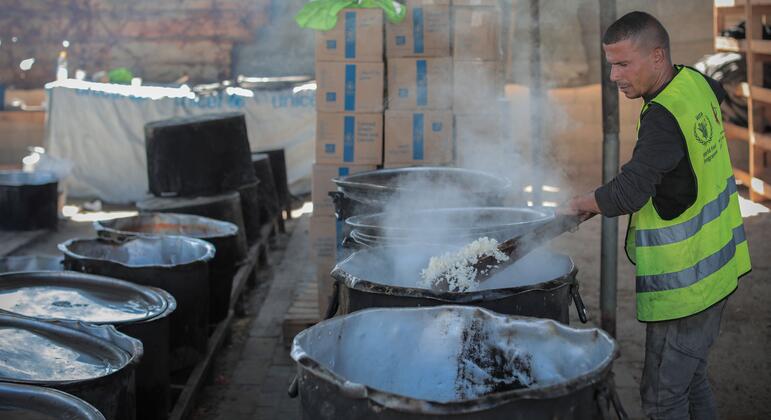
The United Nations has issued a grim new warning: aid workers are under fire like never before, and the rise of cheap, adaptable armed drones is making their jobs deadlier by the day. On World Humanitarian Day, the UN aid coordination office (OCHA) revealed that 907 aid workers were victims of violence last year, simply trying to do their lifesaving work in increasingly hostile conflict zones.
While fatalities dipped in 2025, they remained historically high, with 350 humanitarian staff killed - the second-highest toll ever recorded. And if you thought that was a trend, think again: this year has already seen 322 aid workers injured and 235 kidnapped, according to the Humanitarian Outcomes’ Aid Worker Security Database, funded by the Australian and Canadian Governments. Because nothing says 'support' like tracking how many of your people got snatched.
UN Secretary-General António Guterres marked the day by honoring aid workers worldwide, who face threats, arrest, and detention. “Disinformation is eroding trust. Humanitarian funding is being cut. And humanitarian access is being restricted,” he said, urging Member States to stand up for those who stand up for millions of people. He also commemorated the 23rd anniversary of the bombing of the UN's headquarters in Baghdad, where 22 colleagues were killed by a massive truck bomb - a tragedy that birthed World Humanitarian Day, but apparently didn't teach anyone a lasting lesson.
Gaza remained the deadliest context for aid workers in 2025, for the third consecutive year, with 186 killed, 68 per cent by aerial bombardment - despite a ceasefire declared last October. Sudan wasn't far behind, with record 71 aid workers killed, mostly from small arms fire, as intense conflict drove up fatalities for the fifth year running. Other hotbeds included Ukraine, Ethiopia, Syria, Haiti, Chad, and Cameroon, where kidnappings and aerial bombardments were the most common forms of violence. So far in 2026, 82 aid workers have been killed, 97 injured, and 39 kidnapped.
Tom Fletcher, UN Humanitarian Affairs and Emergency Relief Coordinator, didn't mince words: “More than 1,000 aid workers have been killed in just three years and that is utterly unacceptable.” He stressed that calling it out isn't enough - states must uphold international humanitarian law and ensure real consequences for those who break the rules. Because apparently, 'don't kill the people bringing food and medicine' needs to be repeated.
Now, enter the drones. The UN warns that weaponized drones are reshaping battlefields, putting lethal capabilities into more hands and allowing explosive attacks to reach deeper into towns and cities. In Sudan, armed drones were responsible for 80 per cent of civilian deaths in the first four months of 2026, striking markets and health facilities. In Ukraine, drones killed 80 civilians in April alone. In Russia, drone attacks have killed civilians and damaged infrastructure. And in Colombia, weaponised drone attacks quadrupled between 2024 and 2025.
Aid workers are increasingly caught in the crosshairs. The World Health Organization has recorded 639 attacks on healthcare this year already. In March, an aid worker was killed when a drone struck a residential building in the Democratic Republic of the Congo. In Ukraine, four humanitarian convoys were hit in a single week in May. “Weaponised drones have become the new face of an old danger: the deliberate or reckless destruction of civilian life,” Fletcher said. “The technology may change, but the laws of war do not.” Apparently, someone needs to remind the drone operators of that.
This year's World Humanitarian Day campaign, Act for Humanity, puts a human face on the statistics, sharing stories of aid workers killed and the families left behind. Take Emmanuel Madragule, a humanitarian driver with over two decades of experience, who survived an armed-group attack in eastern DR Congo in June 2024. Despite the danger, he returned to the field, saying, “I cannot leave my colleagues like this. I have to stay with my colleagues.” His motivation is personal: in 2008, humanitarian workers saved his uncle's life after he was shot. His story underscores the growing risks and sacrifices in the DRC.
World Humanitarian Day is observed every year on 19 August, marking the 2003 bombing of the Canal Hotel in Baghdad, which killed 22 UN staff, including Sergio Vieira de Mello. Five years later, the UN General Assembly designated the day. This year, the UN is urging those with power to #ActForHumanity. Fletcher, joining virtually from Kyiv, said, “This is not a temporary spike that we're seeing. This is a stain. It is the normalisation of violence against our community. And we will not accept it.” He noted that drones are “extending the reach of war,” killing or maiming people for life.
International humanitarian law requires parties to armed conflicts to protect civilians and respect humanitarian personnel. Yet, humanitarian organizations are working to reach 87 million people facing the most severe needs this year. Fletcher, reflecting on the birth of World Humanitarian Day from tragedy, said those tragedies are now continuing day to day, powered by “a chilling alliance between technological ingenuity and modern warfare.” The victims are civilians and humanitarians, he said, calling for the international community to uphold the law. “I fear otherwise that the death toll from these weapons will continue to rise. And we'll be back again next year with another grim litany of stats to share with you.” We can hardly wait.