
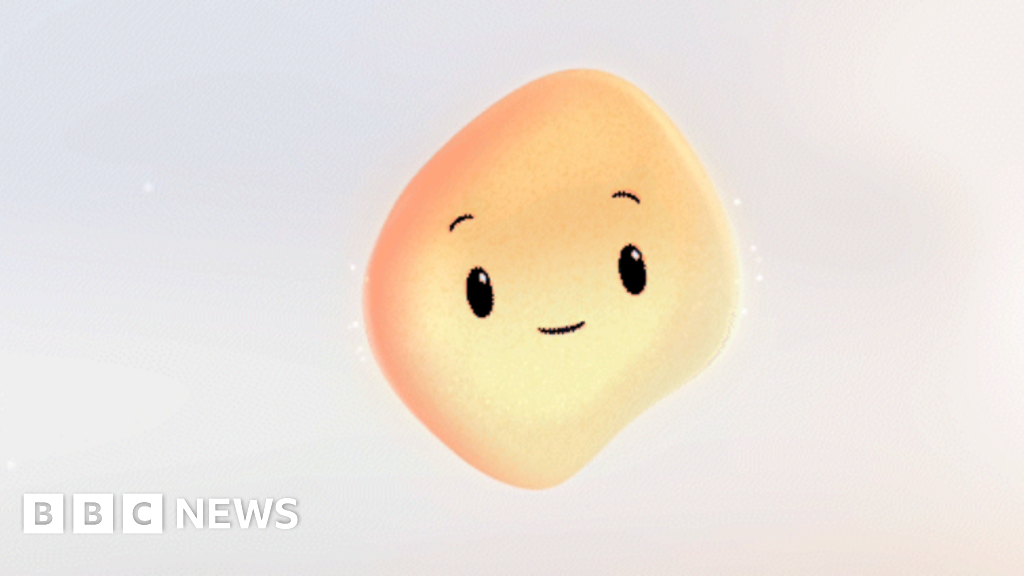
Some of the world's most powerful corporations are trying a new strategy to win us over: being adorable. Because nothing says 'we definitely don't have too much data on you' like a cute blob with a smiley face.
Tech giants Microsoft and Apple are among a wave of businesses that have recently introduced new cartoon mascots. Experts say this is often used to make a brand seem more human and friendly - presumably because actual humans are too busy being annoyed by their products.
Apple's character, a blue-and-white figure with an outsized head unofficially known as Little Finder Guy, debuted in March in social media videos promoting a new laptop. It has garnered some positive coverage, which is more than can be said for most Apple product launches.
Microsoft, which wisely retired its universally reviled Clippy paperclip years ago, has unveiled a new cartoon character for its AI assistant Copilot. The company insists that Mico - a blob with a smiley face - is 'not a mascot, but an optional visual identity for Copilot.' It adds that Mico is 'expressive, customizable and warm' and 'makes voice conversations feel more natural,' which is corporate speak for 'we're trying to make our AI seem less like a robot overlord.'
There are good reasons for this cuteness offensive. Research from 2019 found that businesses whose marketing campaigns include mascots are 37% more likely to grow their market share. 'They give a voice, a personality, a face even, to a company that is cold and impersonal to many people,' says Anthony Patterson, professor of marketing at Lancaster University Management School. In other words, they're the emotional support animals of corporate branding.
Google has gotten in on the act too, letting users create personalized versions of its Android robot mascot via an app launched last September. You can upload a selfie and the mascot will start wearing your clothes and copying your hairstyle - because what the world really needed was a tiny green robot rocking your terrible haircut.
Reddit updated its alien character Snoo in 2023 to be more animated and emotive. In March, Mozilla turned its Firefox logo into a full-fledged mascot called Kit. John Solomon, Mozilla's chief marketing officer, says: 'If you think about our competition - look at a Chrome logo, look at a Safari logo, look at an Edge logo - they're very stark, somewhat similar, somewhat cold. As a challenger brand, we want to distinguish ourselves from them.' So the strategy is: be warmer than a browser icon. Low bar, but okay.
Not everyone is charmed. Nathalie Nahai, who writes about psychology and tech, notes that the resurgence of mascots coincides with growing mistrust in big tech. 'People are reaching a crisis point when it comes to our relationship with consumer-oriented technologies,' she says. 'So many companies are getting a massively bad rap for being these techno overlords. What better way to cut through than to create a cute and cuddly, anthropomorphic mascot?' It's the corporate equivalent of a villain putting on a puppy filter.
Both Nahai and Patterson worry about combining AI with mascots, enabling them to interact with people in highly personalized ways. Patterson warns: 'Individual brand mascots will begin to talk to us on a one-to-one level and try to persuade us to do things. It's a bit creepy, isn't it?' Just a bit, yes.
Microsoft says it has received 'encouraging feedback so far' about Mico, and that users who don't want to interact with the character can turn it off. How generous.
Duolingo's big-eyed green owl, Duo, has been a massive success, attracting over 20 million followers across TikTok and Instagram. Kat Chan, Duolingo's head of brand marketing, says: 'Duo has become much more than a mascot. He's a character people follow and interact with.' He's also, let's be honest, slightly terrifying.
Nahai explains that mascots tap into our innate impulses: 'In nature, we have evolved to respond with certain behaviours towards something like a baby which has a large head and big eyes' - features exaggerated in many brand characters. So tech companies are essentially exploiting our biological weakness for big-headed things.
Mascots aren't new - sports teams have used them since the 19th century. But after a period of over-saturation, they're making a comeback. Book publisher Penguin recently revived its bird mascot with hand-drawn illustrations 'to bring warmth, humour and personality' to its brand. Not all mascots are cute, though. Patterson points to Joe Camel, the smoking cartoon mascot for Camel cigarettes, as a reminder that mascots have 'a chequered history.'
Nahai hopes consumers are savvy enough to see past the cuteness. 'I think there's more cynicism these days,' she says. 'But for people who are younger, who haven't been exposed to cynical marketing practices, these strategies may have more persuasive impacts.' In other words, the kids are going to fall for the blobs. We're doomed.