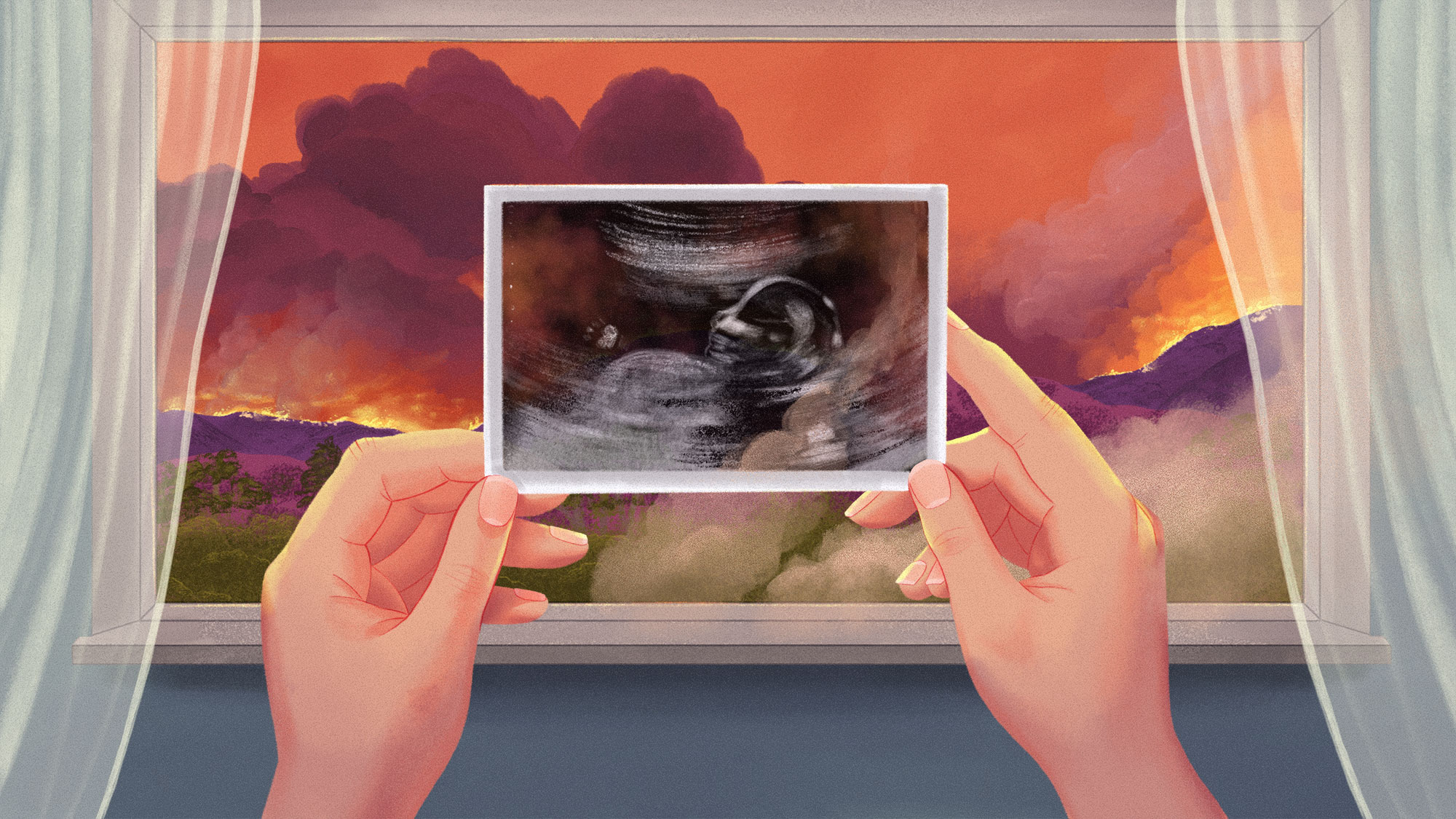
Wildfire Smoke Blanketed Their Cities. Researchers Are Now Asking the Obvious Question: Did It Harm Babies?
Australia's Black Summer and other megafires are revealing a troubling pattern: wildfire smoke may be harming babies in the womb, but public health guidance is still playing catch-up.
They never thought the fires would reach them. They lived in cities, after all, far from the parched, combustible wilderness. But as Anneke French, a nurse at Canberra Hospital, discovered during Australia's 2019-2020 Black Summer, the smoke doesn't care about zoning laws. French was 35 weeks pregnant when a stabbing pain sent her to the hospital. Her obstetrician, Stephen Robson, found a placental abruption - normally linked to trauma or chronic smoking - but French had neither. She did, however, have air so thick with smoke that Canberra's air quality index hit 5,000 on New Year's Day 2020. (For context, anything above 300 is considered hazardous.) Her daughter Margot was born nearly five weeks early and underweight. Six years later, Margot is the only one of French's three children with asthma and eczema, conditions neither parent has. French's friends who gave birth during the same period report similar patterns.
This is not a one-off. The Black Summer coated Australia's east coast in choking smoke; three years ago, 100 million Americans were exposed to deadly pollution from Canadian wildfires; just last year, fires destroyed about 13,000 residential properties in Los Angeles, killing 31. Yet public health systems in both countries remain ill-prepared for the inevitable return of such blazes. Pregnant people, in particular, are given generic guidance - "stay indoors" - as if that solves the problem when your home smells like a campfire and the smoke seeps into the operating room. (Robson noted that smoke floated in the beam of his medical spotlight during a routine birth, looking, he said, "like the bat signal.")
The evidence linking wildfire smoke to preterm birth, low birth weight, and developmental issues is still emerging, but it's not exactly starting from scratch. General air pollution has been extensively studied since the 1970s and is linked to everything from coronary heart disease to dementia. Fine particulate matter can cross the placenta, disrupting oxygen and nutrient exchange. A 2024 study in the southwestern U.S. found wildfire smoke linked to higher risk of preterm birth and low birth weight; two 2025 studies in California found a connection between wildfire smoke in utero and autism diagnoses. The World Health Organization estimates that indoor and outdoor air pollution kills 7 million people annually - more than diabetes, tuberculosis, and car accidents combined.
Treating wildfire smoke as an open question, scientists say, is less about waiting for the science to settle and more about ignoring what we already know about similar pollution. "The exposures in utero, during gestation periods, have an impact on life and the development of children when they're born," said Sotiris Vardoulakis, director of the Health Research Institute at the University of Canberra. "It can have consequences for many years - the rest of their lives." In other words, not preparing for wildfire smoke is a policy choice, and the bill is coming due.
The Good Times
News in your inbox.
One sardonic roundup, delivered on your schedule. Free. Unsubscribe whenever your tolerance for wit runs out.
Already subscribed but we never reach your inbox? Check your spam folder and hit 'Not spam' (or 'Remove from spam') to bust us out of junk-mail purgatory. You'll be helping everyone else too.
Don't open any of our emails for a month and you'll be automatically removed from the mailing list.
Rewrite Article
Select parts to regenerate with a fresh AI pass. Translations will be updated automatically.
Generate AI Image
Creates a sardonic version of the article image using OpenAI.