
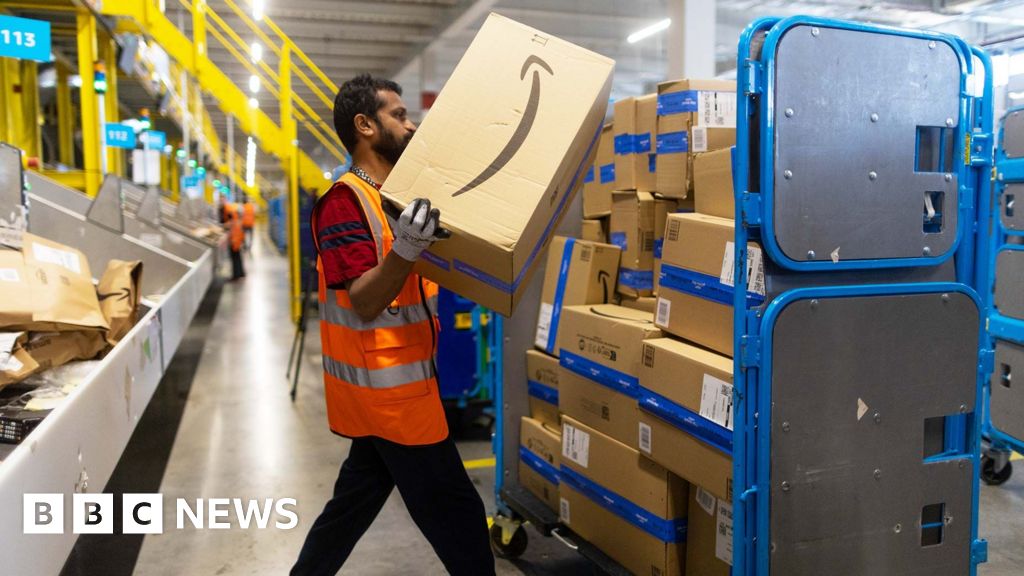
Vitamins, repair tape, and a jar of mango chutney - just a few of the items my household bought last month via Amazon's sprawling online shopping platform. We also shopped at Whole Foods, streamed its TV shows, read books on Kindle, and browsed countless websites powered by Amazon Web Services (AWS), its highly profitable cloud-computing arm.
And that's not even half of the interconnected products and services offered by the global behemoth, which earlier this year overtook Walmart to become the world's largest company by annual sales. But why does Amazon, launched by Jeff Bezos in 1995 as an online bookstore from a rented garage, have so few serious rivals in the West when it comes to e-commerce? Couldn't we consumers benefit from a bit more competition?
First, to be fair, Amazon isn't without competitors in any of its segments. Walmart and Target both have rapidly expanding online retail arms and offer their own versions of Prime. In the UK, Tesco leads in online groceries, and Zalando is Germany's biggest internet clothing retailer. For ultra-cheap goods, Chinese sites Temu and Shein are major forces. Then there's eBay, which recently received a $55.5bn (£41bn) takeover offer from GameStop (rejected, thanks), but its auction-based model is a different beast.
Yet Amazon towers over them all: in the US, it accounts for 40.5% of online retail sales, while nearest rival Walmart has 9.2%, and eBay sits at around 3%. In the UK, Amazon holds about 30% of online retail. "Amazon is not an undisputed monopolist in e-commerce, but it is the dominant firm," says Annabelle Gawer of the University of Surrey. "And the scope of what it sells is unparalleled."
How did this happen? Experts point to a combination of factors. First-mover advantage: Amazon was among the earliest to scale online retail, capturing market share before others could blink. Shareholder patience: for years, investors allowed the company to sell at a loss and reinvest profits - Amazon has never paid a dividend. "The strategy constrained the competition," says David Yoffie of Harvard Business School. Traditional companies would have seen their stock prices tank for such antics.
Today, Amazon uses profits from AWS, its main money engine, to subsidize low-margin retail and fund new ventures. Positioning itself as a tech company helps - algorithms, automation, and data drive efficiency. And it has a culture of bold experimentation, as Sunil Gupta of HBS notes, entering everything from cloud computing to healthcare and moving on when things fail.
Two pivotal moves sealed the deal. In 2000, Amazon became a platform, allowing third-party sellers to offer goods - creating a network effect where more sellers attract more customers, and vice versa. "It is very hard for a new player to break that," says Gupta. Then came Amazon Prime (US 2005, UK 2007), with free fast shipping for an annual fee. "You have the free shipping, in which case you may as well just search for your stuff on Amazon," says Emily West of UMass Amherst. Prime has grown into a bundle of movies, shows, and Whole Foods discounts, making cancellation nearly unthinkable.
But there's another, less flattering reason for Amazon's lack of rivals: alleged antitrust violations. The FTC and the state of California have separate lawsuits against Amazon, set for trial in early 2027, accusing it of unlawful practices to maintain dominance. California recently released a trove of evidence. Amazon denies the allegations. The FTC alleges Amazon penalizes sellers who offer lower prices elsewhere - by reducing visibility or removing their 'Buy Box' - thus keeping prices uniform and discouraging rivals' discount strategies.
Some call for breaking Amazon into multiple companies. "It would oxygenate the market," says Stacy Mitchell of the Institute for Local Self-Reliance. But others see a breakup as unlikely - Google avoided one recently. Meanwhile, with deep pockets and time, a company could build a copycat platform; Walmart is already borrowing elements of Amazon's playbook.
Yet Amazon's next threat may not come from a conventional retailer at all. E-commerce is starting to be embedded in generative AI interfaces like ChatGPT, letting users buy products without leaving the site - a development that could threaten Amazon's dominance. "You aren't necessarily seeing a company that is impossible to compete against," sums up Yoffie. But for now, Amazon remains the 800-pound gorilla, and we're all just shopping in its jungle.