Sunlight: Now With 90.7% Quantum Ghost Imaging, Because Lasers Were Getting Too Fussy
Scientists finally found a use for sunlight that doesn't involve sunburn: quantum ghost imaging with 90.7% visibility, no lasers required. Take that, lab equipment.
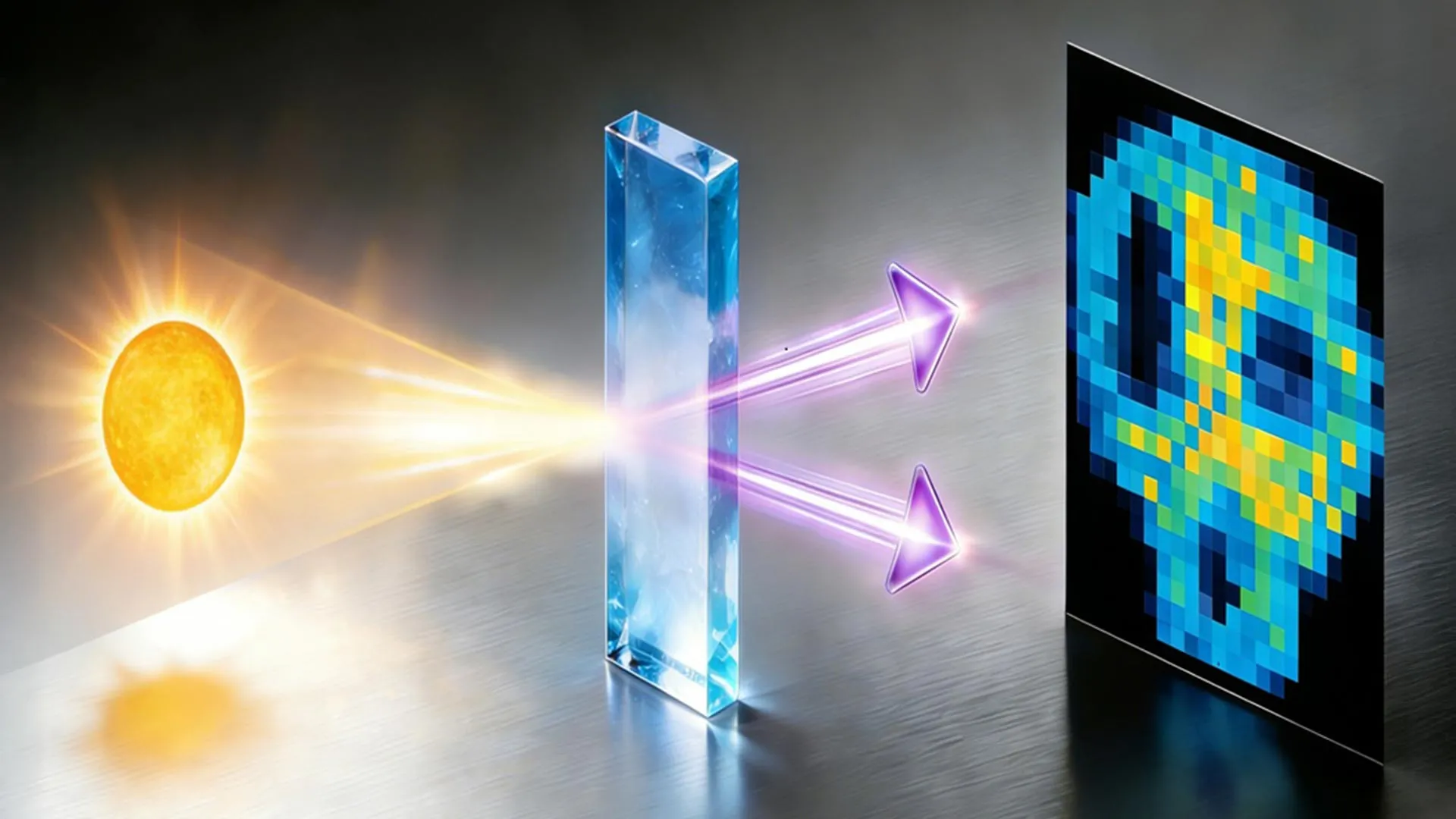
In a stunning twist that will have lasers questioning their life choices, scientists have successfully used plain old sunlight to perform quantum ghost imaging. For decades, quantum optics has relied on a process called spontaneous parametric down-conversion (SPDC), which typically demands a powerful, stable laser shining into a nonlinear crystal. But as it turns out, the universe is more flexible than we thought: even partially coherent light can do the job, and now, as a team from Xiamen University (led by Wuhong Zhang and Lixiang Chen) has shown, so can the sun itself.
The challenges are real, though. Sunlight reaching Earth is a fickle thing - constantly fluctuating in brightness, direction, and position - which makes it a nightmare for precise alignment. But the team, as reported in Advanced Photonics, built an automatic sun-tracking device (like a fancy equatorial telescope mount) that follows the sun all day, funneling its rays into a 20-meter plastic multimode optical fiber, which leads into a dark lab where it hits a periodically poled potassium titanyl phosphate (PPKTP) crystal.
And lo and behold, it worked. The system generated photon pairs with strong position correlations, achieving a ghost-imaging visibility of 90.7% - just shy of the 95.5% from a standard 405 nm laser at the same pump power. They even reconstructed a more complex 2D image they call a 'ghost face,' because science has a sense of humor.
How does it pull this off? Sunlight's broad spectrum helps maintain quasi-phase matching in the crystal, producing plenty of correlated pairs. By collecting data over longer periods, they improved signal-to-noise and contrast-to-noise ratios, proving the system can handle the sun's mood swings.
This is the first successful sunlight-pumped SPDC with ghost imaging, and it opens the door to fully passive quantum imaging - no lasers, no external power. The researchers suggest this could be a game-changer for quantum systems in remote or space-based settings. And with future advances in sunlight collection, crystal engineering, and image reconstruction (hello, compressed sensing and machine learning), we might soon have quantum cameras that literally run on sunshine.
In other news, lasers are reportedly feeling 'unappreciated.'
The Good Times
News in your inbox.
One sardonic roundup, delivered on your schedule. Free. Unsubscribe whenever your tolerance for wit runs out.
Already subscribed but we never reach your inbox? Check your spam folder and hit 'Not spam' (or 'Remove from spam') to bust us out of junk-mail purgatory. You'll be helping everyone else too.
Don't open any of our emails for a month and you'll be automatically removed from the mailing list.
Rewrite Article
Select parts to regenerate with a fresh AI pass. Translations will be updated automatically.
Generate AI Image
Creates a sardonic version of the article image using OpenAI.