
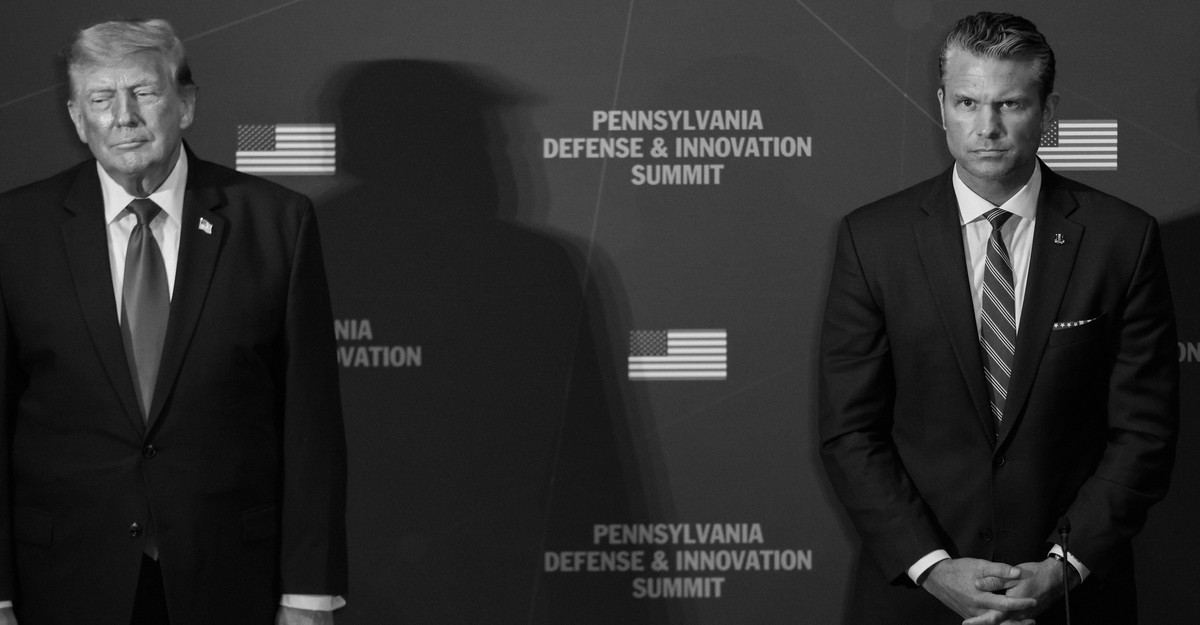
For nearly five months, Donald Trump and his Cabinet have been misleading the American people about the war in Iran, according to a scathing Atlantic piece. The president's statements on the war are described as a mix of wishful thinking, hyperbole, and outright lies. He has given only one prime-time address on the topic - a rambling speech four months ago that contained little substance. After more than 20 weeks of hostilities, at least 18 Americans dead, and hundreds wounded, the public cannot know what is happening, what progress U.S. forces are making, or what the president's goals are.
This opacity appears intentional: Trump and his lieutenants seem unwilling to admit they started and are losing a war with one of America's most dedicated enemies. Trump has claimed the war is over or almost over at least 30 times, including an April 17 declaration to USA Today that the fight to reopen the Strait of Hormuz is "over, it's a great victory." He has insisted Iran's military is finished, saying in the first week, "We've decimated their whole evil empire" - a claim repeated half a dozen times in the first month alone. His goals for Iran's nuclear program have flip-flopped from demanding materials be handed over to saying they're worthless to now calling ending the program the war's most important goal.
The core mistake, the article argues, was betting on quick regime change with no backup plan. Trump, perhaps influenced by Israeli Prime Minister Benjamin Netanyahu, believed optimistic scenarios of rapid regime collapse, despite his own secretary of state reportedly warning he was being sold "bullshit." When regime change didn't happen within days, Trump resorted to prevarication, eventually claiming dishonestly he never intended it. He later said U.S. actions achieved regime change by killing top Iranian leaders, implying either ignorance or face-saving.
Falsehoods piled up. On April 8, Trump told AFP, "Total and complete victory. 100 percent. No question about it." Same day, Defense Secretary Pete Hegseth called Operation Epic Fury "a historic and overwhelming victory on the battlefield, a capital V military victory," claiming Iran was rendered "combat ineffective for years to come." These statements were obvious nonsense, while Joint Chiefs Chairman General Dan Caine was more circumspect in Pentagon briefings.
Trump's favorite word is "obliterated," applied repeatedly to Iran's nuclear program and military. Such claims are clearly false, as highlighted by Fox Business anchor Maria Bartiromo's viral clip: "I don't understand how it's possible that Iran has the capabilities to fight this way... because the U.S. has obliterated Iran's military." The article notes three possible explanations: Trump has no idea what he's saying, advisers are keeping truth from him, or he's lying.
Now that a poorly negotiated cease-fire has collapsed, Trump claims Iran really wants a deal - CNN estimates he's claimed to be close to a deal almost 40 times. He says they're pleading, desperate for a deal, but Iran seems to enjoy disproving him, sometimes launching attacks just to make the point. Yesterday, Iran claimed to have struck an Amazon data center in Bahrain.
The Pentagon has fallen mostly silent: Hegseth offers clips of himself doing comically sloppy pull-ups but hasn't held a briefing since May 5. Americans can't even be sure how many troops have been wounded. This information void is a dramatic departure from previous conflicts, when reporters were embedded and Pentagon briefings were regular. Now journalists are banished, and White House minions lash out. When Washington Post reporter Dan Lamothe pressed DOD about a New York Times story showing slow updates to a casualty database, Pentagon spokesperson Sean Parnell called the Times "partisan hacks" and another spokesperson Joel Valdez blasted Lamothe as a "disgruntled WaPo hack."
As CNN's Brian Stelter notes, "Hegseth hasn't explained the military strategy behind the renewed air strikes. His department hasn't revealed the circumstances that led to the recent deaths of US service members." The Pentagon redirects journalists to an online source that obstructs timely facts.
Deceptions continue. Before the Senate Appropriations Committee, Senator Jon Ossoff read Hegseth's own statements about victory and asked if he stood by them - effectively asking if he was lying then or now. Hegseth became defensive, talking over Ossoff and deflecting. He finished by blowing his stack when Senator Gary Peters called him a failure.
Trump and Hegseth warn Iran will pay for killing more Americans. Trump posted Monday on Truth Social: "Every time Iran kills an American Soldier, they will pay for that killing many times over!" This morning, he threatened to bomb a bridge or power plant for every ship attacked - a potential war crime. Meanwhile, the U.S. appears to be running out of munitions: The Washington Post reported a U.S. official said, "We do not have enough to safely sustain operations, and I don't think the White House is aware of that."
Others in the Pentagon and intelligence community know the truth. The administration should start sharing it with the American people, the article concludes.