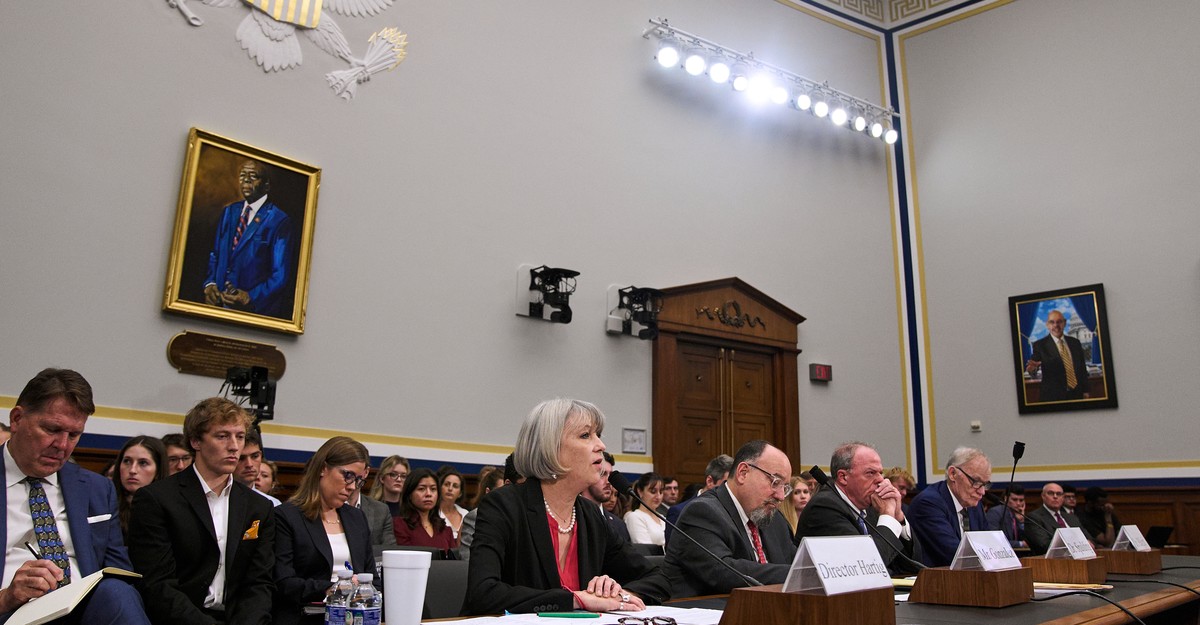
Smithsonian Director Endures Congressional Patriotism Pop Quiz, Somehow Passes Without Actually Answering Anything
Anthea Hartig gets grilled by Congress over patriotism, complexity, and a long-dead exhibit - because nothing says 'rigorous inquiry' like asking if you love your country six times.
Anthea Hartig, the director of the Smithsonian’s National Museum of American History, walked into a congressional hearing this week like a contestant on a game show where the only prize is not getting defunded. She called the museum “your” museum, professed her unconditional love for America, and even dropped her family’s Revolutionary War roots - all in a desperate bid to survive a 162-page White House report accusing her institution of “extreme political activism.”
Representative Eric Burlison of Missouri kicked things off by asking Hartig, “Do you love America?” She replied, “I love this country unconditionally,” a line she repeated at least half a dozen times during what was essentially a de facto loyalty trial. The GOP had clearly already made up its mind: the hearings weren’t about gathering information; they were about widening Donald Trump’s crusade to reshape public memory by enlisting Congress in his attack on the Smithsonian.
Hartig’s defense - that the museum is “committed to rigorous, fact-based, museum-quality experiences” and tells “the full story of American history as a form of respect” - fell on deaf ears. Republicans scolded her, quoting a 2021 webinar where she called loving America “very complicated,” as if complexity were a crime. They also dredged up a closed exhibit titled “Girlhood (It’s Complicated),” which touched on transgender youth, treating it like exhibit A in a case against nuance.
The hearings followed a pattern: a GOP member would ask a loaded yes-or-no question, Hartig would try to answer, and she’d be cut off with “Yes or no!” Representative Mike Carey asked what she meant by changing the museum’s “America First” approach; she barely got out “I would argue” before he shouted her down. At one point, a staffer trotted out a poster board with photos of drag queens for the third time in two days.
Criticism ranged from the bizarre - one lawmaker opined about the historic importance of banjos (the museum has 45) - to the historically dubious. Representative Pat Fallon asked Hartig to agree that America “is the greatest nation history has ever known.” Yale historian David Blight, who testified, had to correct the record: America didn’t lead the world in ending slavery; it took a civil war that killed hundreds of thousands to do it.
This isn’t the Smithsonian’s first rodeo. In the 1990s, a planned Enola Gay exhibit sparked similar accusations of insufficient patriotism, leading to the resignation of the Air and Space Museum director. Back then, Smithsonian Secretary Michael Heyman defended the museum’s role in showing “a full picture” of momentous events. This time, Hartig gamely noted that the founding era is well-represented: “George Washington is mentioned 54 times. You have to walk by a whole section on him to get to a 15-foot-tall reproduction of the Declaration of Independence.”
In the end, it’s unclear whether anyone learned anything about the museum’s actual operations. But one thing is certain: loving America is easy; explaining history to Congress is hard.
The Good Times
News in your inbox.
One sardonic roundup, delivered on your schedule. Free. Unsubscribe whenever your tolerance for wit runs out.
Already subscribed but we never reach your inbox? Check your spam folder and hit 'Not spam' (or 'Remove from spam') to bust us out of junk-mail purgatory. You'll be helping everyone else too.
Don't open any of our emails for a month and you'll be automatically removed from the mailing list.
Rewrite Article
Select parts to regenerate with a fresh AI pass. Translations will be updated automatically.
Generate AI Image
Creates a sardonic version of the article image using OpenAI.