
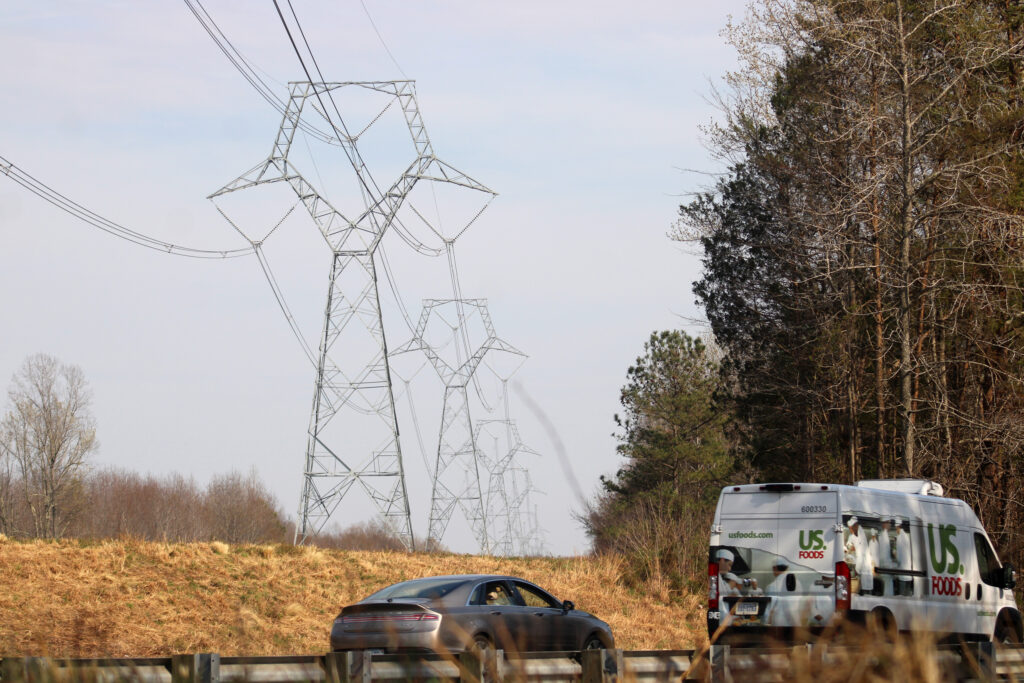
GOOCHLAND, Va. - Deborah Blackburn leaned on her cane in a line to enter the Central High Cultural and Educational Complex, angst-ridden over a giant transmission line proposal for reasons that are common refrains here: It’s all to benefit data centers in Northern Virginia, and it will disrupt the rural character outside Richmond. “We don’t want it,” Blackburn said about the Valley Link transmission project. “I kept as much of my acreage natural. I like seeing my deer, even though they eat my hosta plants.”
Valley Link is a 765-kilovolt system of transmission lines to be hung from towers the height of 12-story buildings by Dominion Energy, Transource and FirstEnergy. Transource is a transmission company jointly owned by American Electric Power and Evergy. Up for public discussion in Goochland at the recent meeting Blackburn attended was a segment starting at the Joshua Falls substation in Campbell County, about 115 miles west of Richmond. From there, several cables and dozens of giant towers will run northeast over 100 miles through the state’s agricultural Piedmont to deliver electricity to the proposed Yeat substation in Fauquier County just outside Northern Virginia. That portion is called Joshua Falls to Yeat. It will tie into an ever-growing network of smaller transmission lines and substations in Northern Virginia to serve the state’s data center market, dubbed the data center capital of the world.
The Goochland Board of Supervisors in November approved a technology overlay district to limit data center development to certain areas of the county, with requirements like 300-foot setbacks and 250-foot vegetative buffers. But residents suing in Goochland County Circuit Court say the district creates an inconsistency: for land zoned light industrial within the district but next to homes, a conditional use permit is still required; anywhere else in the district, data centers can “set up shop” without public review, said Steve Levet, a Goochland resident concerned about sprawl. “That’s a problem,” said Levet. “The county can’t have two sets of standing for the same zoning district.”
The Joshua Falls to Yeat line will cost about $1 billion and run near Blackburn’s property by 2029. Advocacy groups like the Louisa County Farm Bureau, the National Parks Conservation Association and the Piedmont Environmental Council are opposing the project. Preservation Virginia on Tuesday added several counties to its 2026 list of most endangered historic places because the project could impact 11 historic districts and seven battlefields. Jon Gordon, senior director at Advanced Energy United, said data centers are driving the need for these lines. “The data centers have really changed the grid map. They’ve created these huge load centers in these random places,” said Gordon. The cost “is going to hit consumer rates through the transmission charges on consumer bills, slowly and eventually, over time.”
Locally, communities subject to the line want to keep their countryside rural, which they say will be difficult with towers between 135 and 165 feet tall and right-of-way clearings the length of two football fields. Residents in Campbell, Appomattox, Buckingham, Fluvanna, Goochland, Louisa, Spotsylvania, Orange and Culpeper counties are also worried about just compensation for easements and potential eminent domain takings. Louisa County leaders in May allocated $250,000 to cover legal expenses to fight the project. “I want to assure our citizens that Louisa County will continue to protect its residents at every level,” board chair Duane Adams said.
Craig Carper, a Dominion Energy and Valley Link spokesperson, said at the Goochland open house that the project is about maintaining grid reliability. “This is the first 765 kV line in the [Dominion] Zone,” Carper said. The route would connect the 765 kV network running from Michigan, Indiana and Ohio to Virginia. Appalachian Power is also planning a small modular nuclear reactor near the Joshua Falls substation. Anne Dennis, 40, of Goochland said that beyond the proposed modular reactor, it’s a mystery where the electricity will come from. “We have questions about this modular nuclear reactor, whatever that is. Maybe it is better,” said Dennis, who’s also trying to cut down on her reliance on the digital world. “I just feel very uneducated. I don’t know who’s responsibility it is to educate us all. … I wish they’d take a step back.”
Valley Link’s open house allowed residents to discuss route conflicts. More opportunities will happen around late May to early June before the State Corporation Commission reviews a selected route in September. Asked if there’s any chance for residents to stop the project or change the route, Carper said, “Public engagement is a very important part of this process.” Sarah Schmidtke, 64, who retired after 40 years as a county employee, said she saw no benefit to local housing or businesses beyond serving artificial intelligence dreams. Warning her community, she said, “This is going to be the change that’s coming your way.”