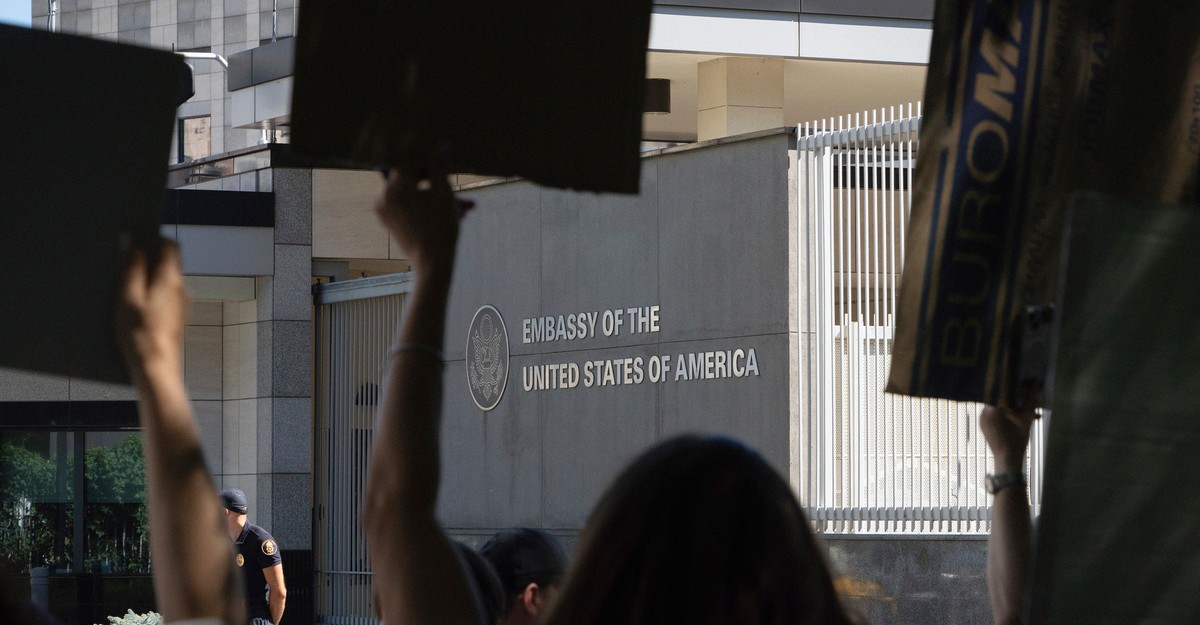
Trump Leaves Over 100 Ambassador Posts Empty, Because Who Needs Diplomats When You've Got Vibes?
The Trump administration has left over 100 ambassador posts empty, preferring to conduct diplomacy through family and cronies - because who needs actual diplomats when you've got vibes and goodfellas?
The United States is currently feuding with what appears to be everyone on the planet - hot war with Iran, cold war with China and Russia (though President Trump may have missed that memo), trade wars with various nations, a simmering spat with Cuba, and a bizarre fixation on Greenland that would annoy NATO, the most successful alliance in history. You'd think this would be a prime moment for old-fashioned diplomacy: sending ambassadors to smooth things over, reassure allies, and handle trade details. Problem is, those ambassadors don't exist.
The Trump administration has left more than 100 ambassadorships unfilled, including key posts with U.S. allies, according to The Wall Street Journal. That's an unprecedented number of vacancies, even for a White House that treats diplomacy like an optional side quest. For comparison, at the same point in Trump's first term, only 45 slots were empty - already a slower pace than predecessors. The American Foreign Service Association diplomatically notes that Trump has been slow to nominate ambassadors, and those he does nominate often get stuck in a clogged Senate confirmation process.
Translation: Trump doesn't understand what ambassadors do and prefers to hand these jobs to friends, donors, and loyalists, who then face tougher-than-usual Senate grilling. He seems to view these appointments as rewards for loyalty or opportunities to troll the public and the international community - not as tools of statecraft. To be fair, every president gives some cushy ambassador jobs to pals; usually it's a smaller nation where they can't do much harm. (Kari Lake, a failed MAGA candidate, got Jamaica, which is at least a slight to a friend.) But Trump has also placed embarrassingly incompetent people in major embassies like Jerusalem and Paris.
Administration officials claim this is actually "more efficient" - they say Trump leans on trusted envoys to manage multiple countries at once, like using Tom Barrack (ambassador to Turkey) to also cover Syria, or relying on family members like Steve Witkoff and Jared Kushner as personal emissaries. This claim is laughable. Trying to mediate a war between Russia and Ukraine without confirmed ambassadors in either Moscow or Kyiv is not efficient; it's foolish. Dual-hatting ambassadors doesn't create regional coherence; it just clogs bandwidth, cross-wires staffs, and snarls communications. For example, ambassador to India Sergio Gor now also covers Central Asia - a region of 85 million people across five very different nations, four of which have no confirmed ambassador.
The real reason? Trump likely has no clue what ambassadors do and doesn't care to learn. Secretary of State Marco Rubio knows better, but one of his first acts was to recall 30 ambassadors - a move the State Department called routine, but misleadingly so. Usually, ambassadors submit resignations at the start of a new administration but stay until replaced; they aren't typically recalled immediately, leaving posts vacant. Rubio's move suggested political vetting of career diplomats.
Trump may also be traumatized by his first impeachment, when whistleblowers exposed his attempts to blackmail Ukraine into investigating Joe Biden. He may now see professional civil servants as political enemies. Or maybe, as the classic film Goodfellas illustrates, he just doesn't want anyone hearing what he says or listening to what he's told - preferring trusted lieutenants to whisper in his ear. As Reuters reported, foreign governments are now bypassing embassies and "rewiring their diplomacy around a small circle of people with direct access to the president." If you're Greece and stuck with Kimberly Guilfoyle (Donald Trump Jr.'s ex) as ambassador, you might not get much done. But if you matter enough for a visit from his son-in-law, you're in.
Not every vacancy is a crisis - some are normal, and ambassador influence varies by president. But Trump's serial diplomatic failures - humiliations by China and Russia, backtracking on trade wars, inability to gather allied support - suggest this is no way to run a superpower's diplomacy.
The Good Times
News in your inbox.
One sardonic roundup, delivered on your schedule. Free. Unsubscribe whenever your tolerance for wit runs out.
Already subscribed but we never reach your inbox? Check your spam folder and hit 'Not spam' (or 'Remove from spam') to bust us out of junk-mail purgatory. You'll be helping everyone else too.
Don't open any of our emails for a month and you'll be automatically removed from the mailing list.
Rewrite Article
Select parts to regenerate with a fresh AI pass. Translations will be updated automatically.
Generate AI Image
Creates a sardonic version of the article image using OpenAI.