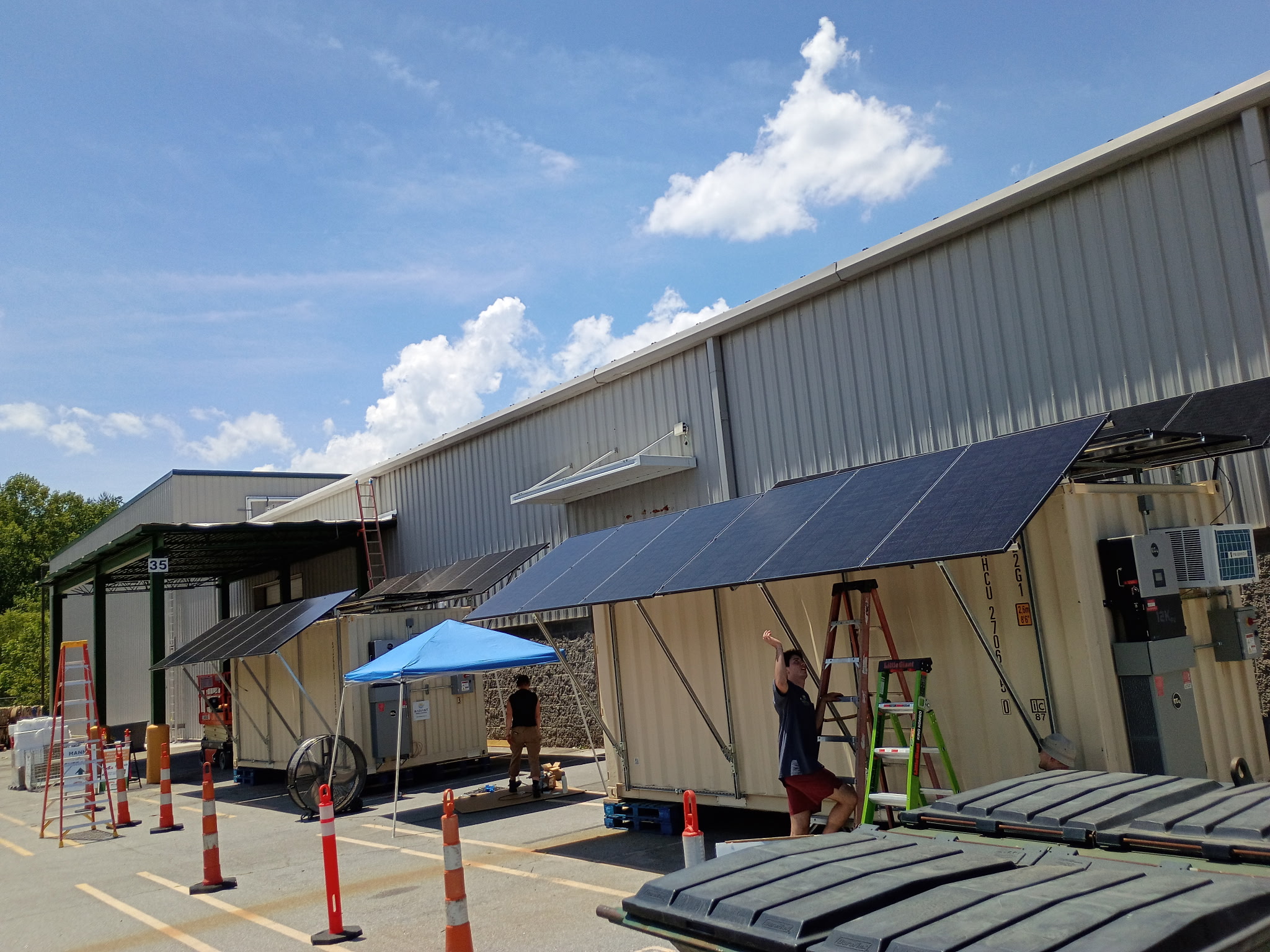
Nearly two years ago, Hurricane Helene knocked out power in Burnsville, North Carolina, forcing Fire Chief Niles Howell to rely on the station’s generator to keep operations running. The fire department served as a landing pad for helicopters, a base for search-and-rescue, and a field hospital - but even in calmer times, Howell worried about running out of generator fuel. Now, he can stop worrying: the fire department will soon install 40 kilowatt-hours of solar panels and double that amount of battery storage as part of a statewide microgrid project targeting communities recovering from Helene.
“I love redundancy, because inevitably what you plan for will fail at some point in time,” Howell said, summing up the philosophy behind a growing number of small-scale energy resilience projects in the Appalachian mountains, repeatedly battered by extreme rain and flash flooding. The state Department of Environmental Quality invested $5 million in 26 microgrid projects last August, partnering with a coalition of nonprofits to build 24 stationary and 2 mobile microgrids, with five sites announced in June. This mirrors similar efforts in storm-battered communities from Puerto Rico to New Orleans.
Solar microgrids can power one or more buildings and even send electricity to the grid, featuring large batteries to keep energy flowing for days without sunshine. Stationary microgrids already power essential infrastructure like hospitals and wastewater treatment plants; one Duke Energy system kept Hot Springs, North Carolina, lit during Helene. Mobile microgrids, dubbed “beehives” by the nonprofit Footprint Project, are trailer-mounted and include “cooler bees” (fridges and freezers), “power bees” (charging stations), and “water bees” (filters). These bees provide up to 100 kilowatt-hours of energy, enough to power a large building for up to 10 hours, and can be towed to disaster-hit communities.
The technology is expensive - all but one stationary microgrid in western North Carolina will cost over $100,000 - so public and philanthropic funding is key. Two mobile solar trailers will be ready by 2027, and stationary installations begin this summer. Sara Nichols of Land of Sky Regional Council hopes the project demonstrates that combined funding can support small-scale renewables despite federal changes reducing solar accessibility. “We are essentially setting the model and the precedent for what we hope will be a much bigger statewide and national project to duplicate,” she said.
Reid Wilson of the Department of Environmental Quality is exploring statewide expansion, though nothing official has emerged. Governor Josh Stein requested $1 million for microgrids in his $792 million Helene relief request, but it didn’t make the cut. Federal funding may help one day, but Wilson isn’t betting on it. For now, North Carolina’s solar bees buzz onward.
The Good Times
News in your inbox.
One sardonic roundup, delivered on your schedule. Free. Unsubscribe whenever your tolerance for wit runs out.
Already subscribed but we never reach your inbox? Check your spam folder and hit 'Not spam' (or 'Remove from spam') to bust us out of junk-mail purgatory. You'll be helping everyone else too.
Don't open any of our emails for a month and you'll be automatically removed from the mailing list.
Rewrite Article
Select parts to regenerate with a fresh AI pass. Translations will be updated automatically.
Generate AI Image
Creates a sardonic version of the article image using OpenAI.