
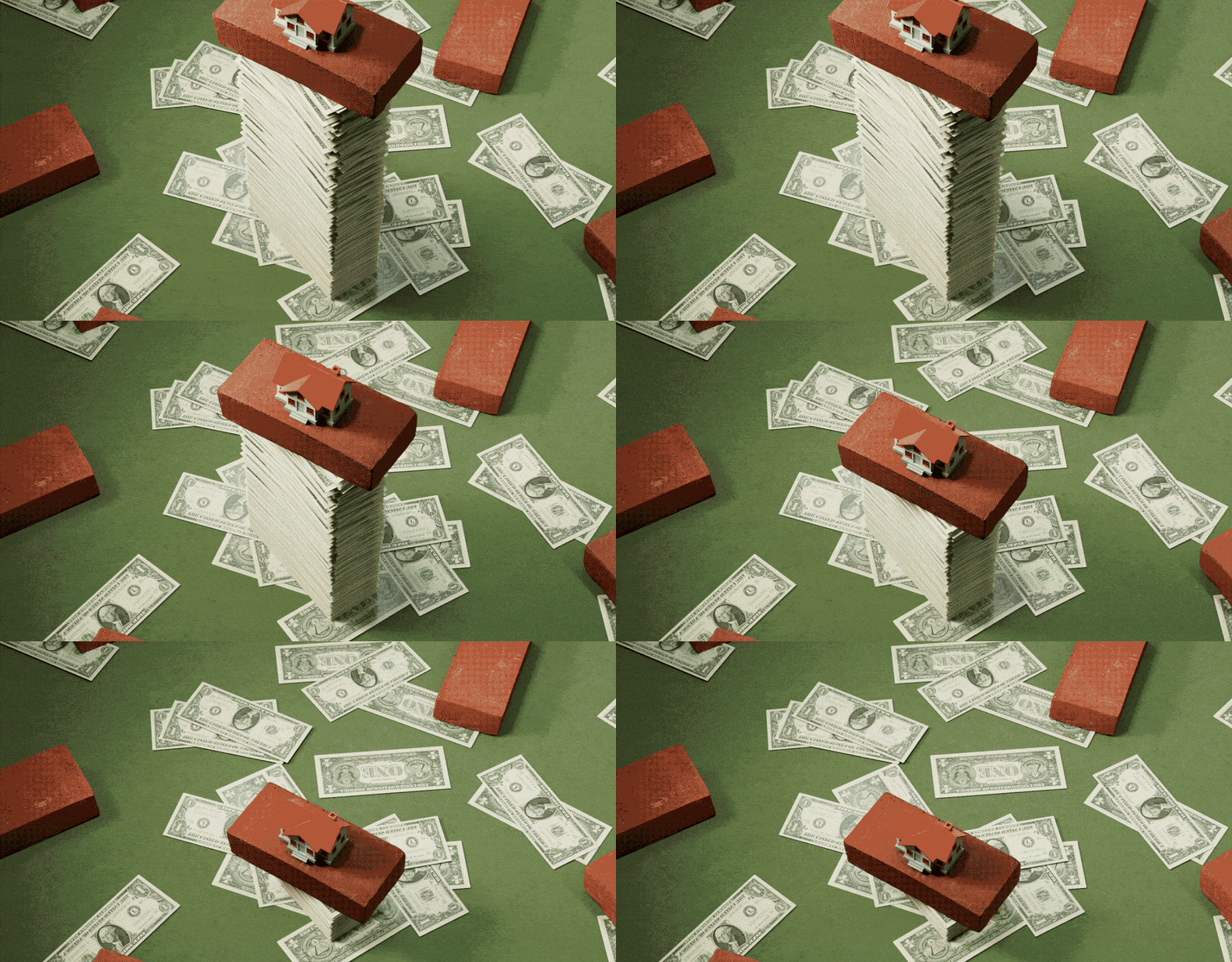
A billionaire acquaintance of mine who fled Manhattan for Miami during the pandemic recently confided that he's not losing sleep over New York City's proposed pied-à-terre tax - an annual surcharge on second homes valued above $5 million. Mayor Zohran Mamdani and Governor Kathy Hochul announced the proposal earlier this month, and predictably, tabloids and business press screamed that it would chase the rich away. But my acquaintance kept his New York apartment, as many Miami transplants do, and has no intention of dumping it. He's too tied to the city - socially, professionally, philanthropically - and travels there constantly.
The lesson for cash-strapped cities and states: the specific type of tax matters. Design it around something the rich don't want to give up - like a home in the world's most economically and culturally important city - not something they can dodge by simply changing their tax residence.
For decades, academic research insisted the rich don't move because of taxes. Studies of millionaire migration found high-income households had lower migration rates than the middle class. The wealthy were embedded where they built careers, networks, and lives. The one exception was a modest flow of New Yorkers shuffling to Florida late in life.
That used to be true because the rich had no real choice. Their businesses were in New York, San Francisco, or Seattle (looking at you, Jeff Bezos's Amazon and Howard Schultz's Starbucks), and they had to be near them. But digital technology - and the pandemic's successful remote-work experiment - severed the bond between where a business is and where the owner lives. Once that bond broke, everything changed.
Recent years have seen a parade of billionaires - including Bezos, Schultz, Ken Griffin, Larry Page, and Sergey Brin - abandoning blue cities for Miami's low taxes, warm weather, and lifestyle. At first, they tried moving chunks of their companies with them. Griffin relocated Citadel from Chicago to Miami. Then they figured out they could just move themselves. Bezos left Seattle for Indian Creek Island, but Amazon remains in Seattle. Page bought a Coconut Grove compound for nearly $180 million, but Google stays in the Bay Area. Mark Zuckerberg snagged a $170 million waterfront mansion on the same island as Bezos, but Meta remains in Silicon Valley. Schultz bought a $44 million penthouse at the Four Seasons at the Surf Club, north of Miami Beach, but Starbucks stays in Seattle.
Florida makes this easy with no real residency requirement. The wealthy simply declare a Florida home as a homestead, and as long as they don't spend more than the threshold number of days in their other homes - New York, Los Angeles, Aspen, the south of France - they're Florida residents for tax purposes. That probably explains why Bezos became a Florida resident before selling $8.5 billion in Amazon stock in 2024. (Florida has no state capital-gains tax.)
This is what Miami, Palm Beach, and a handful of other places are becoming: lifestyle tax havens, offering sunshine, great nightlife, and ideal yacht docking, plus tax advantages. Places for the rich, and increasingly for the rich alone. Meanwhile, an exodus of the less advantaged, working classes, and merely affluent has begun. Miami-Dade County had the third-largest loss of domestic population of any county last year. (The outflow used to be covered by international migration, a process disrupted by President Trump's immigration crackdown.) As the Miami Herald reported, people leaving the city have annual incomes half of what new arrivals make, on average. The rich have altered Miami's housing market, pushed prices up, and taken up limited private-school slots for themselves and key employees.
For the ultra-wealthy, a city's hollowing-out can be a blessing in disguise. Less traffic, less congestion, fewer people competing for housing and schools are more benefit than burden. They'd prefer their lifestyle tax haven to be even more like Monaco. But a city that works for billionaires and few others is not a city. It's a resort with a tax code.
This lifestyle importance explains why a tax on second homes might be the one kind of levy the super-rich - like my billionaire acquaintance - will grudgingly tolerate. The pied-à-terre tax is unlikely to chase many away because it applies to a fixed asset: a house, condo, or co-op. The only way around it is to sell the asset. But that asset is also their home in a place they really want - and often need - to be, and many wealthy people would rather hang on to it.
The amounts involved are also smaller than income or wealth taxes. New York City's proposal is estimated to raise up to $500 million in annual revenue, according to the city comptroller. Under a previous proposal using a sliding scale rising to 4 percent on value above $25 million, Griffin's Central Park South penthouse would generate a surcharge of about $9 million a year. That's real money, but a fraction of what income or wealth taxes cost the ultra-wealthy. If Bezos had still been living in Seattle when he off-loaded Amazon stock in 2024, his Washington State capital-gains-tax bill would have been about $600 million. The proposed California Billionaire Tax - a onetime 5 percent levy on net worth above $1 billion - would have cost Larry Page roughly $14 billion had he not preemptively fled.
A pied-à-terre tax could help refill city coffers instead of eating away at the tax base. The only problem: the mayor has made a political football of it. Mamdani could have pushed the tax through without making new enemies. Most uber-wealthy would have shrugged, grumbled a little, and paid. Instead, the mayor shot a video outside Griffin's apartment building and named him as an example of someone who could pay. Gerald Beeson, Citadel's chief operating officer, immediately called the spectacle shameful and signaled the firm might pull out of its multibillion-dollar new Manhattan headquarters. Billionaires do not take well to being made an example of. Griffin, after all, relocated Citadel from Chicago to Miami after feuding with the mayor and governor over taxes and crime. The purpose of a pied-à-terre is emotional, not financial. After enough public shaming, a rich person might lose their taste for keeping a place in the city.
There's a harder truth underneath the political rhetoric. Blue cities cannot keep taxing their way out of budget problems. The differentials between high-tax and low-tax states are now too large, and the mobility of the rich too real, for that playbook to keep working. Cities like New York have to get serious about the cost side of their budgets - efficiency, productivity, and spending. The revenue side alone cannot close the gap. A pied-à-terre tax is a useful tool if used smartly, but it is not a substitute for running the city well.
None of this means taxing the rich is wrong. The inequality built up in this country has reached levels corrosive to the economy and urban fabric. But income taxes and wealth taxes cannot do the job at the city or state level. They must be levied nationally, where there is no state line to cross. Local governments should tax what cannot move: fixed assets and real estate above all. A pied-à-terre tax is one version of that idea. For cities like New York, the lesson is straightforward. Stop trying to tax what the rich can carry with them, and start taxing what they want to keep.