
The New Jersey Forest Fire Service has announced an elevated risk for fire spread across Delaware and parts of New Jersey, because the weather decided to play a cruel April Fools' prank in May. Humidity dropped, temperatures rose into the 80s, and southwest winds gusted up to 30 miles per hour, creating conditions that, the service said in a statement, "support the rapid spread of any fires that ignite, which could quickly become difficult to control."
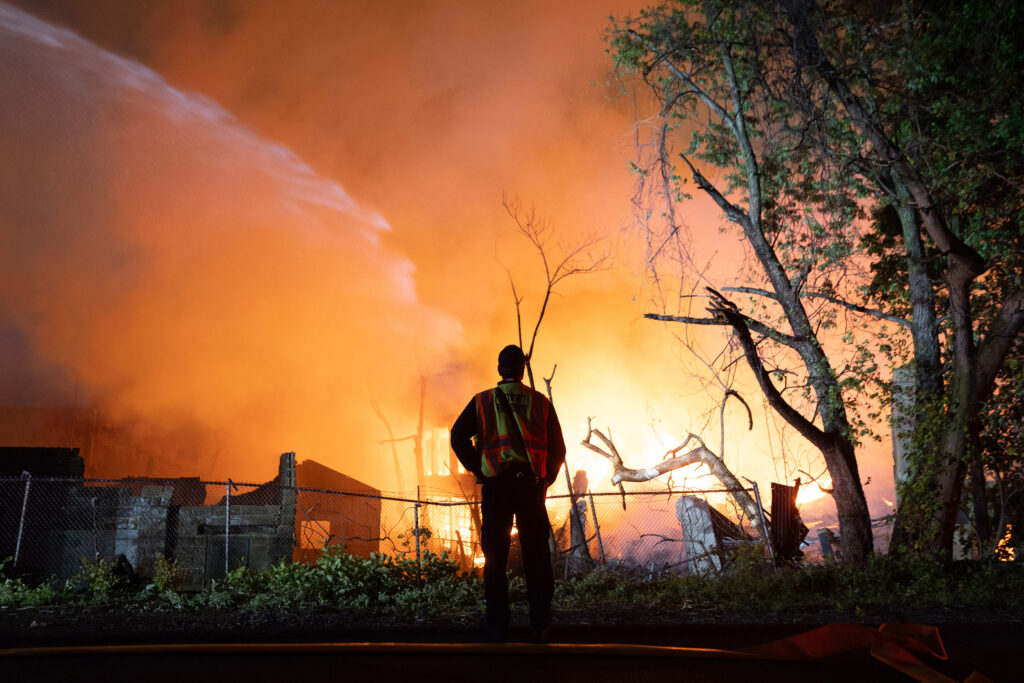
In Belleville Township, five miles north of Newark along the Passaic River, similar conditions contributed to a 14-alarm fire on May 3 that burned for days. The relative humidity was extremely low at 19 percent that night, with strong winds of 20 miles per hour pushing an industrial fire from a warehouse to multiple buildings, prompting school closures and evacuations, and leaving thick, hazardous smoke in its wake. The fire was a real crowd-pleaser for no one.
New Jersey is back in the heat of its wildfire season, which ranges from March to May, and the picture is more complicated than last year's, when the state had one of its worst outbreaks on record. Over 10,000 towering pitch pines were charred in a rampant wildfire that scorched 15,300 acres last April. This season has been mild thus far with fewer acres burned than usual, but the New Jersey Forest Fire Service has had limited opportunities to use the state's primary prevention tool: prescribed burning. Prescribed burns are planned fires that officials use to clear "fuel loads" of vegetation that act like kindling when a fire ignites - think of it as a controlled barbecue for the forest's dead leaves and twigs.
Greg McLaughlin, administrator for New Jersey Forests and Natural Lands, said snow from the nor'easter in February was the largest challenge for the agency this year. Bitter cold nights and limited rain kept the snowpack in place for weeks after, so teams burned only 35 percent of their 25,000-acre goal. "This follows a prolonged drought in 2024 that constrained prescribed fire operations in 2025, when just 3,958 acres were treated, the lowest annual total in the last 25 years," McLaughlin said. The state has used prescribed burns since 1928, and in 2018, then-Gov. Phil Murphy signed New Jersey's Prescribed Burning Act to promote it as a tool for wildfire mitigation.
Stephen Mason, an ecologist who studied the impact of fire on the Pine Barrens, said the ecosystem actually evolved through fire - so it's not all bad news. "Prescribed fires, they're apples to oranges when we're comparing them to wildfires," he said. "The state funds prescribed fires because if part of the Pine Barrens has not been burnt, either naturally from a wildfire or unnaturally from a prescribed fire, that leaf litter is going to build up." The result could be a high-intensity or severe fire, where intensity refers to the heat released and severity refers to the ecological damage. By reducing fuel, prescribed burns make high-intensity wildfires less likely. "Fires are not all good, but they're not all bad," Mason said. "They're just necessary to maintain the Pine Barrens ecosystem as we know it."
With prescribed burning finished for now, the Forest Fire Service is focused on responding to wildfires as they pop up. This year, the agency is prepared: after a $3 million budget increase in fiscal year 2024, it purchased new equipment, air support and protective gear, and added 12 new full-time positions. An additional $1 million increase this year will fund more staff and equipment upgrades. The forest service also got an upgrade on a new fire tower - the first new one in the state in 78 years - which just went into service this spring. The tower stands 133 feet tall in Jackson Township, Ocean County, nestled in the Pine Barrens, with exposed metal stairways leading up to a small office topped with a red metal roof. "The fire tower has already detected several wildfires and has coordinated deploying resources to those incidents," McLaughlin said. "New Jersey's fire towers are critically important to keep a watchful eye over New Jersey's forests and communities."
New Jersey is the most densely populated state in the nation, and about a quarter of its homes are located in the wildland-urban interface, where the forest meets development. After last year's Jones Road fire, new equipment like the tower is meant to monitor these vulnerable areas. David Robinson, New Jersey State Climatologist, said the snowy winter helped suppress wildfire activity, but under the right conditions, fires can still spread rapidly. New Jersey's fire risk is increasingly shaped by volatile weather patterns from climate change. "Every month is warming in New Jersey," said Robinson. "Most of the warmest Aprils have occurred since the turn of the century. Preliminary numbers show April 2026 to be NJ's 6th warmest since 1895." With fewer-than-normal acres burned, Robinson said it's not a guarantee that things will be calm this year. "Mind you, 21 of the past 24 months have had below normal precipitation across New Jersey. Not a good situation as we enter summer," he said. "Fire danger can rise quickly, particularly in the Pinelands. A string of warm, low-humidity, precipitation-free days - add windy conditions too - and in just a handful of days danger can quickly rise."
Mason said it's hard to say if climate change is directly causing more fires in New Jersey, but it exacerbates extreme weather like high temperatures, freezing cold, very dry conditions, or very wet conditions - all of which influence fire behavior. The real issue is not how plants and animals cope, but the speed at which they're expected to adapt. Fast and abrupt weather transitions, like going from blizzard to summer temperatures in a matter of days, cause physiological stress in species like the pitch pine, weakening their defenses and making them susceptible to pathogens, invasive species and greater fire damage. "It's like death by a thousand cuts," Mason said. "Normally, they could better defend themselves if they're healthier, but climate change is really wearing them down over time."