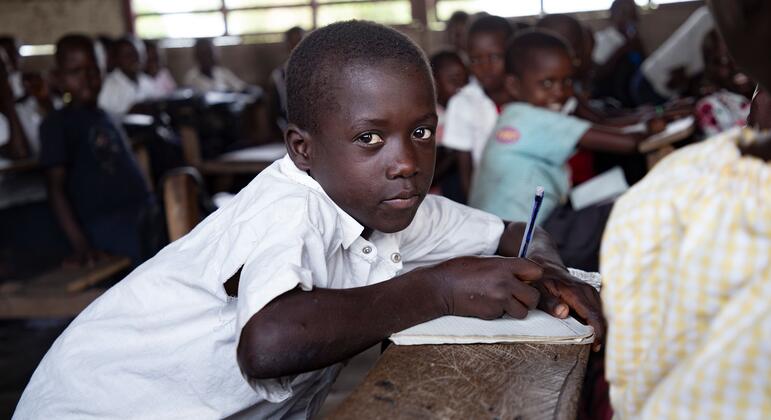
Ten-year-old Shadrac Anyazaka wants to be president of the Democratic Republic of the Congo someday. His classmate Jérémie, displaced by conflict and grieving murdered family members, has a more modest goal: become a general so he can advocate for peace. In eastern DRC, where violence escalated sharply in 2025, both dreams are about as stable as a house of cards in a hurricane.
That region has seen decades of conflict, but recent attacks have forced tens of thousands of families to flee. As of September 2025, an estimated 5.3 million people are internally displaced nationwide. Schools have been destroyed or occupied by armed groups, and children are bearing the brunt: 6.4 million kids remain out of school, exposed to insecurity, hunger, trauma, and recruitment by armed groups. Girls and children with disabilities are especially vulnerable.
Enter the UN's Education Cannot Wait (ECW) fund, which has launched a new US$10 million, two-year programme to reach more than 62,000 crisis-affected children in Ituri Province, prioritizing girls, internally displaced kids, and the most vulnerable. The initiative builds on previous programmes that have already benefited over 125,000 children, providing safe classrooms, teacher training, learning materials, school feeding, and mental health support.
New classrooms are not cosmetic. In displacement-affected areas, schools have been forced to run double shifts or squeeze multiple classes into a single room. At Mabanga Primary School in Goma, eight-year-old Kennedy watched construction underway and said, "I'm very happy to see the new classrooms being built because now I can study with my friends without being disturbed." Previously, two classes shared one space, making concentration nearly impossible.
For business and policy leaders concerned about global instability, the message is clear: fragile contexts like eastern DRC have rapidly growing youth populations. Excluding children from education deepens cycles of poverty and conflict. Educating them delivers long-term dividends: higher lifetime earnings, better health, stronger civic participation, and reduced risk of recruitment into armed groups.
Shadrac's presidential dream, Jérémie's call for peace, and Kennedy's anticipation of learning without distraction are reminders that the country's future is already sitting in its classrooms - or waiting for them to be rebuilt.
The Good Times
News in your inbox.
One sardonic roundup, delivered on your schedule. Free. Unsubscribe whenever your tolerance for wit runs out.
Already subscribed but we never reach your inbox? Check your spam folder and hit 'Not spam' (or 'Remove from spam') to bust us out of junk-mail purgatory. You'll be helping everyone else too.
Don't open any of our emails for a month and you'll be automatically removed from the mailing list.
Rewrite Article
Select parts to regenerate with a fresh AI pass. Translations will be updated automatically.
Generate AI Image
Creates a sardonic version of the article image using OpenAI.