
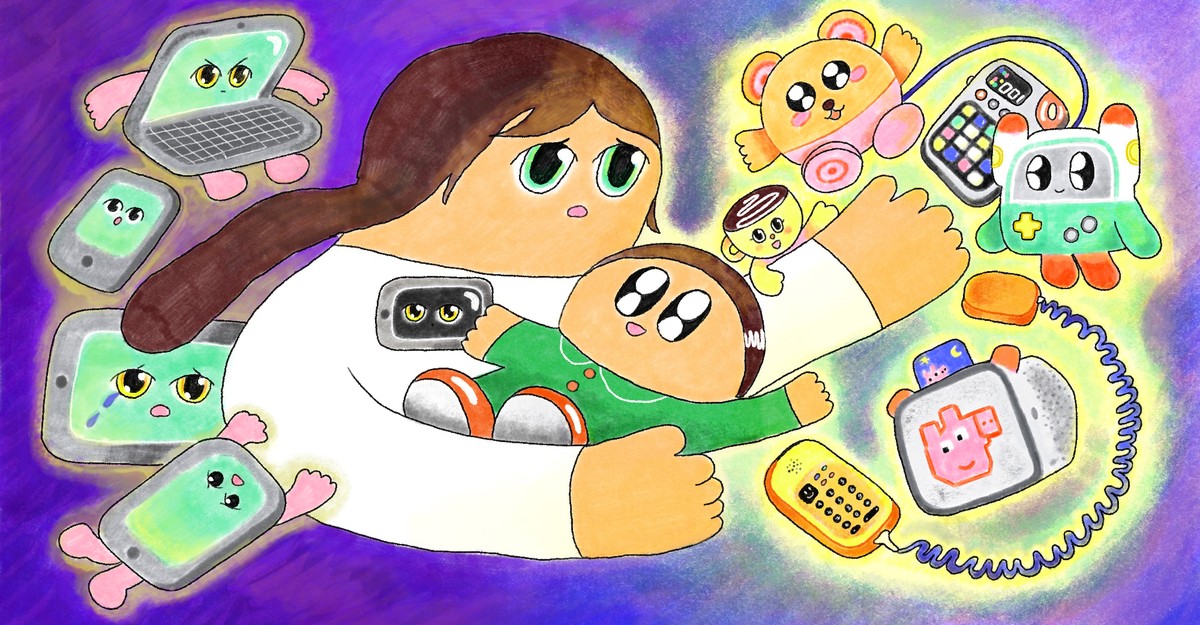
Meet Bondu, a stuffed dinosaur that speaks 27 languages, helps with homework, tells bedtime stories, and patiently endures the kind of inane questions that would make any human parent consider faking their own death. For $300, you get an AI chatbot wrapped in plush fabric and marketed as a playmate, confidant, teacher, and quasi-caregiver. The ads emphasize its safety controls - parents can review conversations via an app - and its ability to adapt to a child's mood, interests, and age. They also repeatedly stress that the product is "screen-free."
This is an odd and technicality-laden argument to make about an object containing computing power that would have been science fiction two decades ago - sort of like marketing a hand grenade as "bullet-free." But Bondu knows its audience. In one testimonial, a 4-year-old chitchats about baby animals with her Bondu, whom she has named Rosie. The mom beams into the camera: "Camryn truly loves sharing about her day with her Bondu. And I love that it’s something she can interact with that isn’t a screen."
Screen time is a problem - the American Academy of Pediatrics says so, early-childhood educators say so, and well-meaning in-laws definitely say so. Unfortunately, screen time also rocks, in that it's the only way to occupy a child while you wash dishes, lie down, go to work, or do any of the other necessary or pleasurable activities life demands. The one thing that feels more urgently worse than plopping a kid in front of the TV is the desperation that forces it. And then, the guilt.
According to a 2023 survey by Lurie Children's Hospital of Chicago, roughly half of polled parents put screens in front of their kids daily, often due to child-care costs. An even higher number - 62 percent - felt guilty about it. In parent forums, admitting to letting kids watch Sesame Street is done in hushed tones that might lead you to imagine they're giving their children black-tar heroin for breakfast. Some game out sophisticated avoidance strategies: skipping family gatherings with screen-addled grandparents, choosing schools that ban devices. In the Facebook group "Screen Free Parenting Community" (250,000+ members), the mood oscillates between radical activism and support group. Last month, a moderator posted a freaky video of toddlers screaming after their tablets were taken away. A few posts down, a mother about to deliver her third child in four years begged for help - or forgiveness - for letting her toddler watch TV while she cared for the newborn. "I feel like an absolute failure," she wrote. "I am scared about the repercussions this will have in the long term on my son."
Commerce, of course, loves anxiety. Enter a new class of "anti-screen-time" electronic devices that promise to entertain your kid without rotting their brain. Bondu is joined by a teddy bear that tells AI-generated bedtime stories, a saucer-eyed blue thing with "interactive AI features," an alien that comforts kids through nightmares, and a plush rocket ship whose chatbot is voiced by Grimes, a self-proclaimed busy mom. Lower-tech options include the Yoto Player and Toniebox (audio devices for music and stories), the Tin Can (a Wi-Fi-enabled phone styled like a '90s landline with a monthslong waitlist), a light-up "screen-free tablet," a STEAM-teaching robot, and an AI-powered sudoku board promising "no screen time battles." Major toy manufacturers are piling in: OpenAI recently announced a "strategic collaboration" with Mattel; Lego introduced "smart" bricks with speakers, microchips, and LED lights.
The sales pitch is similar across the board: these toys eliminate the most offensive aspects of phone- and tablet-based entertainment - the singsongy audio, the bizarre cartoon faces, the abstruse algorithm, the infinite scroll. They're priced to convey attainable quality and aggressively marketed on Instagram. (As soon as I started researching this story, I was bombarded by ads for them, right between the ones for smartphone-addiction tools made for people my age.) The ads stress how educational and fun these toys are - but not so fun that they'll distract your toddler from building a meaningful life. If Sesame Street is heroin, this is methadone.
I ordered a Yoto recently. People in the Facebook group love it, as do many of my friends, and thousands of others. I was hoping my son would, too, because what my son really loves is the television. And the tablet. And playing stupid games on my phone while we wait for the subway. Once he stood so close to the TV while I worked that I texted an ophthalmologist friend, fearing he'd fried his retinas. Another time, he had to be dragged away screaming from a broken museum video display - he was staring slack-jawed at a screensaver. The video with the screaming tablet kids could have been filmed in my house.
I don't know exactly how to feel about this. Like many peers, I grew up transfixed by screens too - but they were small, stuck to a wall, designed for passive family viewing. No swiping, no skipping, no on-demand, no algorithms optimizing for maximum ad time. YouTube arrived in 2005, the iPhone in 2007, the iPad in 2010. In the decade-plus since, entertainment has become more algorithmic and absorbing. People are directed by technology, not the other way around. And many adults who survived this transformation worry about what it did to them - their ability to think independently, live authentically, read a novel, appreciate a sunset, blast through a spreadsheet. Some engage in ostentatious acts of self-restraint, buying dumbed-down products to import functionality without the itchy pull of a screen.
The people who personally experienced the smartphone revolution are now the ones with young kids. They're passing down their anxieties, like every generation does. The parents with Bricks are buying their kids Tin Cans. We are old enough to remember a different world, and to worry about what kind their children are growing up in. I spend an average of five hours and 22 minutes a day staring into my phone. I love my son's mind more than anything on Earth - the last thing I want is for it to turn out like mine.
The Yoto works like a first-generation iPod and looks like an old-fashioned cuboid TV. (Like many screen-free products, it actually has a screen, just a janky one.) Its narrative content - accessed via playable cards - reminded me of the TV I grew up with: Mickey Mouse, Thomas & Friends, The Wizard of Oz. That these products adopt nostalgic signifiers is intentional, I think, or at least a secret to their success. Of course we want the objects sucking up our kids' attention to feel like the ones that used to suck up ours, even if they're equipped with computing power never before possible. Of course we want to be reminded of the good old days, before anyone had to think about screen time.
Those days were defined by benign neglect and a life less documented. Contemporary parents work more and parent more than previous cohorts. Child-rearing is more intensive, public, and competitive. Smartphones ushered in an era of always-on work and endless opportunities for comparison. (The screen-free parents group, after all, is a space made possible by screens.) Bondu, according to ads, is useful as a playmate - but will also get your child to practice piano. Tin Can advertises "no distractions," though what exactly a child needs to be undistracted from is unclear. The discussion seems predicated on two assumptions: that there's a right and wrong way to spend leisure time, and that screen-free activities are inherently more noble. Gazing at a sunset is good; taking a picture for Instagram is bad. Reading a novel on Kindle is okay; in paperback is better; scrolling BookTok is worse. Katie Davis, co-director of the University of Washington's Center for Digital Youth, notes that parents who feel guilt about screens often justify it by emphasizing educational value: "Oh, my kid was building worlds in Minecraft and learning to code." Many people concerned about their own screen-wrecked focus are putting their kids in front of not-screen screens so they can do more work, probably on a screen. And all the while, they're worrying about their child's future ability to be successful at work, probably also on a screen.