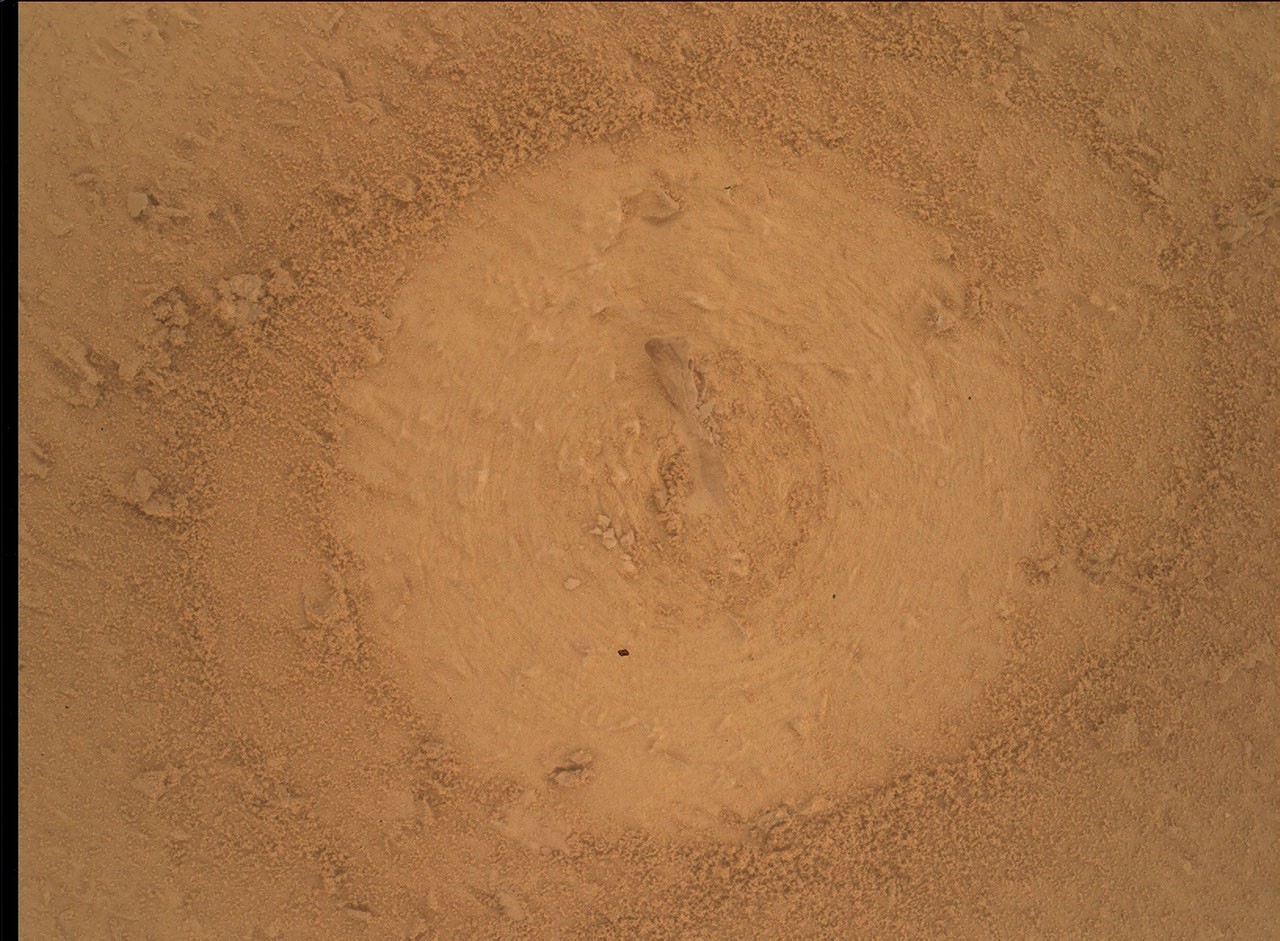
NASA's Curiosity Rover Drills 48th Hole, Still Not Technically Striking Gold
Curiosity drills its 48th rock target in a quad named after a Gold Rush trail, proving that even on Mars, the real treasure is the X-ray diffraction analysis you make along the way.
After 14 years, 38 kilometers (24.6 miles) of driving, and more than 1 kilometer (0.6 miles) of elevation gain, NASA's Curiosity rover has done what any self-respecting prospector would do upon entering a quad named after a 1860s Gold Rush trail: it drilled a hole and hoped for the best. The rover successfully drilled into its 48th rock target in Gale crater, dubbed "Basque Lakes," from the newly entered Cache Creek quad.
The Cache Creek quad is named after an area of geological diversity in British Columbia, Canada, which features exposures of oceanic crust, marine sediments, volcanic rocks, and glacial deposits, plus lakes with unusual chemistry that may be analogous to lakes that once existed on Mars. It also sits at the southern end of the 1860s Gold Rush Trail, where miners and prospectors flocked in search of riches. Curiosity, sadly, is not literally striking gold, but the team is eagerly awaiting the CheMin X-ray diffraction analysis of the drilled sample in this weekend's plan, hoping to find a gold mine of minerals that could reveal the depositional and alteration history of the rock exposure - and perhaps minerals similar to those in the Cache Creek lakes of British Columbia.
Written by Lucy Thompson, Senior Research Scientist at the University of New Brunswick, Canada, with an Earth planning date of Friday, Sept. 25, 2026, the blog details how the team conducted triage contact science on the potential drill target. APXS was placed in contact with the rock to measure its chemistry, MAHLI camera got within 1 centimeter (about 0.4 inches) to examine textures in detail, and ChemCam fired its laser at the target to further characterize composition. MAHLI also imaged the target after engineers checked rock stability with a pre-load test. All these results helped determine whether to proceed with drilling.
Despite significant power constraints from drilling and analyses, and an aging rover, the team planned additional activities. Mastcam imaged the surrounding terrain for context. ChemCam analyzed another nearby bedrock target, "Peace River," and used imaging and passive spectroscopy on the new drill hole and tailings. ChemCam remote imaging also examined a jumbled block deposit at the base of a nearby butte, "Cordillera." Navcam and Mastcam continued monitoring environmental and atmospheric conditions in Gale crater.
Analysis of the Basque Lakes sample should continue next week with delivery to SAM, which will reveal more nuggets of information about the rock's history. Curiosity will likely stay at this location for another week before dumping the sample and driving away to continue exploring Mount Sharp and Gale crater.
The Good Times
News in your inbox.
One sardonic roundup, delivered on your schedule. Free. Unsubscribe whenever your tolerance for wit runs out.
Already subscribed but we never reach your inbox? Check your spam folder and hit 'Not spam' (or 'Remove from spam') to bust us out of junk-mail purgatory. You'll be helping everyone else too.
Don't open any of our emails for a month and you'll be automatically removed from the mailing list.
Rewrite Article
Select parts to regenerate with a fresh AI pass. Translations will be updated automatically.
Generate AI Image
Creates a sardonic version of the article image using OpenAI.