NASA Rover Photographs Mars Cliffs, Immediately Raises More Questions Than It Answers
NASA's Curiosity rover captured a stunning Martian dawn panorama, climbed more elevation than anything else on Mars, and still can't explain the weird cliffs it's driving toward.
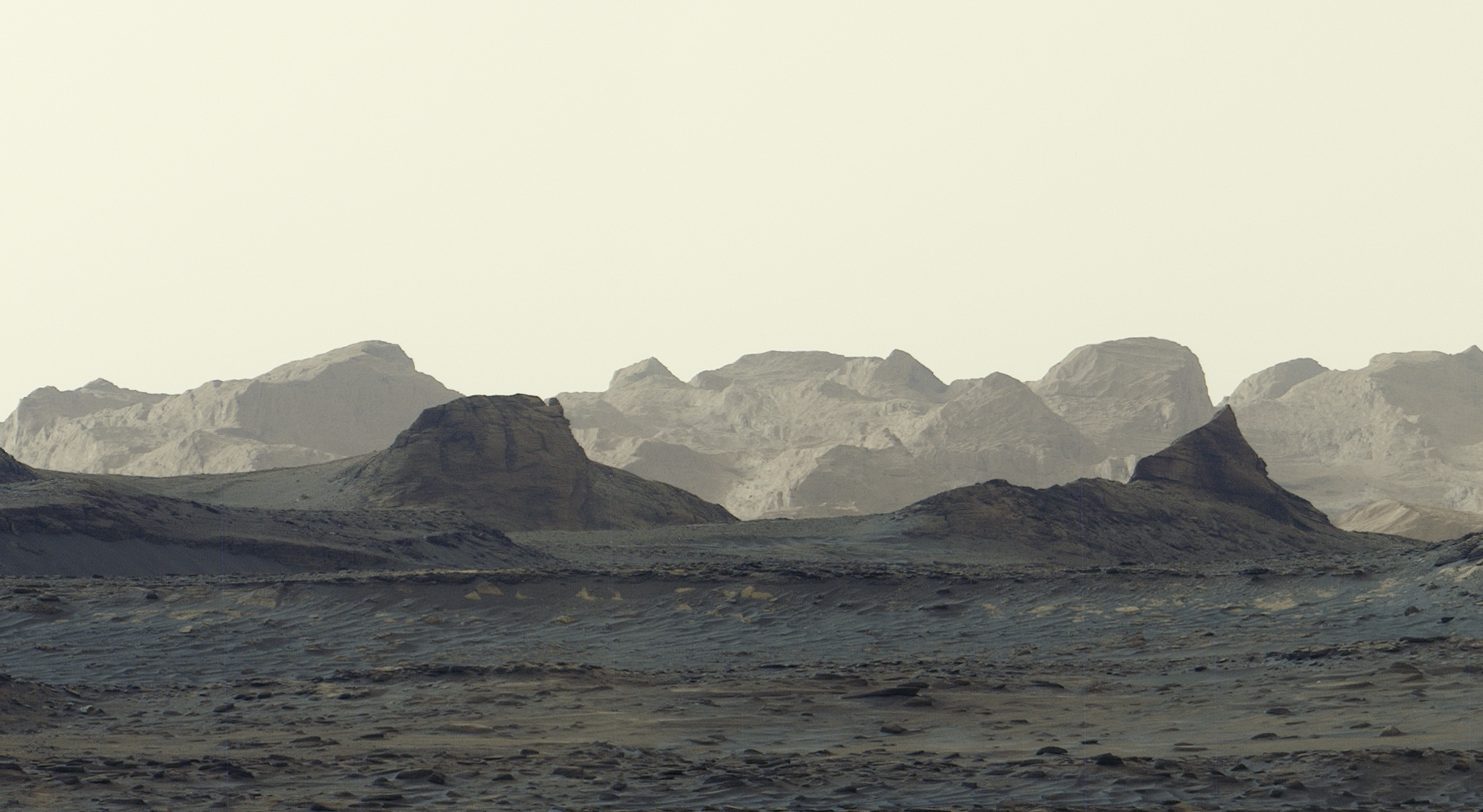
NASA's Curiosity rover has released a panorama of distant, wind-carved Martian cliffs that mission scientists are calling the most detailed view yet of features they've been squinting at from afar for years. The image was captured at 8:30 a.m. local Mars time, because even on another planet, scientists understand the importance of good morning light. The scene shows striking blue hues in the foreground as bright morning sunlight illuminates rocky crags known as yardangs on the horizon.
The panorama was snapped by Curiosity's Mastcam on Aug. 11 - the 4,982nd Martian day, or sol, of the mission - and is composed of six individual images stitched together after being transmitted to Earth. In a departure from most Mastcam images, this one was processed without white balancing, preserving the early morning appearance. Apparently, sometimes the raw footage is the aesthetic.
The yardang layer stretches roughly 10 miles (16 kilometers) across the northwestern reaches of Mount Sharp, a 3-mile-tall (5-kilometer-tall) mountain Curiosity has been climbing since 2014. The rover recently hit another milestone in its ascent, reaching 0.6 miles (1 kilometer) of elevation - the most elevation ever climbed on Mars, which is admittedly a low bar given the competition, but a milestone nonetheless. As Curiosity gets closer to the yardangs, scientists expect even more impressive imagery - and, they cautiously hope, actual answers about how these cliffs formed.
Mount Sharp is built from layers, each preserving a distinct chapter of Martian history. By studying them, scientists have pieced together a picture of lakes and streams that covered this region billions of years ago. Eventually, the water dried up and left salty minerals behind. After new material stopped accumulating, some of it may have been stripped away by wind, which is how you get yardangs - and also how you get a planet that looks like it's been sandblasted for a few billion years, because it has.
"The yardang layer looks out of place. It's the wrong color, the layers tilt at an odd angle, and it almost appears plastered on," said Ashwin Vasavada, Curiosity project scientist at NASA's Jet Propulsion Laboratory in Southern California. "But that's what makes it exciting to reach. No one is sure exactly what created this layer, but one idea is it may be ash deposited by ancient volcanic eruptions." So: either volcanic ash or a geological anomaly that looks suspiciously like volcanic ash. Science remains thrillingly uncertain.
Curiosity is in the second year of its fifth extended mission, which began with an exploration of spiderweb-like boxwork ridges. The rover will spend most of the next year or so driving through layers enriched with sulfates and carbonates, both markers of ancient surface drying. Sometime in 2027, scientists hope to reach the base of the yardangs, where Curiosity can use its robotic arm to collect one-of-a-kind data on these mysterious formations. The rover has been on Mars since 2012 and is still doing field work, which is more than most of us can say after a decade on the job.
Curiosity was built by NASA JPL, which is managed by Caltech in Pasadena, California. NASA JPL leads the mission on behalf of the agency's Science Mission Directorate in Washington as part of its Mars Exploration Program portfolio. Malin Space Science Systems in San Diego built and operates Mastcam.
For more information about the mission, visit https://science.nasa.gov/mission/msl-curiosity.
The Good Times
News in your inbox.
One sardonic roundup, delivered on your schedule. Free. Unsubscribe whenever your tolerance for wit runs out.
Already subscribed but we never reach your inbox? Check your spam folder and hit 'Not spam' (or 'Remove from spam') to bust us out of junk-mail purgatory. You'll be helping everyone else too.
Don't open any of our emails for a month and you'll be automatically removed from the mailing list.
Rewrite Article
Select parts to regenerate with a fresh AI pass. Translations will be updated automatically.
Generate AI Image
Creates a sardonic version of the article image using OpenAI.