
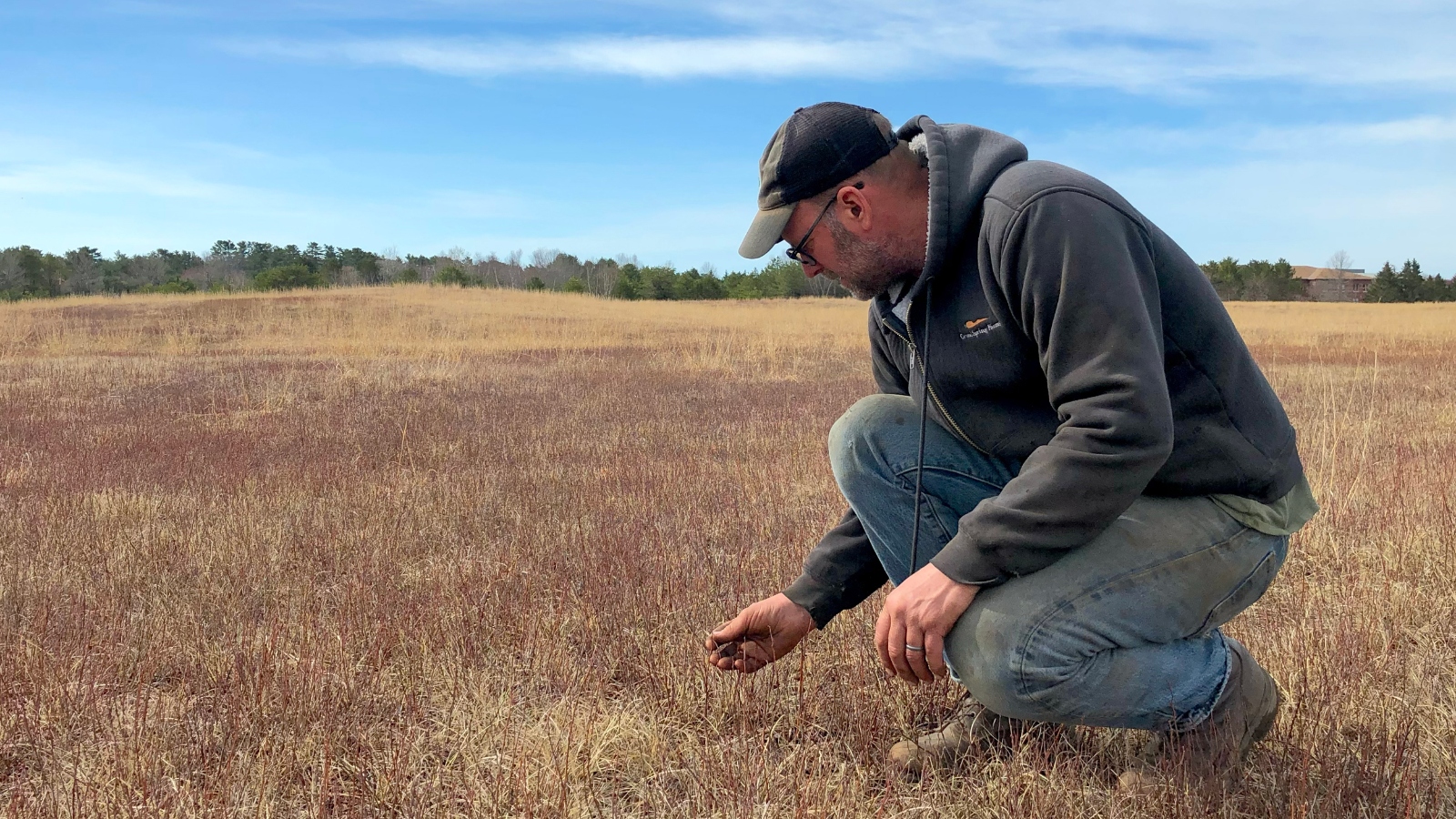
Last summer, the wild blueberry fields at Crystal Spring Farm in Maine turned red too soon. Not because of some dramatic autumnal aesthetic choice, but because severe drought had gripped most of the state. Seth Kroeck, the farm's operator, knew the leaves were changing color prematurely because the plants were stressed. Berries shriveled before they could ripen. The farm's 2025 harvest was almost a total loss.
"We got about 7 percent of our expected harvest," Kroeck said. Standing in his fields in April, he pointed out new growth still only a few inches high and noted that last year's yield was "a lot of raking with not a lot to show for it." This was just the latest blow for Crystal Spring Farm's 72 acres of wild blueberries. "In the last seven years, we've lost the crop three times, almost completely," he added.
As the climate changes, these losses are becoming more common for wild blueberry farmers, and the solutions are pricey. Wild blueberries are an iconic food in Maine - smaller and stronger-flavored than their cultivated cousins, typically frozen rather than sold fresh. Maine's farms contribute almost all of the United States' commercially sold wild blueberries, harvesting nearly 88 million pounds in 2023 and bringing $361 million in revenue to the state, according to the Wild Blueberry Commission of Maine.
"It's really something that's a backbone industry to the state and a part of the state's character," said Kroeck, a father of two who grew up in St. Louis, Missouri, and studied printmaking in college - a degree he jokes is useful every day on the farm. Wild blueberry patches are one of the few native North American fruits, often existing in the same spot for millennia. "The blueberry plants have been there for millennia, and they have been cared for by generations of farmers before me, and then the Indigenous community [before that]," Kroeck said.
An individual bush only produces fruit every other year, so farmers typically harvest about half their acreage annually. Also called "lowbush" blueberries, the plants grow in dense mats on sandy, gravelly, or low-nutrient soil primarily in eastern Canada and New England. "Blueberry soil is not nutrient-rich. Nothing else wants to grow there … but wild blueberries love it," said Rachel Schattman, a professor of sustainable agriculture at the University of Maine.
Despite their hardy nature, wild blueberry farms are struggling with recent extremes of temperature and precipitation. Maine experienced severe droughts in 2020, 2022, and 2025, plus one of its wettest years on record in 2023. Too-wet conditions encourage disease and weeds; droughts reduce flowers and shrivel fruit. Surprise late-spring frosts can kill flower buds, and warm autumns can cause bushes to flower again before winter, sapping energy. "It would be a real cultural loss to have fewer wild blueberry farms and fewer berries available in the future," said Lily Calderwood, a wild blueberry specialist at the University of Maine Cooperative Extension.
Maine's wild blueberry populations are caught in a climate hotspot, driven partially by rapid warming in the Gulf of Maine. According to 2021 research, the state's blueberry barrens are warming faster than the rest of the state, especially near the coast. Berries are ripening sooner - traditionally harvested in early or mid-August, now most are ready by late July. High heat shortens the harvest window, requiring more labor and equipment. Kroeck said he was unprepared for early ripening in some years, leading to lower yields and worse quality.
Last year, Maine saw a wet spring followed by hot, dry conditions starting in June, with drought intensifying through August and into 2026. Calderwood called it "a classic example of climate whiplash." The Maine Wild Blueberry Commission estimates the industry lost $30 million in 2025. Many farmers reported losing a third to half of their yields. "There were reports of many, many acres of blueberries going unharvested because the berries had basically dehydrated on the bush," Schattman said.
Kroeck's 2025 losses were higher than most because his farm sits on exceptionally sandy soil that doesn't hold water well. He has crop insurance, but that's partly based on previous years' yields. "If you have losses in close succession, then your average harvest goes down," he said. He has applied for state and federal relief, but that money would go toward 2023 losses from a late freeze, which have been on the books for nearly three years.
The state's wild blueberry industry has declined in recent years in both number of farms and total acreage, according to Wild Blueberry Commission data. Even Wyman's, one of the state's largest producers, plans to sell nearly 800 acres of blueberry fields this year.
Researchers are trying to prevent climate change from being another reason farms go under. At the Wyman's Research Center farm in Old Town, Schattman's team is halfway through a four-year study simulating potential futures for wild blueberries - testing temperature, rainfall, and irrigation effects on soil health, pollination, and yields. Some plants have irrigation, some have mulch to slow evaporation, and others have neither. Some are grown in isolation, others clustered. Open-top plexiglass structures passively trap heat, while others use heating coils. "We're collecting a massive amount of data," Schattman said.
Irrigation and mulching are showing promise, though mulch alone can't replace irrigation in severe drought. "[Mulching] is a really healthy thing to do for our fields," Calderwood said. "It can be used as a buffer for drought, but it cannot replace irrigation." Irrigation is difficult with wild blueberries since their preferred soil often isn't great for wells or pipes. Most small growers lack irrigation systems. "Obviously, it's useless to install an irrigation system if you don't have a reliable water source," Schattman noted.
When the study is complete, Schattman hopes to create a roadmap for farmers to keep crops healthy in future conditions. Calderwood's work at the University of Maine Cooperative Extension overlaps with this research, aiming to help farmers adapt. For now, Maine's wild blueberry farmers are stuck watching their iconic crop struggle through a climate that seems determined to make their lives difficult - one shriveled berry at a time.