Kennedy Center Scrubs Trump's Name, Proving That Removing Graffiti Is Easier Than Fixing the Wall Behind It
The Kennedy Center's fight to scrape Trump's name off its facade is a neat metaphor: erasing the graffiti is easy, but fixing the wrecked institution underneath is going to take a lot more than a power washer.
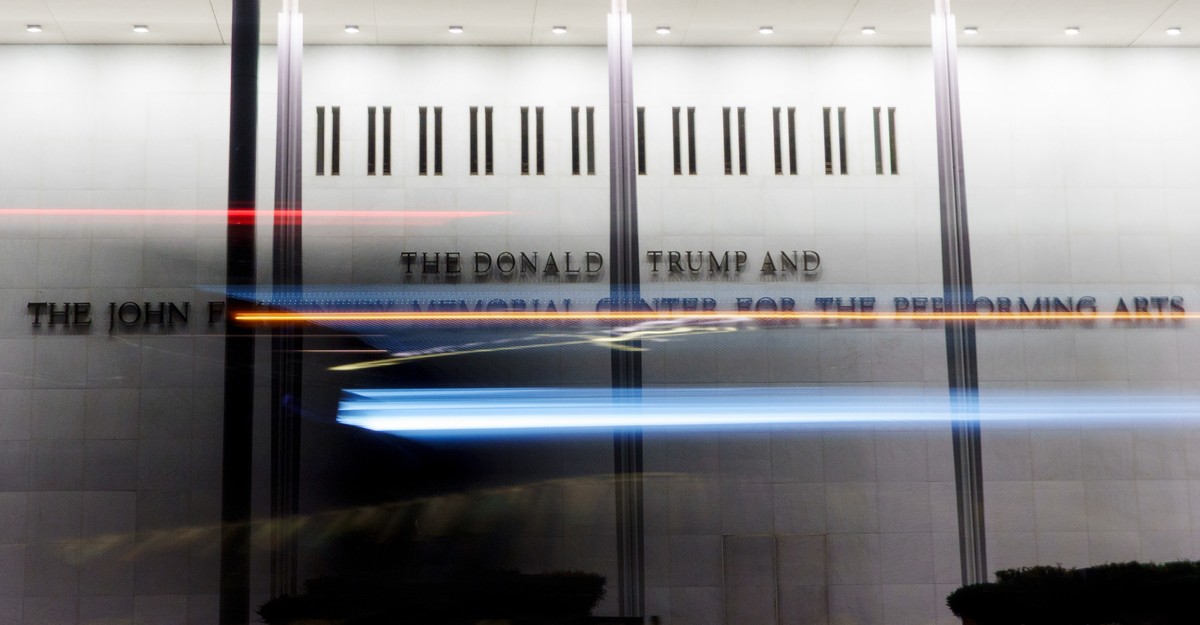
The Kennedy Center is preparing to remove Donald Trump's name from its facade, following a judge's ruling that the institution must revert to its statutory name. The ungrammatical moniker "The Donald J. Trump and the John F. Kennedy Memorial Center for the Performing Arts" was slapped on in December, and the letters are now scheduled for demolition - date and time TBD, but the Washington press corps is poised with binoculars and snacks.
Trump's name has already been scrubbed from the center's website, email signatures, letterhead, brochures, press releases, signs, contracts, and MOUs - basically, any surface that could legally be expunged without a jackhammer. The re-renaming is a win for the rule of law, but as my colleague Janay Kingsberry reports, the center is now a useful metaphor for the Trump-era United States: removing the name is the easy part; repairing the damage is a much longer, more painful process.
Trump still chairs the board after firing half its members and appointing loyalists, leaving the center hollowed out and rudderless. Judge Christopher Cooper ruled the board hadn't been given enough info to approve a two-year closure, but he didn't weigh in on whether it's actually a good idea. Meanwhile, artists and attendees have fled, and the center has no scheduled programming - a bit like a theater that's only showing the movie of its own dysfunction.
The Kennedy Center's troubles mirror the nation's, the article argues. A future president could remove the UFC arena from the White House lawn or demolish Trump's intended ballroom, but something must fill the hole where the old East Wing sat. More critically, they'd need to rebuild the National Security Council, replace partisan hacks, and recreate the interagency process - damage that's less visible but harder to reverse.
At the Pentagon, restoring the legal name of the Department of Defense will be easy, as will removing Trump's name from the "Trump class" nuclear-powered battleship he proposed. But replacing ammunition used in his unauthorized war in Iran, or refilling the pipeline of female and nonwhite officers whose careers stalled under Secretary Pete Hegseth, will take years.
A future attorney general could restore DOJ independence, but rebuilding trust with federal judges after 17 months of partisan purges is trickier - especially given the exodus of experienced lawyers and the influx of dubious hires. (Merrick Garland can now attest that any restoration is fragile without legislative changes.)
Unless Congress abolishes the Department of Education - unlikely - the next administration can abandon Trump's attempt to kill it, but replacing thousands of experienced civil servants will be challenging. An Ebola outbreak in the DRC has spread partly because DOGE slashed U.S. monitoring and containment funding last year, even as federal spending grew.
A future president could fire commissioners at the FCC and FTC, thanks to Trump's efforts to dismantle protections for independent regulatory agencies - the Supreme Court appears poised to approve this power grab, meaning those bodies will forever be susceptible to political interference unless Congress acts.
Trump's threat to walk away from the Kennedy Center suggests another danger: he could lose interest and doze off, leaving parts of government to fend for themselves. At one time, that might have been beneficial. In their already injured state, neglect would not be benign.
The successful legal battle to remove Trump's name is not hollow, but incremental. The hardest work - for both the Kennedy Center and the nation - remains ahead.
The Good Times
News in your inbox.
One sardonic roundup, delivered on your schedule. Free. Unsubscribe whenever your tolerance for wit runs out.
Already subscribed but we never reach your inbox? Check your spam folder and hit 'Not spam' (or 'Remove from spam') to bust us out of junk-mail purgatory. You'll be helping everyone else too.
Don't open any of our emails for a month and you'll be automatically removed from the mailing list.
Rewrite Article
Select parts to regenerate with a fresh AI pass. Translations will be updated automatically.
Generate AI Image
Creates a sardonic version of the article image using OpenAI.