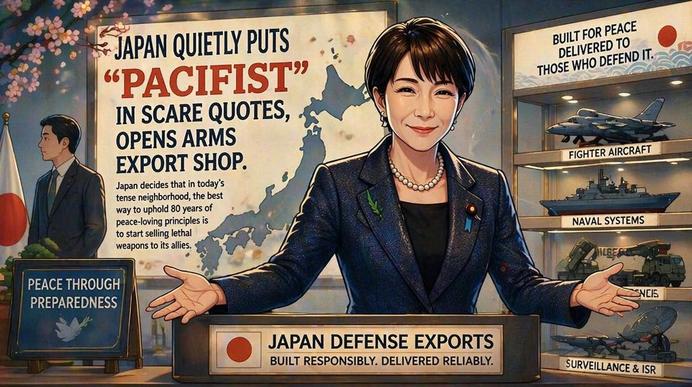
Japan Quietly Puts 'Pacifist' in Scare Quotes, Opens Arms Export Shop
Japan decides that in today's tense neighborhood, the best way to uphold 80 years of peace-loving principles is to start selling lethal weapons to its allies.
In a move that would make its 1947 constitution blush, Japan has officially loosened its decades-old restrictions on arms exports, clearing the way to sell weapons to more than a dozen countries. The announcement on Tuesday marks a significant pivot away from the post-World War Two pacifism that has, until recently, been a core part of the national identity.
Gone are the rules limiting exports to just five non-lethal categories: rescue, transport, warning, surveillance, and minesweeping. Under the new policy, Japan can now sell lethal weapons to the 17 countries with which it has defence agreements, including the US and the UK. A ban on sales to countries actively involved in conflict remains, but authorities have thoughtfully included a loophole for exceptions 'in special circumstances' - a phrase historically favored by nations on the brink of selling things they said they never would.
Prime Minister Sanae Takaichi took to X to frame the shift as a necessary adaptation, writing, 'In an increasingly severe security environment, no single country can now protect its own peace and security alone.' She was quick to add there was 'absolutely no change in our commitment to upholding the path and fundamental principles we have followed as a peace-loving nation for over 80 years since the war,' a statement that presumably now includes the strategic promotion of equipment transfers.
The timing, as ever, is impeccable. The new rules were announced as Japan's Self-Defence Forces participated as combatants for the first time - not mere observers - in annual war games between the US and the Philippines. The exercises occur near waters and islands claimed by Beijing, including Taiwan, which China views as a breakaway province. China's foreign ministry expressed being 'seriously concerned' about Japan's 'reckless militarisation' and promised to remain 'highly vigilant and resolutely opposed.'
Regional reactions were mixed. South Korea's foreign ministry offered the diplomatic equivalent of 'we're watching you,' suggesting Japan's policy 'should ideally be carried out in a manner that upholds the spirit of the Peace Constitution.' This comes from a nation with a long and painful history of Japanese colonization from 1910 to 1945.
This shift is the latest step in a gradual decade-long walk back from strict pacifism. In 2014, then-PM Shinzo Abe relaxed a blanket ban to allow joint arms development. In 2023, then-PM Fumio Kishida allowed exports of finished lethal weapons for the first time since WWII. PM Takaichi, a supporter of revising the pacifist constitution - potentially amending the war-renouncing Article 9 - argues Japan must face a new reality surrounded by China, Russia, and North Korea. Critics, meanwhile, worry the country is becoming war-capable and might be drawn into conflicts. It seems the only thing exported more than weapons these days is anxiety.
The Good Times
News in your inbox.
One sardonic roundup, delivered on your schedule. Free. Unsubscribe whenever your tolerance for wit runs out.
Already subscribed but we never reach your inbox? Check your spam folder and hit 'Not spam' (or 'Remove from spam') to bust us out of junk-mail purgatory. You'll be helping everyone else too.
Don't open any of our emails for a month and you'll be automatically removed from the mailing list.
Rewrite Article
Select parts to regenerate with a fresh AI pass. Translations will be updated automatically.
Generate AI Image
Creates a sardonic version of the article image using OpenAI.