
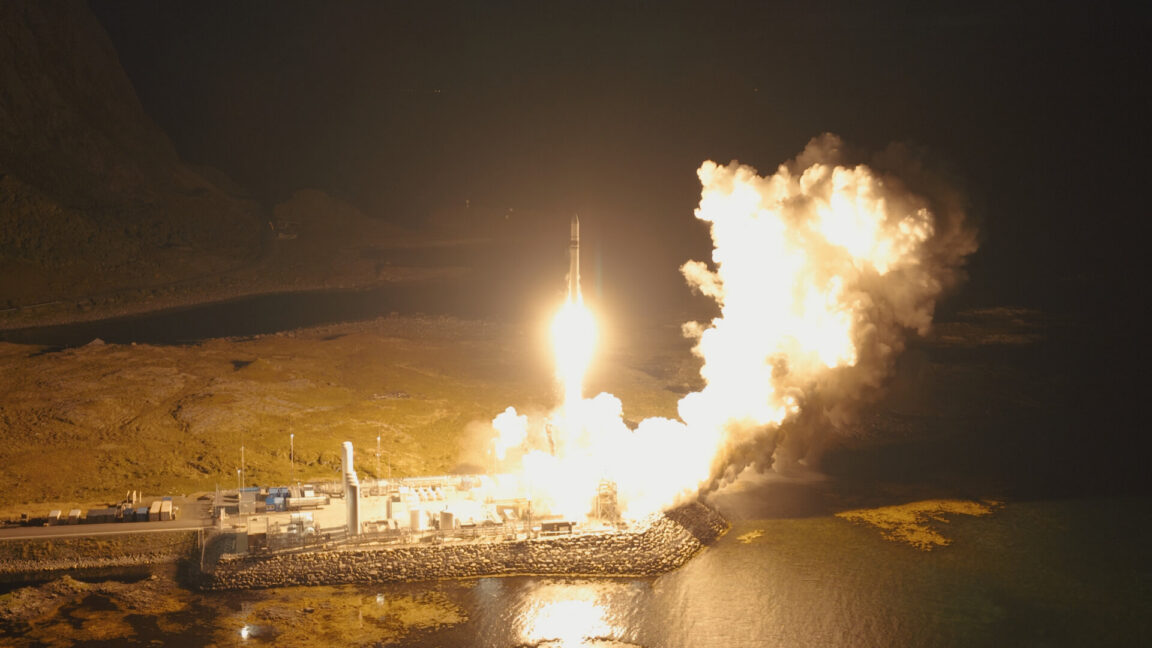
Isar Aerospace, a company founded in 2018 by three students at the Technical University of Munich, has successfully launched its privately-developed Spectrum rocket into low-Earth orbit from Andøya Spaceport in Norway. The launch, which occurred at 4:12 pm EST (20:12 UTC) Saturday, marked the first time a fully commercial launch vehicle from Europe has reached orbit. The 92-foot-tall (28-meter) rocket lifted off at 10:12 pm local time, with the final bluish hues of daylight fading from the late summer sky. Seven minutes later, the rocket was in orbit, and Isar Aerospace suddenly became the coolest kids on the European space block.
“Today, Isar Aerospace opened space from continental Europe,” said Daniel Metzler, co-founder and CEO, in a press release. “Launch continues to be the largest bottleneck for the global space industry and from today on, there is a true alternative for commercial and institutional customers.” Metzler, along with classmates Josef Fleischmann and Markus Brandl, started the company after tinkering with rocket parts in a campus workshop. Because what else are you going to do with a degree in aerospace engineering? Apparently, start a rocket company that would go on to raise roughly $1 billion and employ nearly 500 people. Not bad for a hobby.
Europe's space industry has long been a bit, shall we say, stodgy. Incumbent providers Arianespace and Avio have relied on billions of euros in government funding, with a procurement model called 'geo-return' that ensures everyone gets a piece of the pie, even if the pie is lukewarm. Isar, by contrast, took the Silicon Valley route, raising private capital and aiming for commercial customers. “Especially early on, back in 2018, when, frankly, there was no 'New Space' industry, especially on this side of the Atlantic, people said it will never work,” Metzler told reporters. “People will continue to always say this will not work, and that will not work, until we just prove them wrong. Giving up is not in our DNA.” Eight years later, the proof is in the orbit.
The success is a boon for the European Space Agency (ESA) and European governments, who are desperate for lower-cost, sovereign access to space. Europe's current rockets, Ariane 6 and Vega-C, are reliable but only marginally competitive even with subsidies. Meanwhile, European governments have had to pay a premium to launch on European rockets or grit their teeth and sign contracts with SpaceX, which is cheaper but politically unpalatable given the rocky relations with the Trump White House. Isar's success offers a third way: a homegrown, privately-funded option that doesn't require a government committee to sign off on every bolt.
There's also a historical twist: Spectrum is the first rocket built predominantly in Germany to reach orbit, and it supplants the V-2 as the largest German rocket in history. The V-2, a World War II weapon of terror, was developed by Wernher von Braun and his team, who then emigrated to the US to work on rockets for the military and NASA. Germany's domestic space industry has since focused on satellites, science missions, and payloads - like the service modules for NASA's Orion spacecraft - but not on big rockets. Now, German Chancellor Friedrich Merz, who visited Andøya in March, is heralding the launch as the “beginning of a new era.” Walther Pelzer, director general of the German Space Agency DLR, which awarded Isar $13 million (11 million euros) in 2021, said the flight “redefined the path to independent European access to space.” Notably, the Spectrum rocket was not developed under a government contract; it was developed to serve a global market.
The Spectrum rocket fits neatly into the small-to-medium launch market, capable of carrying up to a metric ton (2,200 pounds) to low-Earth orbit. That puts it in the same class as Firefly Aerospace's Alpha, heavier than Rocket Lab's Electron, but lighter than Italy's Vega-C. The first test flight in March 2025 failed when a vent valve opened unintentionally, causing the rocket to spin out of control and crash. But this second flight, named “Onward and Upward,” carried five small CubeSats and a non-separating technology experiment. The rocket's nine Aquila engines, burning propane and liquid oxygen, generated more than 150,000 pounds (675 kilonewtons) of thrust. The first stage fired for two-and-a-half minutes, then separated, and the second stage accelerated to orbital velocity - about 5 miles per second - seven minutes into the flight. At least one CubeSat made contact with ground teams, confirming a successful orbit.
Isar's victory lap comes just days after ESA awarded the company $230 million (197.8 million euros) through the European Launcher Challenge, a program designed to foster commercial launch development. The other two awardees, Germany's Rocket Factory Augsburg and Spain's PLD Space, are still aiming for their first orbital attempts by year's end. MaiaSpace, a subsidiary of ArianeGroup, is in negotiations to join. The challenge requires an orbital launch by 2027; Isar has already cleared that bar. As ESA Director General Josef Aschbacher put it, “Spectrum quite literally rose to the challenge and delivered its payloads in low-Earth orbit.”
Now comes the hard part: repeating this feat consistently. Isar has five more Spectrum rockets in production and a new 10-acre factory near Munich with the capacity to produce up to 40 launch vehicles per year. But Metzler is realistic: “Realistically, it's going to take a few years until we will actually be there. We'll try to push it as hard as we can, while making sure that the quality we put out of the factory is also actually good quality.” The company is also scouting a second launch site in Canada. With customers like ESA and Astroscale (which specializes in space debris mitigation - how very responsible), Isar is poised to shake up the European launch market. And for a continent that has long watched from the sidelines as SpaceX dominated, this is a welcome change: Europe can move fast and deliver, even if it took a few students with a hobby to prove it.