
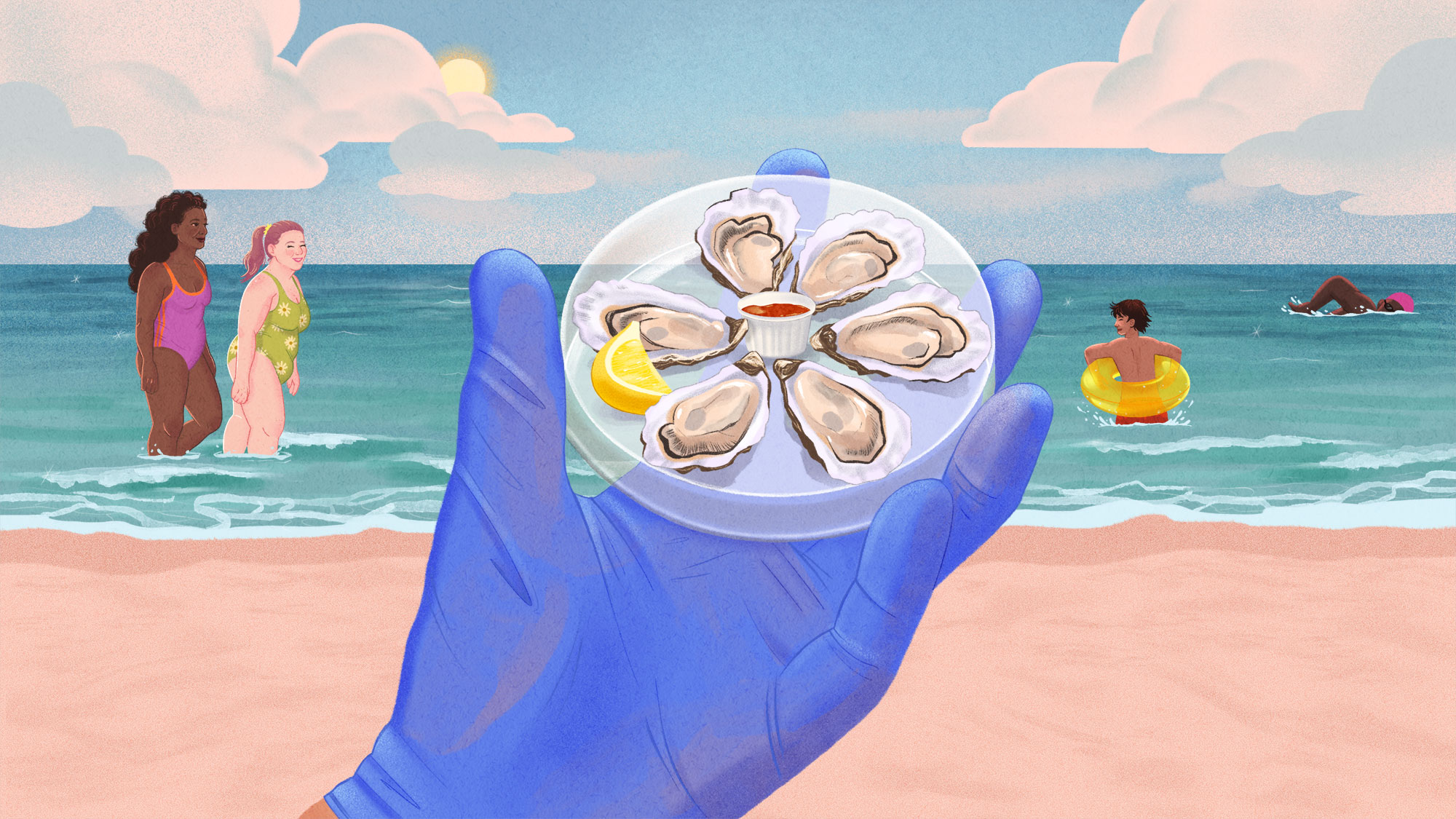
On a sunny Florida beach last August, two researchers in full hazmat chic - Bailey Magers and Sunil Kumar - were busy doing what scientists do: collecting seawater samples while wearing enough rubber and plastic to make a hazmat suit jealous. An older woman in a swimsuit wandered over to ask what they were up to. "We're just actively monitoring water quality," they told her, trying to sound casual. She saw right through them. "Are you looking for that flesh-eating bacteria?" she asked. They admitted they were looking into it, hoping not to alarm her. As she turned back toward the ocean, Kumar noticed she had scrapes and bruises all over her body. A few minutes later, she waded into the waves. He shook off a chill and got back to work.
Magers and Kumar study Vibrio, a genus of ancient marine bacteria that has been floating around since the Paleozoic Era - back when Earth was basically one giant supercontinent with shallow, warm seas that were apparently great for both early marine ecosystems and, hundreds of millions of years later, making headlines. There are over 70 Vibrio species today, and they spend their time chillin' in warm, brackish water, hitching rides on plankton and algae, and accumulating in filter-feeders like clams and oysters. A few of these species can make you very sick or even kill you. The worst-case scenario? You swim in brackish water with an open wound or eat raw contaminated shellfish, and within hours, the flesh on your extremities starts bruising, swelling, and decaying. Without quick antibiotics, septic shock sets in. Fun times.
Climate change, which has heated up more than 90 percent of the excess heat trapped by greenhouse gas emissions, is making the oceans cozier for Vibrio. Temperature and salinity are the biggest predictors of how widespread the bacteria get: as water warms, Vibrio concentrations rise, boosting infection risks for beachgoers and oyster lovers. The bacteria start getting active above 60 degrees Fahrenheit and multiply like crazy as coastal waters heat up in summer. Scientists have documented Vibrio expanding northward along the U.S. East Coast, all the way to Maine, and popping up more often in temperate seas globally.
Vibriosis infections are now the leading cause of shellfish-related illness in the U.S., and they've increased more than any other foodborne pathogen since the CDC started tracking them in 1996. A 2019 analysis called it a "perfect storm" of climate change, food handling practices, globalization, regulatory patchwork, and better diagnosis. Magers and Kumar are part of a University of Florida lab trying to create a Vibrio early warning system for the eastern U.S. - a program that could alert public health departments to high Vibrio concentrations a month in advance. Imagine how many limbs could be saved if doctors knew to expect a spike in these underdiagnosed infections.
But Vibrio isn't just a menace; it's also a messenger. As it spreads north, it signals changing marine conditions - a first warning that the local species composition is shifting. In the Baltic Sea, a 2014 Vibrio spike closely tracked a heatwave, showing researchers that Vibrio can serve as a barometer for ocean heatwaves. "We see Vibrio as the indicator for climate change," said Kyle Brumfield, a microbiologist at the University of Maryland. "We can use the presence of Vibrio and Vibrio cases as a proxy for water health in general."
The CDC estimates about 80,000 vibriosis cases occur annually in the U.S., with about 100 deaths. Most are caused by Vibrio parahaemolyticus, which gives you food poisoning. But the vast majority of deaths come from Vibrio vulnificus - Latin for "wound-making," because of course it is. Vulnificus is so potent it can enter through a pinhole-sized cut and kill within 24 hours. In the last five years, the CDC recorded 429 wound-related vulnificus cases and 136 foodborne ones, though foodborne cases are deadlier: 32 percent of those died, compared to 13 percent of wound infections. Most cases cluster around Gulf and Atlantic coasts.
Vulnificus is rare - 150 to 200 cases a year, versus chlamydia's 1.5 million - but its speed and 15 to 50 percent fatality rate make it a unique threat, especially as climate change expands its reach. Since the late 2010s, it's been behaving erratically, with spikes linked to hurricanes and marine heatwaves. In 2022 and 2024, Florida reported 17 and 19 deaths from vulnificus after hurricanes pushed brackish water inland. North Carolina, New York, and Connecticut saw clusters during a 2023 heatwave. "As coastal water temperatures increase," the CDC warned, "V. vulnificus infections are expected to become more common." A 2023 study found the northern boundary of infections has moved 30 miles per year since 1998, and annual cases may double as temperatures rise and the elderly population grows. "In the 1980s," Brumfield said, "Vibrio abundance would drop in mid-October. Now we can pretty much find them almost year-round."
How worried should you be? Depends who you ask. The gruesome nature of vulnificus makes it irresistible to news media, fueling headlines like "Virginia dad wades in calf-high water, dies 2 weeks later of flesh-eating bacteria" or "2 dead after eating oysters." Neither story mentions how rare the bacteria are. That's bad news for the seafood industry. Shellfish farmers argue media attention is unwarranted. "'Flesh-eating bacteria' - the media loves it," said Leslie Sturmer, a University of Florida researcher. Paul McCormick, a Long Island oyster farmer selling 750,000 oysters a year, thinks all press is bad press. "Even if the title says 'New York oysters are the safest in the universe,'" he said, "you've already created a problem."
In unrefrigerated oysters, Vibrio doubles every 20 minutes. But since 2010, states have deployed "Vibrio control plans" requiring harvesters to rapidly cool their catch and refrigerate it within hours - measures that have proven effective. The dual infection pathways - seafood and seawater - make it easy to shift blame. Consumers can choose not to eat raw oysters or swim with open wounds. For industry reps, personal responsibility is key. "The person is the risk," said Sturmer. "Not the climate, not the water, not the bacteria." The government seems to agree: there's no numerical threshold for closing beaches, though advisories are issued. But that perspective ignores climate change's rapid marine shifts, uneven vibriosis awareness, and the fact that Americans often make decisions at odds with their own safety. The shellfishers Grist spoke to acknowledged the science, but the disconnect remains: a warming world is expanding the range of a fast-acting, potentially deadly bacteria, and our response so far is basically "just don't get in the water." Good luck with that.