Financial Analyst Has Big Plans for Seabed He Doesn't Own, Can't Mine
A San Francisco financial analyst wants to mine the seabed just outside three Pacific nations' waters, despite owning no equipment, having no website, and facing strong opposition from France.
Last summer, French Polynesia declared the world’s largest contiguous marine protected area, reinforcing its 2022 ban on seabed mining, with President Emmanuel Macron proclaiming, “The deep sea is not for sale.” A year later, that sentiment apparently doesn’t apply to the waters just beyond French Polynesia’s maritime border, where a little-known American startup is seeking the Trump administration’s approval to lease 25 million acres of international waters for mining exploration.
The area, dubbed Eastern High Seas Pocket 3, is a mineral-rich patch of ocean entirely surrounded by the exclusive economic zones of French Polynesia, the Cook Islands, and Kiribati. It’s also a hotspot for albacore, yellowfin, and bigeye tuna, and hosts dozens of fishing vessels each year. American Deep Sea Minerals is the first company to propose exploring the seabed there for manganese and other critical minerals, capitalizing on the global rush for battery and military tech components.
The company’s application is the latest example of the Trump administration enabling deep sea mining enthusiasts to sidestep international law. Most nations have agreed to a treaty giving the International Seabed Authority oversight of high-seas mining, but the U.S. never ratified it. Instead, Trump announced in 2025 that the U.S. would permit mining under the 1980 Deep Seabed Hard Mineral Resources Act, a law meant as a temporary measure until the U.N. Convention on the Law of the Sea was adopted. That was 43 years ago.
American Deep Sea Minerals’ application is one of at least a dozen the Trump administration has received, and it’s open for public comment until August 3. The company, however, does not own any ships, mining equipment, or apparently a website. Its CEO, Graham Goulet, is a San Francisco-based financial analyst. “He wants it to become an idea with a U.S. license to an area that nobody else has a license to,” said Coalter Lathrop, a lawyer specializing in international ocean law. Lathrop likened the strategy to “a guy who got advance notice that a rural area is about to get a highway running through it, so he goes and buys some cheap land.”
Goulet initially submitted his bid under the name Kraken Metals in August 2025, four months after the Trump administration began accepting applications, and paid $100,000 - what Lathrop called “peanuts” in finance. Goulet told Grist the application is for exploration only, and the company has not yet decided to pursue commercial mining. In April, it hired Wouter Duijnstee, an environmental engineer who previously worked with Allseas, a contractor that has provided deep sea mining equipment to The Metals Company. It’s unclear if the company has other employees.
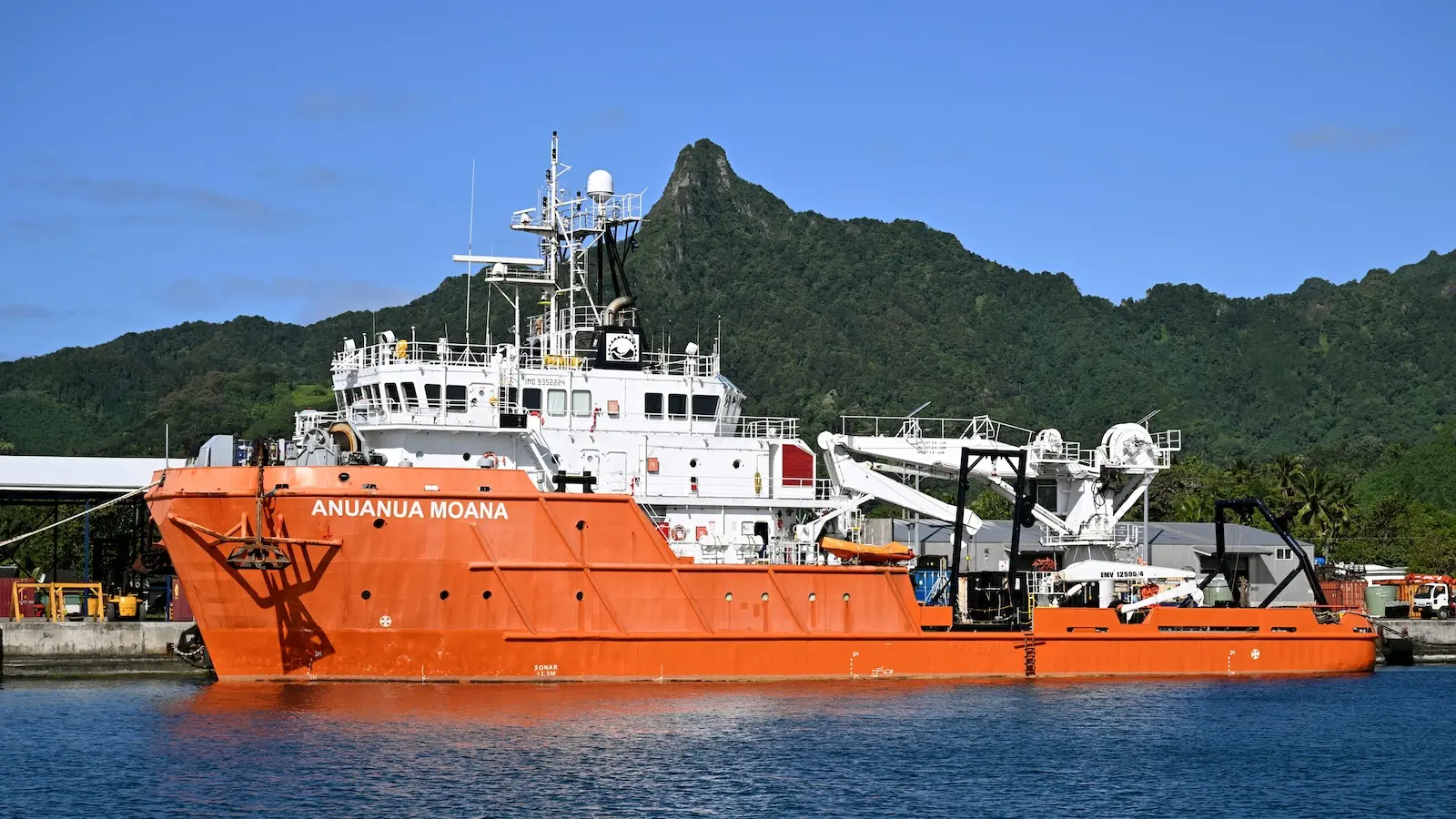
Proximity to national waters poses risks: if any of the three surrounding countries successfully extends its continental shelf claim, the company’s claim would be overridden. The U.S. recently claimed roughly 300,000 square miles of additional marine area using the same law. Nearby seafloors, like those around the Cook Islands, are thought to hold polymetallic nodules - fist-sized lumps of ore rich in critical minerals. American Deep Sea Minerals’ application says it intends to charter the MV Anuanua Moana, a deep sea mining exploration vessel owned by the Cook Islands.
Representatives of French Polynesia, Kiribati, and the Cook Islands did not respond to requests for comment. But the application raises questions about the consequences of mining near regional fisheries, as well as the rights of Pacific nations and Indigenous peoples. “This is a particularly important area of the high seas because of the fish stocks that migrate through it,” said Pradeep Singh, an ocean governance expert at the Oceano Azul Foundation. One study funded by The Metals Company found that releasing mining waste near the ocean surface could starve zooplankton and harm tuna. Other studies show deep sea mining would reduce life on ocean floors by at least a third.
Despite the risks, Kiribati and the Cook Islands are considering permitting deep-sea mining, hoping for “transformational” revenue where average annual incomes are $3,000 and $9,000 respectively. But because American Deep Sea Minerals seeks a U.S. permit, neighboring nations aren’t guaranteed any revenue sharing. French Polynesia remains opposed, with President Moetai Brotherson saying last year, “We’re playing gods with the cradle of life - and that’s way too dangerous.” In June, he added conservation protections on another 200,000 square miles of surrounding waters.
The Good Times
News in your inbox.
One sardonic roundup, delivered on your schedule. Free. Unsubscribe whenever your tolerance for wit runs out.
Already subscribed but we never reach your inbox? Check your spam folder and hit 'Not spam' (or 'Remove from spam') to bust us out of junk-mail purgatory. You'll be helping everyone else too.
Don't open any of our emails for a month and you'll be automatically removed from the mailing list.
Rewrite Article
Select parts to regenerate with a fresh AI pass. Translations will be updated automatically.
Generate AI Image
Creates a sardonic version of the article image using OpenAI.