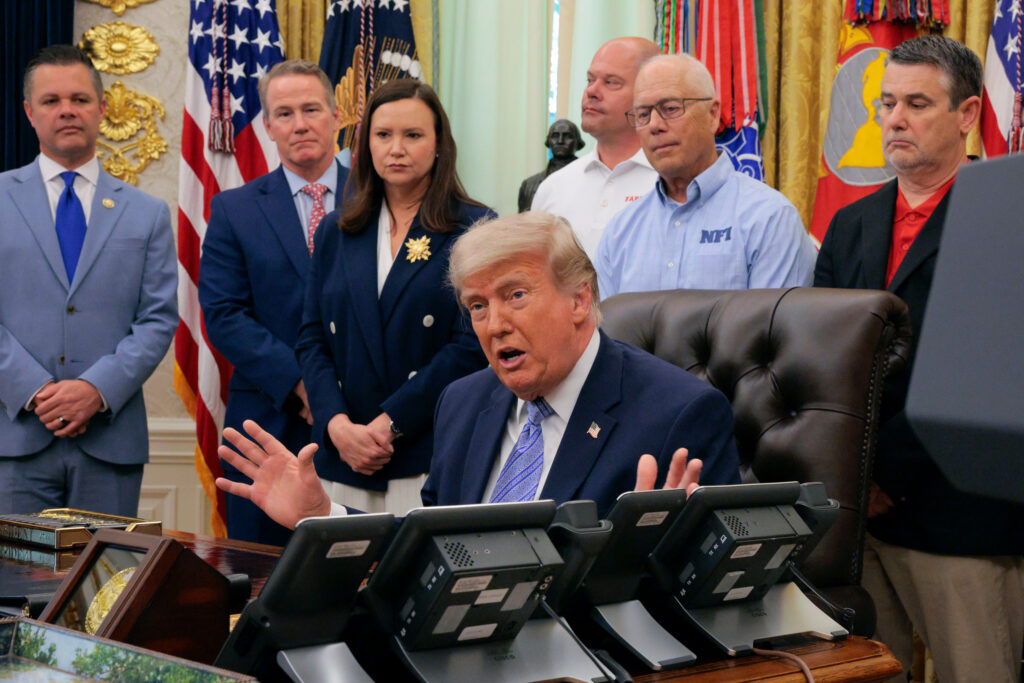
President Donald Trump has announced new regulatory rollbacks on chemical refrigerants, promising that they will lower grocery prices and definitely not harm the environment. The U.S. chemical, refrigeration and air-conditioning manufacturers, meanwhile, have a different take: prices will go up, and the administration's own projections show greenhouse gas pollution will increase. But who's counting, right?
The primary rollback, announced by Trump and EPA Administrator Lee Zeldin this month, extends the timeline for manufacturers of air conditioners and other equipment to phase out devices using high-global-warming-potential hydrofluorocarbons (HFCs) as refrigerants. The change pushes the deadline back by several years for most equipment, giving the planet a little extra time to warm up.
HFCs are synthetic chemical refrigerants that can be hundreds to thousands of times more effective at trapping heat than carbon dioxide, pound for pound. Current EPA regulations, stemming from the American Innovation and Manufacturing Act of 2020 (which Trump himself signed), required manufacturers to gradually shift to climate-friendly refrigerants. The EPA's assessment of the rule change found that cumulative HFC emissions will increase by 68 million metric tons of carbon dioxide equivalent by 2050 compared with the baseline. A second proposed change would exempt transport companies from repairing HFC leaks in refrigeration equipment on trucks.
The EPA estimated both changes would save Americans more than $2.4 billion over the next quarter-century. "It's ridiculous, unnecessary and costly," Trump said of the existing regulations, apparently forgetting he signed the law that created them.
Industry experts are not amused. John Hurst, executive director of the Alliance for Responsible Atmospheric Policy, which represents chemical refrigerant producers and cooling equipment manufacturers, said: "I don't see how it saves any money. It's not a cost reduction, it's actually going to be a cost add." Hurst noted that American manufacturers followed the rules, invested in new equipment and refrigerants, and now the administration is undercutting those investments.
Stephen Yurek, president of the Air-Conditioning, Heating, and Refrigeration Institute, said the rule works against basic supply and demand. Increased demand for limited refrigerants could cost the refrigeration industry nearly $8 billion, according to Heating, Air-conditioning & Refrigeration Distributors International.
When Trump signed the AIM Act in 2020, manufacturers supported it because it allowed the U.S. to ratify the Kigali Amendment to the Montreal Protocol, which would create 33,000 manufacturing jobs and increase exports by $5 billion per year while reducing imports by nearly $7 billion annually. The EPA's own economic assessment noted potential cost increases from limiting supply while boosting demand but chose not to quantify them. "We are not able to quantify all of these tradeoffs in this document," the agency said, which is a fun way of saying "we prefer not to look."
Global HFC emission reductions under the Kigali Amendment were projected to prevent 0.5 degrees Celsius of additional warming by 2100 - a difference that matters when every fraction of a degree fuels more extreme weather. Avipsa Mahapatra, climate campaign director for the Environmental Investigation Agency US, called the rollback "a reckless step backward for climate action" and warned that exempting leaky refrigerated trucks from repair requirements weakens one of the most practical tools for reducing emissions.
Trump, perhaps forgetting his own signature, suggested he may try to roll back the AIM Act entirely. "We've got to get rid of the law that was signed quite a while ago," he said, because ultimately he wants to make the changes permanent. Because nothing says "permanent" like undoing a law you yourself signed.
The Good Times
News in your inbox.
One sardonic roundup, delivered on your schedule. Free. Unsubscribe whenever your tolerance for wit runs out.
Already subscribed but we never reach your inbox? Check your spam folder and hit 'Not spam' (or 'Remove from spam') to bust us out of junk-mail purgatory. You'll be helping everyone else too.
Don't open any of our emails for a month and you'll be automatically removed from the mailing list.
Rewrite Article
Select parts to regenerate with a fresh AI pass. Translations will be updated automatically.
Generate AI Image
Creates a sardonic version of the article image using OpenAI.