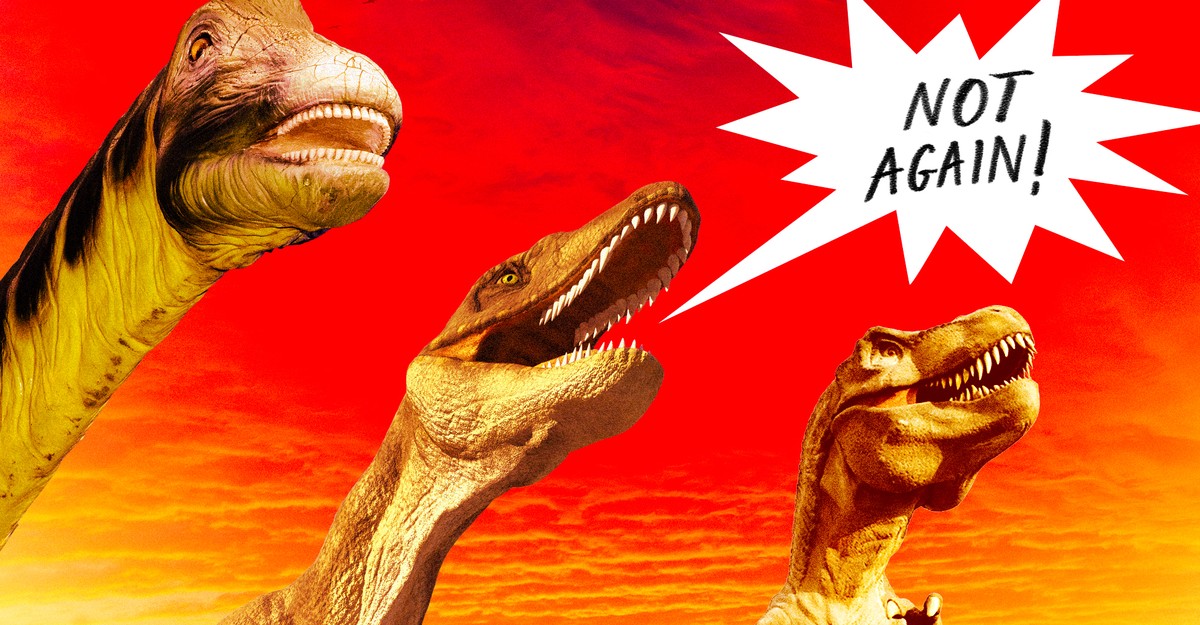
Dinosaurs Had It Worse: A Brief History of Truly Terrible Air Quality
Wildfire smoke is bad, but 66 million years ago, dinosaurs faced an asteroid-triggered global firestorm that blocked the sun for years. Perspective, people.
This week, smoke from Canadian wildfires turned the sky orange in Philadelphia, veiled the Statue of Liberty in Manhattan, and blurred Detroit's skyline. For those of us from the wildfire-prone West, it's tempting to brag about having seen worse. But let's be real: we've got nothing on the dinosaurs 66 million years ago.
The asteroid that ended the Cretaceous period struck Earth at about 40,000 miles per hour, blasting a 112-mile-wide crater into Mexico's Yucatán Peninsula. The explosion was so massive that it punched a hole in the atmosphere, bringing "outer space down to the surface of the Earth," according to Kirk Johnson, director of the Smithsonian National Museum of Natural History. Trillions of tons of debris shot into the sky, forming a global cloud that blocked virtually all sunlight, plunging the world into solar-eclipse-level darkness for years. Hot debris sparked wildfires that consumed "all the biomass on the planet," Johnson said, burning in a dark world.
Brian Toon, a senior research scientist at the University of Colorado Boulder, noted that dinosaurs faced smoke far more intense than anything the U.S. experienced this week. But many never felt it: the impact released energy equivalent to 1 billion Hiroshimas, instantly killing dinosaurs within about 1,000 miles. For anyone human-sized standing anywhere on Earth, survival of the first week was "pretty unlikely," Johnson said.
For those who made it past the initial blast, the next few years were hellish. The brightest day looked like a moonlit night for perhaps months, Ken MacLeod, a geology professor at the University of Missouri, told me. The air was thick with dust, soot, and gases. The gloom lasted about two years, with particulates and soot blocking sunlight and starving herbivores. Sulfate aerosols created a "global, orange-brown smog" for years. According to the American Museum of Natural History, 40 percent of sunlight was still blocked two years after impact, and full sunlight didn't return for about four years.
Scientists know this from the massive charcoal and soot layers still detectable today, along with a thin layer of asteroid debris. You can touch it at Trinidad Lake State Park in Colorado, a reminder of a truly apocalyptic time. So yes, this week's smoke is bad, and you should take precautions. But as Brian Huber, a research geologist at the Smithsonian, put it: compared with the dinosaur extinction, this "ain't nothin'." Be grateful you're not a dinosaur.
The Good Times
News in your inbox.
One sardonic roundup, delivered on your schedule. Free. Unsubscribe whenever your tolerance for wit runs out.
Already subscribed but we never reach your inbox? Check your spam folder and hit 'Not spam' (or 'Remove from spam') to bust us out of junk-mail purgatory. You'll be helping everyone else too.
Don't open any of our emails for a month and you'll be automatically removed from the mailing list.
Rewrite Article
Select parts to regenerate with a fresh AI pass. Translations will be updated automatically.
Generate AI Image
Creates a sardonic version of the article image using OpenAI.