Concorde's 74-Minute Eclipse Chase: Still the Gold Standard in Lunar Shadow Racing
Eight scientists rode a supersonic plane to stare at the Sun for 74 minutes - a record that still stands, because why walk when you can fly at Mach 2.2?
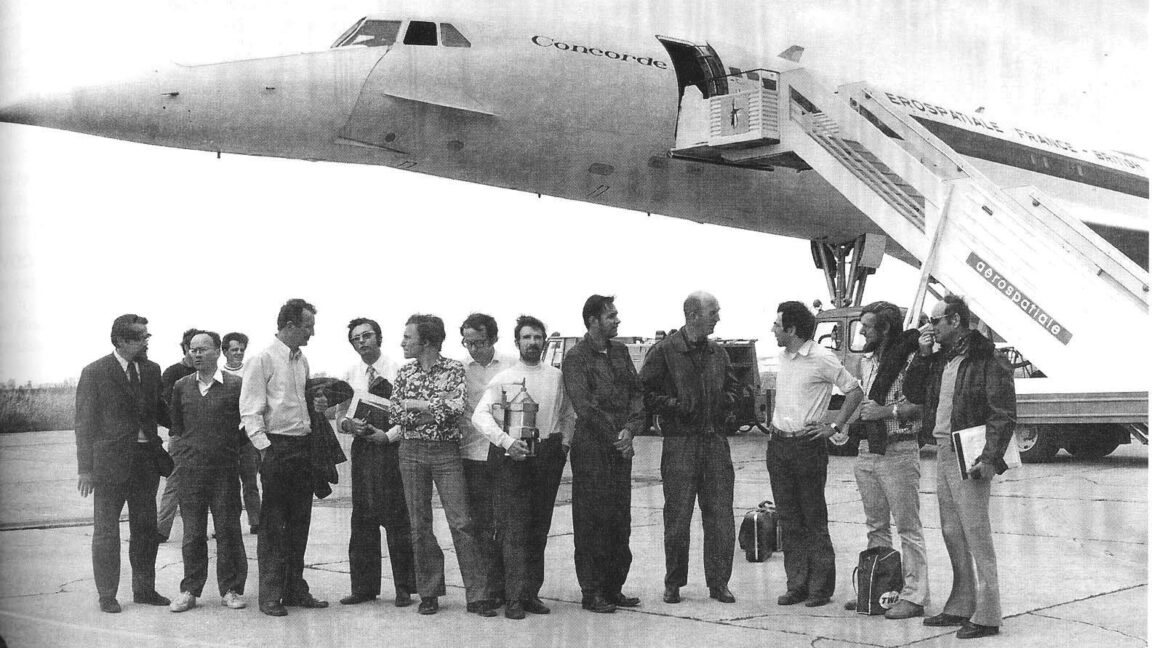
A stroll through the National Air and Space Museum of France at Paris-Le Bourget airport is a guaranteed thrill for aviation nerds. But for science nerds, one exhibit stands out: the legendary Concorde F-WTSS 001 prototype, whose long nose is adorned with a painted map tracing the path of a June 1973 total solar eclipse across Africa. Why? Because eight scientists used this very aircraft to set a world record by observing a total solar eclipse for 74 minutes while flying at more than twice the speed of sound.
To put that in perspective, the maximum totality duration on the ground is about 7.5 minutes in equatorial regions. The upcoming August 12 solar eclipse, visible from parts of Europe, will offer a measly two minutes of totality from terra firma. So, you know, no big deal.
Pierre Léna, an astronomer at the Paris Observatory, initiated this record-breaking project. In 1972, a year before the eclipse, Léna - who had previously done astronomical observations from high-altitude aircraft - decided to chase the Moon's shadow. The 1973 eclipse was near the equator, where the shadow moves at a relatively slower speed, though still more than 2.2 times the speed of sound. Only one big aircraft could keep up: the Concorde.
Léna approached André Turcat, chief of test flights at Aerospatiale in Toulouse, who was intrigued. The plan was accepted, and Léna organized experiments. Flying at nearly 17 km above Earth's surface had perks: no humidity, excellent infrared transmission of solar light. Léna planned to study dust particles in the corona at infrared wavelengths, but he wisely opened seats to other scientists from France, the UK, and the US, including groups from the French National Centre for Scientific Research, Queen Mary College in London, Kitt Peak Observatory in Arizona, Los Alamos National Laboratory, and the University of Aberdeen.
The experiments aimed to study the solar corona - the whole corona is only visible during a total eclipse - at different wavelengths, including dust emitting infrared radiation, oscillating hot gas, and the chromosphere. To accommodate these, the Concorde 001 underwent modifications: four portholes were added to the ceiling, one for each experiment. Those portholes remain visible today, a testament to scientific ambition and questionable interior design.
Two rehearsal flights preceded the actual event. Taking off from Las Palmas in the Canary Islands, the Concorde rendezvoused with the eclipse shadow over Mauritania. The precision required was severe: the rendezvous point had to be within 1 nautical mile and 15 seconds of time. They nailed it within one second, using only inertial navigation - no GPS, because this was the 1970s, not the future.
Léna recalls the experience: "The sky was completely dark, and the curvature of the horizon noticeable. On the ground was a dark circle of 300 km radius in the Sahara Desert and on the horizon we could see the light because it was outside the eclipse. This was absolutely unique. Nobody had seen this before."
The shadow moved east at a slightly higher speed than the Concorde's Mach 2.2, giving the scientists 80 minutes of observation time before the aircraft fell behind. Headwinds reduced that to 74 minutes - still an astonishing achievement. "No one has achieved even half of it during the past 53 years," Léna said.
After the chase, the Concorde landed in N'Djamena (then Fort-Lamy) in Chad, where a partial eclipse continued for another hour and a half. Locals celebrated with music in the streets. "It was a very special moment in my life," Léna said. We'd say so.
The Good Times
News in your inbox.
One sardonic roundup, delivered on your schedule. Free. Unsubscribe whenever your tolerance for wit runs out.
Already subscribed but we never reach your inbox? Check your spam folder and hit 'Not spam' (or 'Remove from spam') to bust us out of junk-mail purgatory. You'll be helping everyone else too.
Don't open any of our emails for a month and you'll be automatically removed from the mailing list.
Rewrite Article
Select parts to regenerate with a fresh AI pass. Translations will be updated automatically.
Generate AI Image
Creates a sardonic version of the article image using OpenAI.