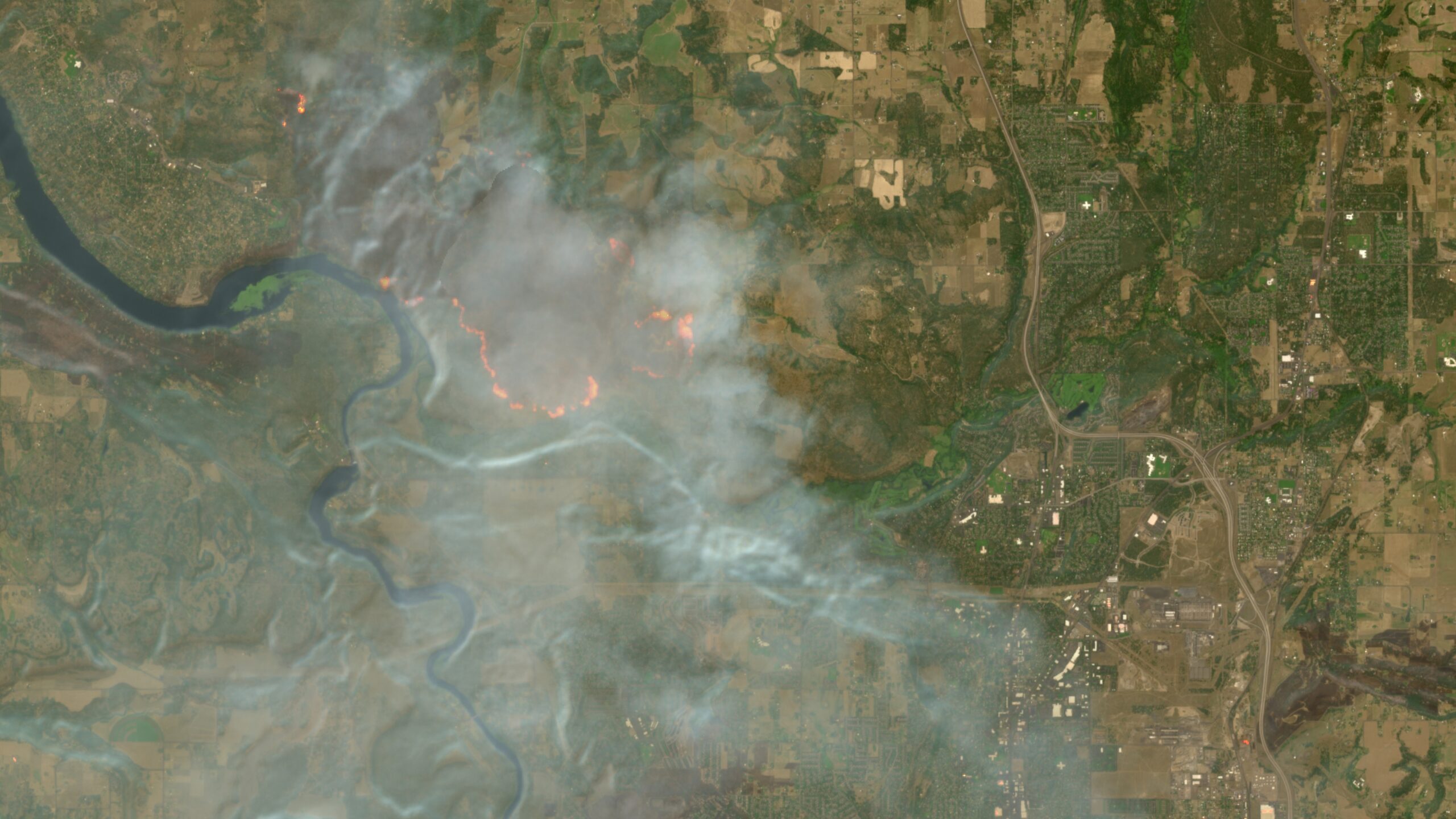
Wildfires are having a banner year - unfortunately, that's not a compliment - but at least now anyone with an internet connection can watch the carnage unfold in remarkable detail, courtesy of Europe's free satellite service. The Copernicus Browser, which offers complimentary access to the latest imagery from the European Space Agency's Sentinel satellites, just added a dedicated "wildfires" visualization layer on August 4. Because who doesn't love a new way to watch the world burn?
The new layer, integrated as a default option, is the brainchild of remote sensing expert Pierre Markuse, whose JavaScript script combines the red visible light band, a narrow near-infrared band to distinguish healthy from scorched vegetation, and the short-wave infrared 2 band to reveal moisture levels and thus burned landscapes. The result: active fires appear in white or yellow, burning vegetation in red, and charred earth in dark brown or black. It's like a morbid paint-by-numbers, but for disaster tracking.
Previously, users had to manually copy and paste Markuse's script into the browser using a custom visualization option - a bit like building your own IKEA furniture just to see if the shelf is on fire. But now, thanks to Simon Proud, mission scientist for Sentinel-2 at ESA, who lobbied for the integration (and announced it in a Discord channel run by Bellingcat, because where else do you announce satellite imagery updates in 2024?), it's just a click away.
The Sentinel-2 mission's three satellites provide multi-spectral imaging at resolutions as granular as 10 meters in visible light and near-infrared bands, which makes this the best free tool for high-resolution wildfire tracking. NASA's FIRMS tool, by contrast, offers coarser imagery down to 250 meters, though it updates within hours. Sentinel-2 refreshes every few days but delivers much sharper pictures. It's a trade-off: speed vs. clarity, like choosing between a blurry photo of Bigfoot or waiting for the high-res version.
And there's no shortage of fires to point this thing at. Climate change is making wildfire seasons longer and more intense, as if they needed any help. Currently, much of Washington and Oregon are engulfed in flames and smoke, Canada is on track for one of its worst wildfire seasons ever, and France and Spain are battling record-breaking blazes that have forced hundreds of thousands to evacuate. So fire up that new layer, folks - you're going to need it.
The Good Times
News in your inbox.
One sardonic roundup, delivered on your schedule. Free. Unsubscribe whenever your tolerance for wit runs out.
Already subscribed but we never reach your inbox? Check your spam folder and hit 'Not spam' (or 'Remove from spam') to bust us out of junk-mail purgatory. You'll be helping everyone else too.
Don't open any of our emails for a month and you'll be automatically removed from the mailing list.
Rewrite Article
Select parts to regenerate with a fresh AI pass. Translations will be updated automatically.
Generate AI Image
Creates a sardonic version of the article image using OpenAI.