
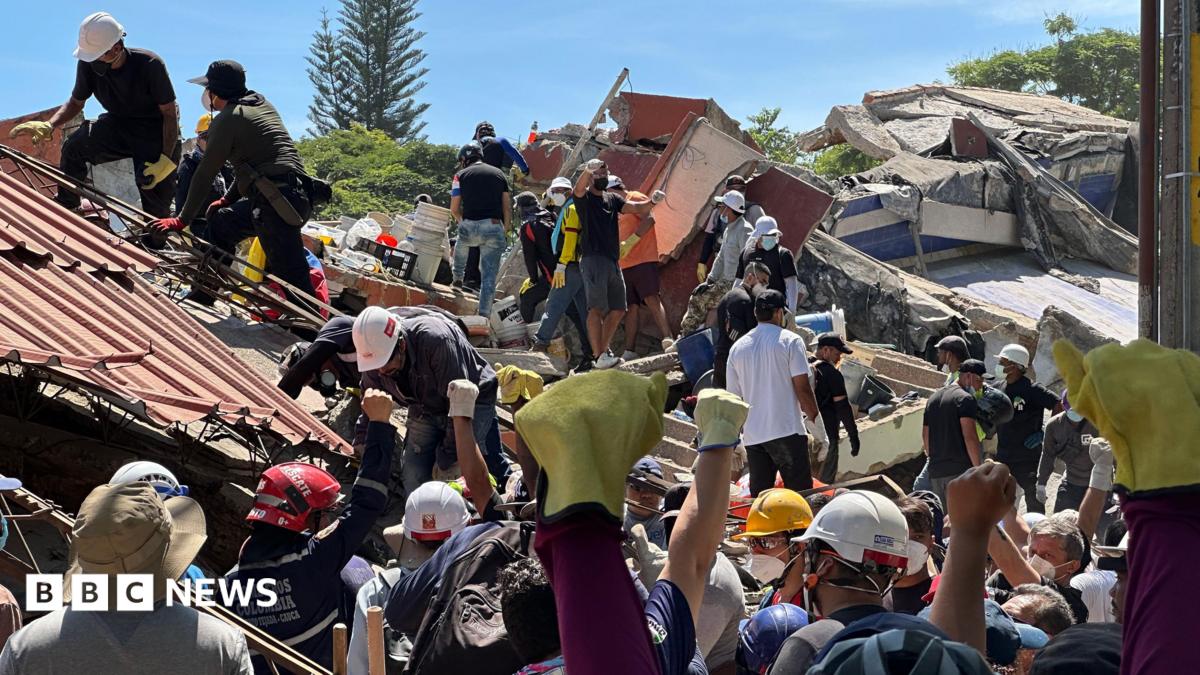
Efraín Gallego refuses to give up hope that his brother will be found alive, even as he speaks of him buried beneath the rubble of a collapsed building, his voice cracking with emotion. "You feel anguish. Every time there is an alert about someone being alive, hope is reborn that we will find him," Gallego tells us, his composure hanging by a thread.
His 80-year-old brother and sister-in-law were trapped when the Torres del Limonar building collapsed in Cali, a city in south-western Colombia that took the brunt of the earthquake. The building has become a grim monument to the tragedy in the country's third-largest city, home to over two million people. Mayor Alejandro Éder reports at least 95 dead.
Under a Tuesday morning sun that seemed personally offended, Torres del Limonar is a shattered mountain of concrete, with mattresses and furniture poking out like guilty secrets. Rescuers and volunteers crawl over the wreckage, chanting the mantra: "Silence! We are firefighters. If you can hear us, shout or make any noise." Every time they dig deep enough to imagine a survivor, hope flares - but the seconds tick by, and the rubble remains silent.
The building is one of more than 50 that collapsed in Cali, located in the Capri neighborhood. The four-story structure held dozens of apartments, though the exact number of occupants at collapse time is anyone's guess. Around it, other buildings stand awkwardly intact, save for a few cracks, as if embarrassed to have escaped the same fate.
Rescuers, military personnel, volunteers, paramedics, firefighters, humanitarian workers, and journalists have descended on the site, with over 100 people anxiously awaiting news. As of Monday night, Mayor Éder estimated 25 people were trapped. A nighttime curfew was declared to speed up rescue operations. The night passed; excavations continue. One rescuer says about 10 people have been pulled out alive since the collapse, while local media reports speak of six survivors, including an infant just a few months old. In the midst of tragedy, numbers are more like estimates than hard facts.
"What I can tell you is that right now there are at least two people detected alive. Tunnels are being made to get them out. One of them has to have his leg freed," rescuer James Velasco tells us.
The magnitude 7.4 earthquake that struck Colombia on Monday, 10 August, is the worst this century, according to the National Geological Service. Beyond Cali, it left destruction and death in regions like Chocó in the north-west.
Around the remains of Torres del Limonar, many residents choose silence, visibly shaken. Some sleep on the ground or on a sofa dragged into the street; others huddle in the shade for support. The hours stretch, and the anguish grows.
"In the past I have participated in operations where we have pulled out survivors after seven days trapped," a rescuer says. "Those who are meant to survive, survive. Nothing is written."
Amid his own torment, Gallego finds time to praise the efforts of ordinary citizens: "We must mention all the people who have come to help with water, supplies, tools, equipment; there is a lot of collaboration. Volunteers are plentiful."
Alejandro Mahecha, 19, is one such volunteer. After spending the night safely with his family, he decided to act: "I wanted to help from the very beginning. The earthquake affected my city and the homes of people I know. I came to this site because there has been a lot of talk about this building and the need for help here."
With friends, Mahecha helps remove rubble, brings water to rescuers, and clears streets for evacuation. Hammers and saws create escape routes through the destruction, but work halts whenever arms are raised - a signal for absolute silence. Gallego waits. This time, again, there is no news of his brother.