
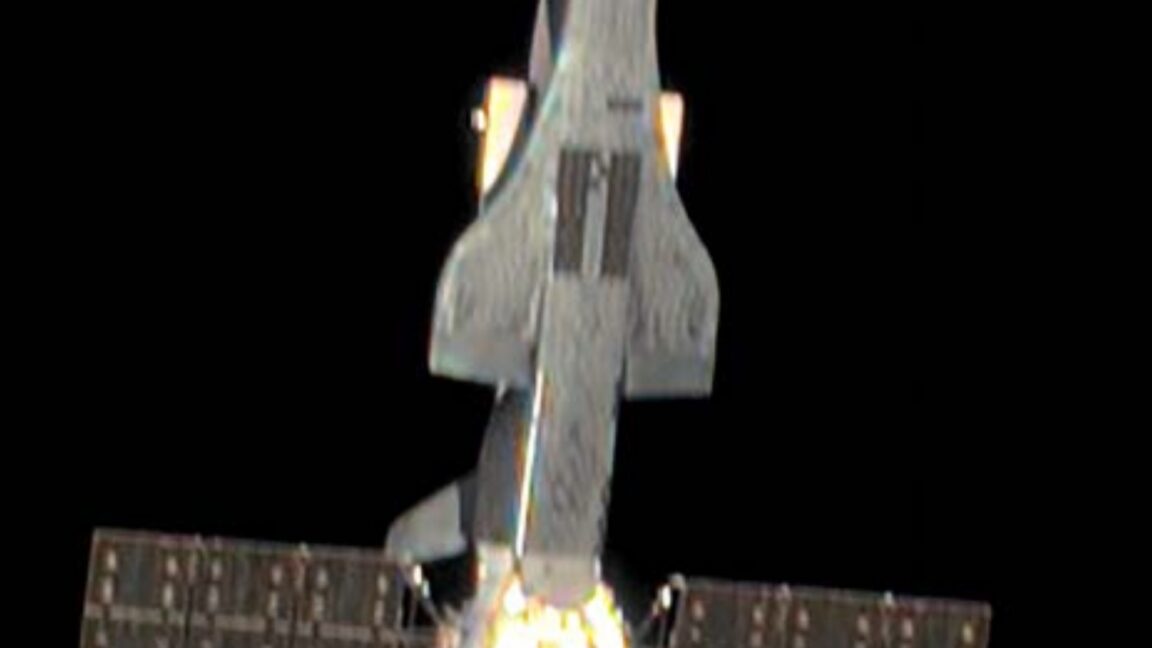
A Chinese spaceplane that bears a striking resemblance to the US military's X-37B was photographed in orbit by a passing US-owned commercial satellite in 2024, and we finally have the image. Because nothing says "top secret" like a spacecraft that can be spotted by a camera phone with a really good zoom lens.
The Chinese spaceplane has delta wings, payload bay doors, a dark heat shield, and a rear-mounted service module with power-generating solar arrays. In other words, the design is, to a great degree, a copy of the X-37B spaceplane flown by the US Space Force. Imitation, as they say, is the sincerest form of flattery - and also the most legally ambiguous.
The photo was taken by a commercial imaging satellite owned by a company called Vantor, known as Maxar in 2024. Vantor is one of several companies that provide reconnaissance imagery of locations around the world to the US military and US intelligence agencies. The same Earth-imaging satellites can point their telescopes at objects in space, which is either reassuring or terrifying depending on how much you enjoy the idea of being watched from above.
Lower-resolution views of a Chinese spaceplane showing the vehicle's general shape were publicly available before the DIA assessment. A US Space Force official revealed Maxar's observation at a 2024 conference in South Korea, but the Pentagon did not release the full-resolution image to the public until Monday, when it appeared in an unclassified Defense Intelligence Agency assessment of threats to the United States in space. Because nothing declassifies a photo faster than someone else already having it.
The DIA report doesn't reveal much new about what the Chinese spaceplane does in orbit. China has launched four spaceplane missions since 2020 with durations of up to nine months. The fourth mission is in orbit today after launching in February. It is not publicly known whether China has one or more such spaceplanes in its inventory - which is exactly the kind of mystery that keeps defense analysts up at night and everyone else mildly curious.
The Space Force has two X-37Bs flying in rotation, with the longest of their eight missions to date running two-and-a-half years from launch until landing. US officials have released photos of the X-37B vehicles, published information about their design and dimensions, and disclosed a handful of experiments they have carried into orbit. Most of the X-37B's activities in space are classified, because of course they are.
Like the X-37B, China's spaceplane lifts off inside the payload shroud of a conventional rocket, then operates as a satellite once in orbit. The spaceplane flies like a miniature unpiloted version of NASA's Space Shuttle and reenters the atmosphere for an autonomous land runway landing at the end of each mission. Ground teams then refurbish it for another flight. It's essentially a reusable shuttle bus, minus the passengers and the complaints about legroom.
The "enhanced maneuverability" of spaceplanes make them "more suitable for certain missions than traditional satellites," the DIA said in its report. So far, the Chinese spaceplane has only flown in low-Earth orbit (LEO) at an altitude of a few hundred miles. One of the Space Force's X-37B flights soared to an altitude of more than 24,000 miles before using aerobraking to set up for reentry and landing. Because if you're going to have a secret spaceplane, you might as well send it really far away.
Spaceplanes like China's and the X-37B can also deploy small satellites from their cargo bay. Most recently, China demonstrated an ability to catch an object in orbit, perhaps using a robotic arm. The vehicle now in space released a sub-satellite in June and recaptured it in July, then did the same thing again in August and September, according to an analysis of open source orbital tracking data by Jonathan McDowell, an astrophysicist who catalogs spaceflight activity. It's like a game of catch, but with multimillion-dollar hardware and significantly higher stakes.
The official name of the Chinese spaceplane is even a mystery. It is often called Shenlong in Western publications, citing reports from the 2000s about China's development of a robotic spaceplane. Chinese state media only refer to the vehicle as Chongfu Shiyong Shiyan Hangtian Qi, or CSSHQ, which means reusable experimental spacecraft, according to a fact sheet published by the Secure World Foundation. Because nothing says "transparency" like an acronym that sounds like a sneeze.
The DIA did not disclose the exact circumstances of Maxar's observation of the Chinese spaceplane, such as its timing, location, or distance, but Earth observations often use cameras to view other objects in space as their orbits intersect, an emerging field known as non-Earth imaging (NEI). Which is a fancy way of saying "we pointed our camera at their camera and took a picture."
NEI allows commercial operators and government analysts to inspect satellites. This is especially useful for gleaning information about classified or proprietary satellite designs, extending a new avenue for international and corporate espionage to the high frontier. Because why should espionage be limited to Earth when there's a whole universe out there?
The capability exhibited by Maxar and other commercial companies in the NEI field is distinct from the recent actions of some military spacecraft, such as Russia's Kosmos 2612, which deliberately maneuvered to approach a US-registered radar imaging satellite earlier this month. Commercial NEI observations come from chance encounters, often at extremely high speed. So it's less "aggressive stalking" and more "accidental photobombing."
The DIA's assessment of space threats includes an update on China's pursuit of anti-satellite technology, or "counterspace" weapons. The intelligence agency reported the Chinese military likely considers directed-energy weapons (DEWs) "ideal counterspace systems" because they can be used to permanently or temporarily disable a satellite. One potential use for lasers in space would be to dazzle a sensor on an adversary's satellite. Because nothing says "diplomacy" like a laser to the lens.
"China has multiple ground-based laser weapons with varying power levels to disrupt, degrade, or damage satellites in LEO," the DIA said. "By the late 2020s, China may field space-based directed energy systems and higher-powered ground-based directed energy systems capable of threatening satellites in higher orbits." So, you know, something to look forward to.
The DIA noted China's testing of ground-based anti-satellite missiles and the country's historic demonstration last year of satellite refueling in geosynchronous orbit, a regime some 22,000 miles (36,000 kilometers) over the equator, something no other country has achieved above LEO. China has also tested a robotic arm that could snag a spacecraft out of orbit, and now operates a growing fleet of satellites called TJS that routinely approach foreign spacecraft. Because apparently, space is the new neighborhood where everyone wants to know what everyone else is doing.
The US Space Force also has a constellation of inspector satellites in geosynchronous orbit and recently procured more that could be refueled, overcoming maneuverability limitations. Air Force Secretary Troy Meink revealed last month that the Pentagon has fielded weapons in space, making the United States the first nation to acknowledge possession of orbital weapons. Because if you're going to have a secret spaceplane, you might as well have the weapons to go with it.
Russia is pursuing its own orbital combat program, which includes an ambition to deploy a nuclear weapon in space, according to US intelligence officials. Because nothing says "global stability" like a nuclear weapon in orbit.
A more conventional Russian weapons system, known as Nivelir, is designed to fire projectiles from one satellite to smash into another. The Russian military simulated an attack using the Nivelir system in 2020. In April, Russia launched a fleet of small satellites into an orbit close to a commercial radar remote sensing satellite owned by ICEYE that provides reconnaissance imagery to Ukraine. One of the Russian satellites moved within "tens of meters" of the ICEYE satellite earlier this month before backing away, US officials said. It's like a game of chicken, but with satellites and international incident potential.