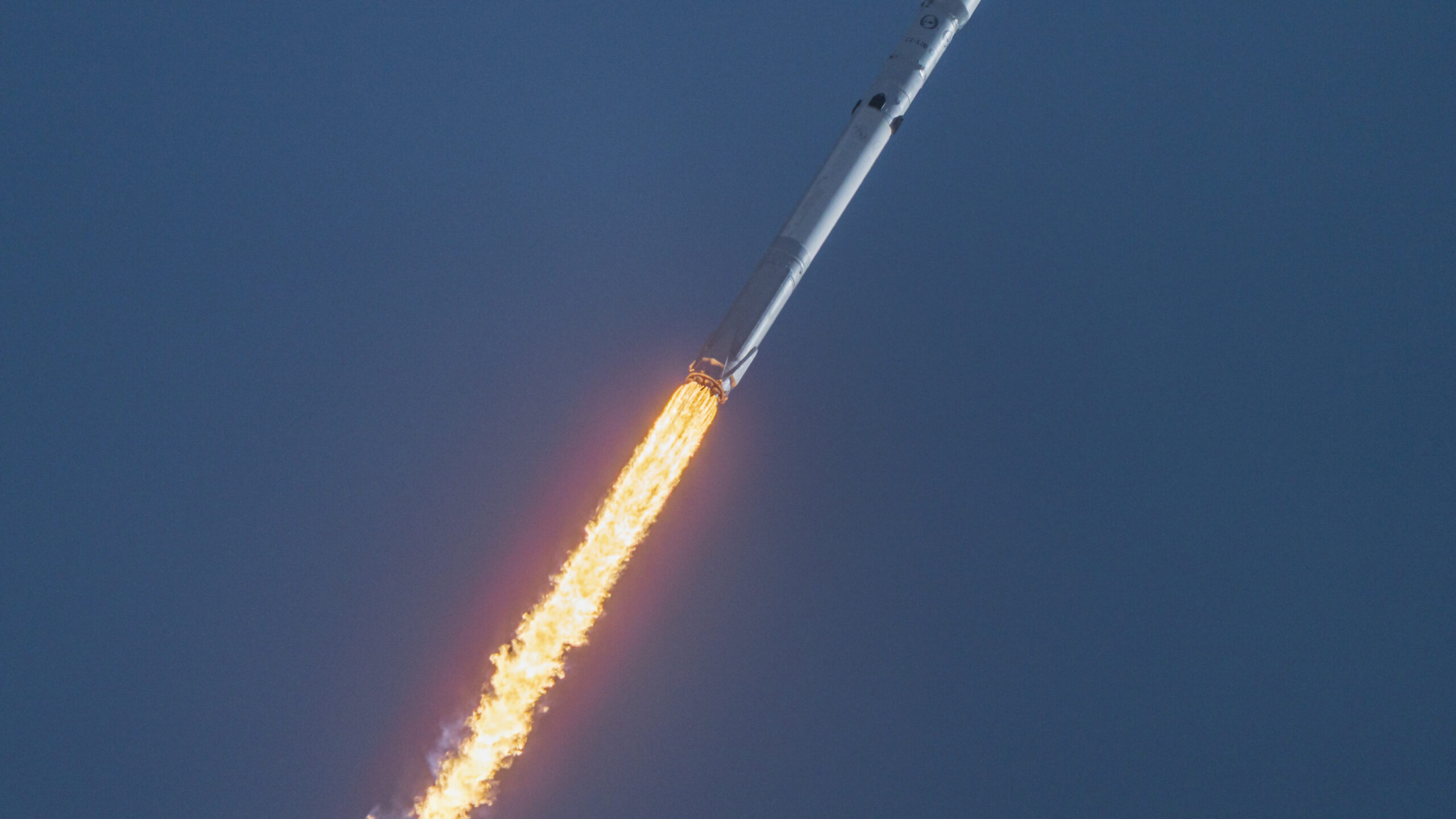
China has a new big reusable rocket, and it just sort of showed up without much fanfare - because apparently, advance notice is for amateurs. The Long March 12B, the largest and most powerful reusable rocket China has launched to date, lifted off Monday from a remote pad in the Gobi Desert at 4:40 pm Beijing time (08:40 UTC). Unusually, Chinese officials didn't announce the launch in advance or issue the customary flight path warnings for pilots. Whether this is a one-off or a new policy of "surprise, we're in space" remains unclear. Russia has been doing a similar thing by issuing vague multi-day warnings, so maybe it's a trend.
The Long March 12B is the latest entry in China's increasingly crowded reusable rocket race - a competition that is far less predictable than the U.S. version, where SpaceX landed a Falcon 9 booster in 2015 and took nearly 10 years for anyone else to catch up. In China, several companies and state-owned enterprises have a realistic shot at landing an orbital-class booster this year. Monday's launch didn't include a landing attempt, but the rocket carried grid fins and landing legs - the hardware equivalent of packing a parachute but not jumping out of the plane yet.
The rocket was developed by China Commercial Rocket Co. Ltd. (CACL), an opaque state-backed venture, and engineers reportedly designed and built it in just 21 months - a timeline that sounds impressive unless you consider that's about how long it takes some people to renovate a bathroom. The Long March 12B uses nine kerosene-fueled main engines on its first stage and a single engine on the second, generating 1.7 million pounds of thrust at liftoff - same as SpaceX's Falcon 9. In expendable mode, it can deliver about 20 metric tons to low-Earth orbit, slightly less than Falcon 9's 23 metric tons, but who's counting?
The launch carried a batch of Qianfan broadband satellites into low-Earth orbit, part of China's attempt to build its own Starlink-like mega-constellation. The Long March rocket family dates back to 1970, when China launched its first satellite using a vehicle derived from ballistic missiles - because everything old is new again, including rocket designs. The Long March 12B joins a confusing family that now includes three dissimilar designs: the original expendable Long March 12, the partially reusable methane-powered 12A, and now the kerosene-powered 12B. It's like a family reunion where nobody looks alike.
China's rocket programs - run by state-owned entities like CASC, SAST, CACL, and the venerable China Academy of Launch Vehicle Technology - bear a striking resemblance to SpaceX's creations. The Long March 9 is supposed to be China's answer to Starship, while the Long March 10 is being readied to send astronauts to the Moon. A suborbital version of the Long March 10 made a controlled splashdown in February, because apparently, even fake moon missions need practice.
As for the reusable rocket race, China's first two attempts to recover heavy boosters failed in December. LandSpace's Zhuque 3 crashed near its landing zone, and the Long March 12A had a similar fizzle. Space Pioneer's Tianlong 3 failed to reach orbit on its first flight in April. But with the state-backed Long March 12B now in the mix, China's legacy players may have the advantage - because nothing says "fair competition" like unlimited government resources.
The Good Times
News in your inbox.
One sardonic roundup, delivered on your schedule. Free. Unsubscribe whenever your tolerance for wit runs out.
Already subscribed but we never reach your inbox? Check your spam folder and hit 'Not spam' (or 'Remove from spam') to bust us out of junk-mail purgatory. You'll be helping everyone else too.
Don't open any of our emails for a month and you'll be automatically removed from the mailing list.
Rewrite Article
Select parts to regenerate with a fresh AI pass. Translations will be updated automatically.
Generate AI Image
Creates a sardonic version of the article image using OpenAI.