
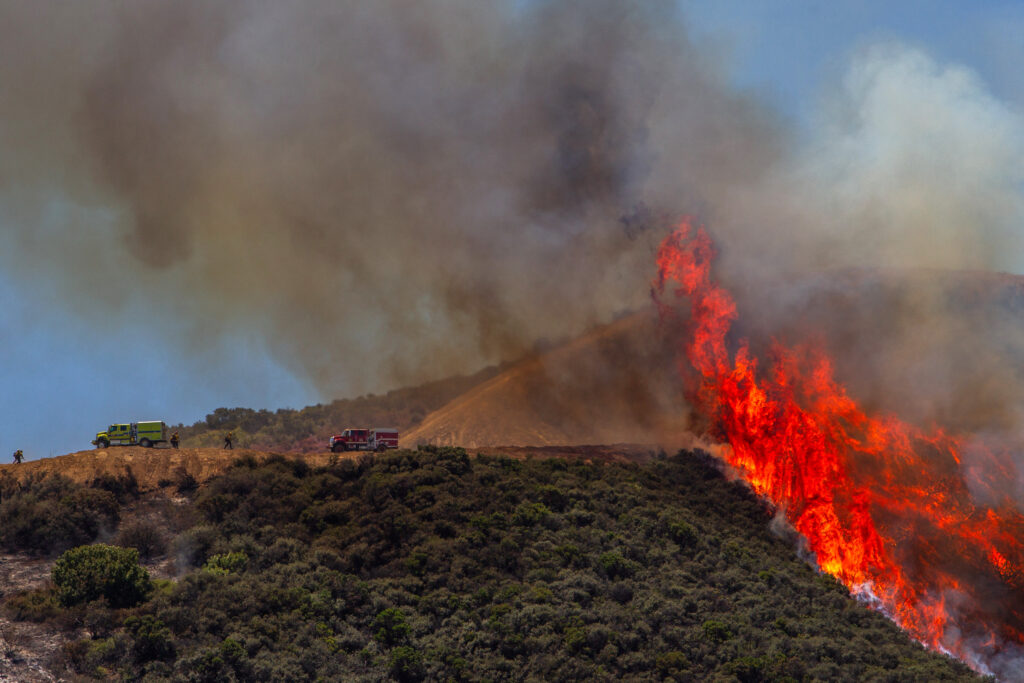
A Southern California wildfire is proving that even retired nuclear sites can't escape the drama of fire season. The Sandy Fire, currently burning its way through Ventura County, has crept within roughly a quarter-mile of the Santa Susana Field Laboratory (SSFL) - a former nuclear reactor and rocket testing site that, like that one relative at Thanksgiving, just won't stop being a source of concern.
Nuclear research at SSFL ended in 1988, rocket testing stopped in 2006, but the 2,800-acre complex - once jointly occupied by NASA, the Department of Energy, and Boeing, and owned by Boeing since 1996 - still harbors radioactive and chemical contamination. Because why clean up when you can just leave it for future generations to worry about?
As of Friday afternoon, the fire had swelled to over 2,100 acres and was 40% contained. The Ventura County Fire Department has deployed "hazardous materials and radiological monitoring teams" to track air quality, setting up air sampling locations in seven areas near the fire northwest of downtown Los Angeles. The Department of Energy is also lending a hand "out of an abundance of caution," which is government-speak for "we really hope this doesn't turn into a disaster."
So far, there's "no indication that any radiological material" has been released, according to Andrew Dowd, an engineer and spokesman for the Ventura County Fire Department. "The fire has not reached the Santa Susana Field Laboratory," he added, presumably while crossing his fingers.
Local residents, however, are less than reassured. SSFL is known for radiation concerns that have lingered for years without a finished cleanup - a situation that has sent families mixed signals about how worried they should be, especially given that the site was the scene of possibly one of the worst nuclear meltdowns in U.S. history. The Ventura County Air Pollution Control District said Friday it is "not aware of any confirmed off-site air quality impacts" specifically from SSFL amid the fire. A Boeing spokesman said the company is "continuing to coordinate with authorities responsible for fire control."
The fire at one point placed more than 33,000 people under evacuation orders, though some families left voluntarily - presumably because "near a burning nuclear site" is not in most vacation brochures.
Amy Marshall, a 27-year-old former resident now living in Thousand Oaks, remembers growing up hearing about the toxins at the lab site. "I definitely keep all the windows closed," she said. "We use tons of air filters in every room, and I don't go outside. If I have to go outside, I'll wear a mask or I'll go out to visit a family member up north to avoid the smoke." It's a lifestyle that blends pandemic-era habits with post-apocalyptic preparedness.
Radiation measurements from last year and modeling after the 2018 Woolsey Fire - which burned through 80% of the SSFL site - "continue to indicate that the extremely low levels of residual radioactive material at the site pose no risk to public health, even in the event wildfire activity reaches the area," the fire department said Thursday. But this time, shifting winds have put more people in the path of potentially contaminated smoke.
One former heavy equipment operator who worked with Ventura County Fire for decades noted the difference: "During the Woolsey fire, the wind was blowing straight out to sea the whole time. But this time with all the shifting winds … I don't know. So yeah, I'm really concerned."
An independent study after Woolsey, looking at 360 samples, found 3% contained radioactive particles traceable to SSFL. Another study, funded by Boeing, found no such contamination. Make of that what you will.
The SSFL cleanup plan still hasn't been finalized. Interim measures removed about 6,000 cubic yards of the most contaminated soil in 2024, but that cleanup was limited to a single area. The full remediation scope is still being decided by state and federal authorities and Boeing - a process that moves at the speed of bureaucracy.
Stephen Andrews, a 71-year-old retired construction supervisor living in Thousand Oaks, considers the Sandy Fire response progress compared to the Woolsey Fire, when he doesn't recall a publicly accessible air monitoring dashboard. "They are taking it seriously this time," he said, cautiously optimistic but still waiting for more action before fire season.
As the Sandy Fire continues, community members remain vigilant - because when a wildfire approaches a radioactive ghost town, vigilance is the least you can do.