California Declares Emergency Over Tank That Can't Decide Whether to Leak or Explode
California declares emergency as 7,000-gallon tank of volatile goo threatens to either spill or explode, leaving residents to wonder which outcome is worse.
California Governor Gavin Newsom has declared a state of emergency as crews battle a toxic chemical leak at a manufacturing facility in Orange County - because apparently, a single tank of volatile plastic-making goo is now the state's top priority.
A tank containing about 7,000 gallons of methyl methacrylate - a highly flammable substance used to make plastic - is at risk of failure, officials warned. Thousands of Garden Grove residents have been evacuated as a precaution, because nobody wants to be around when a tank decides between "spill" and "explosion."
Orange County Fire Authority division chief Craig Covey laid out the options with characteristic optimism: "Does it rupture and spill, or does it blow up?" On Sunday, officials confirmed they had found a "potential crack" in the tank - which, in fairness, might be relieving some pressure, or might be the prelude to a very bad day.
Firefighters sent a specialized team in the middle of the night on Saturday to investigate. Interim fire chief TJ McGovern reported they spotted a crack that "could potentially be relieving some of the pressure." Experts are now analyzing data, with McGovern promising "a lot more information coming today" - because nothing says reassurance like a wait-and-see approach.
The facility sits about 5 miles from Disneyland, which remains open and operational, presumably because Mickey Mouse is built different. The evacuation zone extends one mile from the plant, and schools have closed as a precaution. Several major road exits are shut to limit access, because traffic jams are the least of anyone's worries.
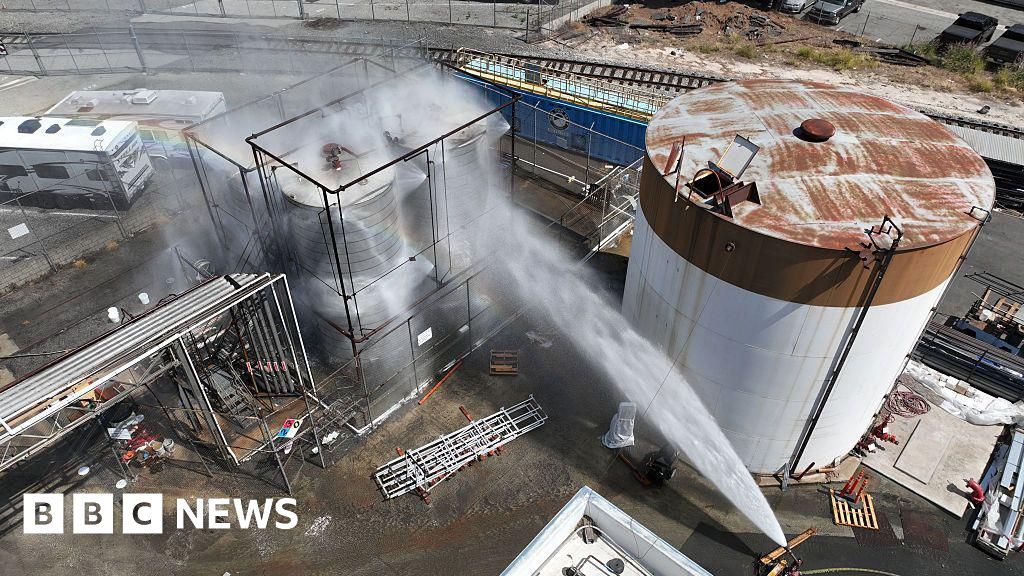
Emergency crews have been spraying the tank with water to stabilize its temperature, but an "inoperable valve" has created "additional operational challenges" - which is a polite way of saying things are getting worse. On Saturday, the tank's temperature hit 32C (90F) and was rising by about one degree Fahrenheit per hour. Officials initially thought they'd cooled it to 16C (61F) using drone readings, only to discover the internal temperature was much higher when they got close enough to read the gauge.
Covey expressed hope they could slow the chemical reactions causing the heat and pressure buildup, adding, "Letting this thing just fail and blow up is unacceptable to us." Officials are developing "very aggressive plans" for a worst-case scenario, including building dykes and dams to contain chemicals and prevent them from reaching storm drains or the ocean.
Orange County health officer Dr. Regina Chinsio-Kwong warned residents to watch for "a fruity and heavy smell" - which is not a new Yankee Candle scent. "Smelling it doesn't mean you've reached a level that causes symptoms. But we don't want you to smell that," she said. Inhaling the vapor can cause respiratory issues, eye irritation, and dizziness. Those outside the one-mile evacuation zone should be safe, she added.
Covey had earlier warned that the tank faces "literally two options left: the tank fails and spills... or, two, the tank goes into a thermal runaway and blows up." If it spills, "very bad chemicals" would leak into the parking area. If it blows up, it could affect nearby tanks containing fuel or other chemicals. "This is not precautionary," Covey said. "This thing is going to fail, and we don't know when."
Evacuee Mark Olsen told NBC LA he was woken by sirens and grabbed some stuff before heading to the Garden Grove Sports and Recreation Center. "Not knowing what would happen to the chemical plant, or when he could return home, was weighing on him," the report noted - because uncertainty about potential explosions tends to do that.
The facility is operated by GKN Aerospace, a UK-based company that supplies parts for aircraft. A spokesperson apologized to local residents, saying they are "fully focused on working with emergency services" to ensure safety - which is nice, but doesn't exactly help the tank make up its mind.
The Good Times
News in your inbox.
One sardonic roundup, delivered on your schedule. Free. Unsubscribe whenever your tolerance for wit runs out.
Already subscribed but we never reach your inbox? Check your spam folder and hit 'Not spam' (or 'Remove from spam') to bust us out of junk-mail purgatory. You'll be helping everyone else too.
Don't open any of our emails for a month and you'll be automatically removed from the mailing list.
Rewrite Article
Select parts to regenerate with a fresh AI pass. Translations will be updated automatically.
Generate AI Image
Creates a sardonic version of the article image using OpenAI.