America's Rural Lands Are Burning, and Apparently So Is the Usual Fire Narrative
Wildfires are torching rural America, and volunteer ranchers are fighting fires with Vietnam-era bulldozers while their own land and cows go up in smoke.
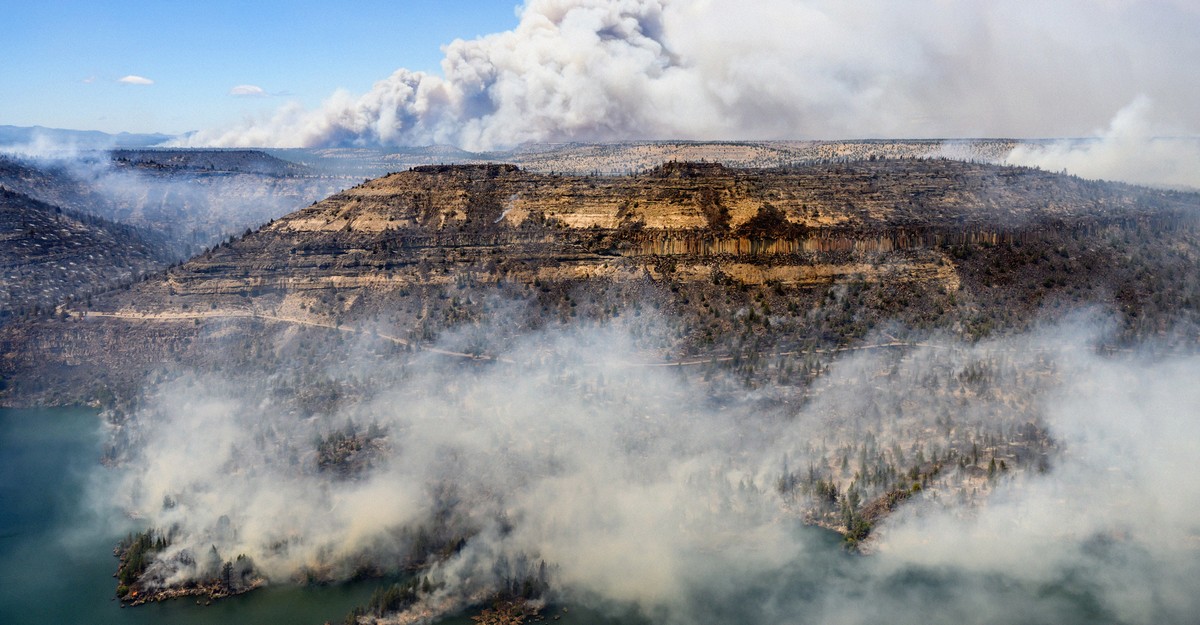
The summer of 2026 has been one for the record books, and not in the fun way. Europe has seen hundreds of thousands of acres scorched in France and Spain, homes destroyed across England, 13 people killed in Spain last month, and an elderly couple in Greece this past weekend. Canada has burned an area larger than Belgium - which, in a touch of cosmic irony, is also fighting its largest recorded wildfire. And in the United States, about 7.2 million acres have burned, the largest year-to-date area in a decade, nearly double this time last year, according to the National Interagency Coordination Center. Allison Rayburn, a program coordinator for the Oregon Department of Forestry, described eastern Oregon as a place where "you can barely see the sun" through the smoke: "It’s just devastation, and miles and miles and miles of blackened landscapes."
While European fires have menaced populated areas, the U.S. West is burning where the cows are. The Big Grass Fire near Jordan Valley, Oregon, has been blazing since July 23, ranking among the state's largest modern fires. It hopped a canyon into Idaho, making that state's air quality the worst in the nation. In Spokane, Washington, a fire complex flattened entire neighborhoods, while three other wildfires, each ten times bigger, rage elsewhere in the state.
Daniel Swain, a climate scientist at UC Agriculture and Natural Resources, notes the shift: "This is an extraordinary fire season in the American West. It just hasn’t been in California," the usual headline hog. Back-to-back lightning strikes, extreme heat, drought, and dry fuel left by a warm winter have fueled these fires. They've destroyed grazing land, killed livestock, and incinerated fruit just shy of harvest. Ranchers and officials compare 2026 to Oregon's 2024 season, when 1.9 million acres burned; this year, residents have already lost hundreds of thousands more. Dave Upthegrove, Washington's public lands commissioner, drove from Spokane to a fire near Walla Walla threatening the water supply, having just visited the 150,000-acre Sinlahekin Fire, where one side of a road was flat and black, the other wilting crops.
With fires on rugged terrain far from roads, elite "hotshot" firefighters rappelling from helicopters are in high demand but can't hit every blaze. Enter the Rangeland Fire Protection Associations (RFPAs) - about 40 volunteer nonprofits of ranchers and farmers trained by state and federal agencies, equipped largely with military surplus, including bulldozers that didn't go to Vietnam (and some that did, per Rayburn). Silas Skinner, a sixth-generation rancher, described government trucks at the Big Grass Fire, but the rest were RFPAs. Skinner and about 100 volunteers have been fighting that fire, which now spans sagebrush and juniper nearly the size of Luxembourg, using military trucks with water tanks.
Federal resources are stretched thin, diverted to populated areas like Spokane, so volunteers shoulder more than usual. Morgan Kromm and Tom Doman of the Crane, Oregon RFPA had just finished a 10-day stretch of 36-hour shifts - without sleep, Doman clarified. They've already handled 18 fires this year, normally an October total, with 90 more days of fire season left.
Fire seasons are longer and less predictable, complicating mutual-aid agreements. Oregon typically swaps help with Southwest and East Coast states, but "they’re busy with their own fires," said Michael Curran, Oregon's fire chief. RFPAs help each other while managing their own ranches. Skinner was moving cows with the fire burning above him. His grazing land has burned; other ranchers have lost cattle. In Jordan Valley, neighbors donate hay. Rayburn watched landowners rebuild fences and herds after 2024's devastation, only to see it burn again - land that families have worked for generations, and on which their livelihoods depend.
The Good Times
News in your inbox.
One sardonic roundup, delivered on your schedule. Free. Unsubscribe whenever your tolerance for wit runs out.
Already subscribed but we never reach your inbox? Check your spam folder and hit 'Not spam' (or 'Remove from spam') to bust us out of junk-mail purgatory. You'll be helping everyone else too.
Don't open any of our emails for a month and you'll be automatically removed from the mailing list.
Rewrite Article
Select parts to regenerate with a fresh AI pass. Translations will be updated automatically.
Generate AI Image
Creates a sardonic version of the article image using OpenAI.