
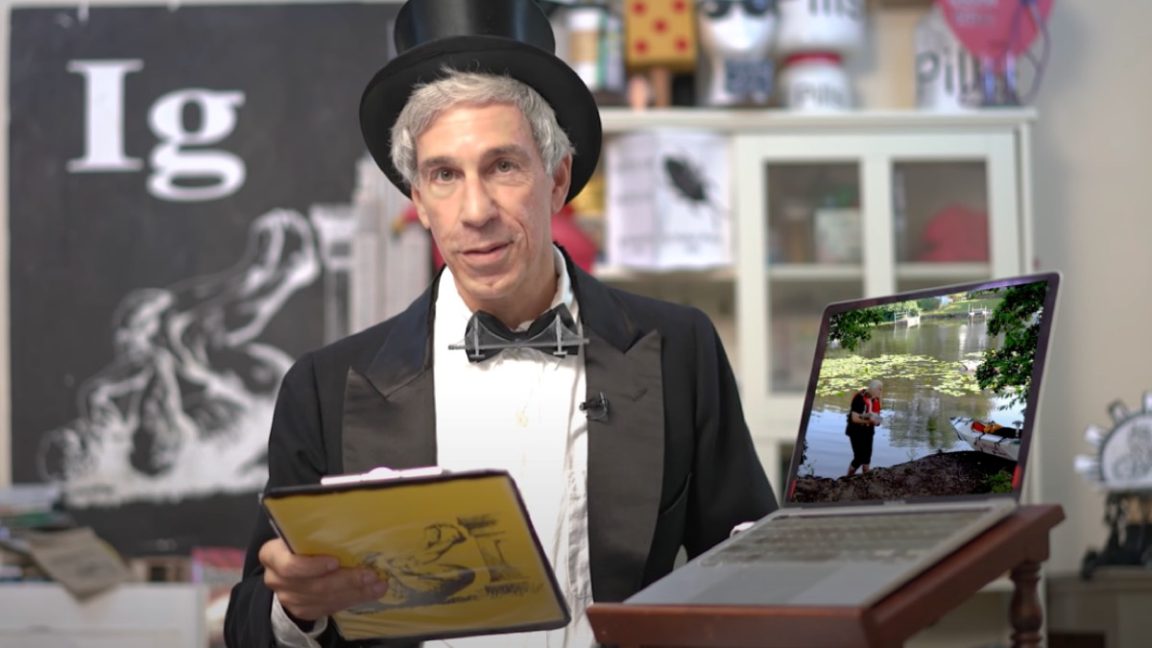
It’s that magical time of year again, when science’s most gloriously absurd achievements get their moment in the spotlight. The 2026 Ig Nobel Prizes have been announced, and this year’s winners include research on designing the perfect splash-free urinal, using mosquito proboscises to "necroprint" tiny nozzles, studying the decomposition rates of buried cotton underwear, and the aerodynamics of a healthy nose-blow. Because nothing says "scientific progress" like peeing without a mess and blowing your nose with precision.
The Ig Nobels, established in 1991, are a good-natured parody of the Nobel Prizes, honoring "achievements that first make people laugh and then make them think." The ceremony is gloriously campy, featuring miniature operas, scientific demos, and "24/7 lectures" where experts must explain their work twice: once in 24 seconds, and once in just seven words. Acceptance speeches are capped at 60 seconds, presumably to prevent anyone from taking themselves too seriously. And while the research may look ridiculous at first glance, it often has real scientific merit - as the winners will prove in free public talks posted on the Improbable Research website.
This year, the ceremony is leaving its longtime Boston home for Zurich, Switzerland, and will stay in European cities for the foreseeable future. Why? Concerns about the safety of international travelers, who are increasingly reluctant to visit the US. Four of last year’s 10 winners skipped the ceremony rather than travel to the US, and the situation hasn't improved. "During the past year, it has become unsafe for our guests to visit the country," said Marc Abrahams, master of ceremonies and editor of The Annals of Improbable Research, in March. "We cannot in good conscience ask the new winners, or the international journalists who cover the event, to travel to the US this year." Next year’s ceremony will be in Antwerp, Flanders, with Zurich hosting again in 2028 and every even-numbered year after. As Abrahams put it, "In that respect, it will be a little like the Eurovision Song Contest with a base in Europe."
Without further ado, here are the 2026 Ig Nobel laureates, who have made the world a slightly more ridiculous - and slightly more informed - place.
First up, Matilda Brindle, Catherine Talbot, and Stuart West win for devising a more precise definition of kissing: "non-agonistic interactions involving directed, intraspecific, oral-oral contact with some movement of the lips/mouthparts and no food transfer" - applied to ants, birds, polar bears, and humans. You’d think defining a kiss would be simple, but previous attempts (like "protruded lips and suction movement") are too anthropocentric. The team prefers a definition that captures mouth-to-mouth contact across the animal kingdom, excluding things like mouth-to-mouth feeding or dogs licking their owners’ lips. With this definition, they found that most large apes engage in some form of kissing, though data on Afro-Eurasian monkeys and apes is lacking. Eastern gorillas, sadly, seem to have lost this evolutionary feature. And yes, our Neanderthal ancestors were likely kissing too. As for why kissing evolved, that’s future research, but there’s evidence it may increase mating success - and every species that kisses also practices premastication.
Next, Paul Piff, Daniel Stancato, Stéphane Côté, Rodolfo Mendoza-Denton, and Dacher Keltner win for amassing evidence that upper-class people are more likely to snatch from a children’s candy supply and engage in other unethical behavior. In seven related studies, they examined everything from whether upper-class drivers (judged by car type) cut off other vehicles or pedestrians, to whether lab subjects helped themselves to candies meant for children. Over and over, upper-class participants were more likely to cut off cars or pedestrians, take candy from metaphorical babies, lie about dice rolls, and view greed positively. Of course, there are exceptions - philanthropic billionaires do exist - but the data suggest "the pursuit of self-interest is a more fundamental motive among society’s elite." Shocking, we know.
Then there’s the team of Sanchari Banerjee, Nathan Coussens, François-Xavier Gallat, Nitish Sathyanarayanan, Jandhyam Srikanth, Koichiro Yagi, James Gray, Stephen Tobe, Barbara Stay, Leonard Chavas, and Subramanian Ramaswamy, who discovered that milk proteins from viviparous cockroaches pack three times as much energy as those from cows. Yes, there’s a cockroach species (Diploptera punctata) that produces milk to nourish its embryos - a process called viviparity. The embryos initially use yolk, then gorge on protein-rich liquid milk secreted by the brood sac, which crystallizes in their guts. The researchers extracted these crystals, used X-ray diffraction and free-electron lasers to determine their structure, and found that one crystal has more than three times the energy of an equivalent amount of dairy milk, thanks to its tightly packed crystalline lattice. This allows a constant supply of complete nutrients - yet another reason cockroaches will inherit the Earth.
The late Tokuji Unno wins for his study "How to Blow the Nose - An Aerodynamic Study of the Nose Blowing." The study is mostly in Japanese, and the abstract lacks details, but Unno was interested in cultural differences between Europeans and Japanese nose-blowing habits and wanted to "give good instructions to those who do not understand how to blow the nose." It’s a noble goal, as incorrect or over-enthusiastic nose-blowing can lead to sinus infections - and in one memorable case, a woman fractured her left eye socket. Unno used pneumotachometers to measure the velocity, volume, and time of blowing through each nostril over 60 trials, plus a balloon catheter to monitor ear canal pressure. He concluded that faster "expiratory thrust" expels mucus more efficiently, and that pressure changes weren’t high enough to risk ear infection. His advice: "a big and long nose blow is therefore recommended to prevent upper and lower respiratory tract diseases."
João Miguel Alves-Nunes, Adriano Fellone, Selma Maria Almeida-Santos, Carlos Roberto de Medeiros, Ivan Sazima, and Otavio Augusto Vuolo Marques win for gently stepping on various parts of venomous snakes - repeatedly, at various temperatures and times of day - to learn what does and doesn’t induce a bite. Snakebites are painful and potentially fatal, so understanding what triggers them is valuable. The team focused on Bothrops jararaca, a pit viper native to São Paulo, Brazil, and staged 75 confrontations, stepping on heads, mid-bodies, and tails while wearing safety boots. They found that snakes are more likely to bite during the day, in warmer temperatures, and if stepped on the head. Young females and smaller males are also more bite-prone. These findings align with epidemiological data on snakebites in the region.
Randy Hurd, Zhao Pan, Tadd Truscott, and Kaveeshan Thurairajah win for theoretical and experimental attempts to design a splash-free urinal. Their creation, the Nautilus (aka the "Nauti-loo"), was first teased in 2022 and formally published in PNAS Nexus in 2025. The key is the angle at which the urine stream hits the surface: a small enough angle prevents splashback, allowing smooth flow instead of droplets. (There’s a critical threshold between splashing and flowing - phase transitions are everywhere, even in public restrooms.) Dogs have already mastered this angle when lifting their legs, and the team pegged the optimal angle for humans at 30 degrees. They designed a curved, nautilus-shell-shaped urinal to provide this angle for men of various heights, and in simulated tests, not a single droplet splashed back. In comparison, other designs... well, let’s just say they didn’t fare as well.
And finally, in a posthumous tribute, the late Tokuji Unno’s study on nose-blowing aerodynamics (already covered above) reminds us that even the most mundane bodily functions can be a subject of rigorous scientific inquiry. The Ig Nobels continue to celebrate research that makes us laugh, then think - and occasionally, makes us appreciate the absurdity of human existence.
In the weeks following the ceremony, winners will give free public talks, which will be posted on the Improbable Research website. So if you’re curious about cockroach milk or the physics of peeing, there’s a lecture for you. And who knows - maybe next year’s winners will finally figure out why we can’t seem to keep our socks from disappearing in the laundry.