
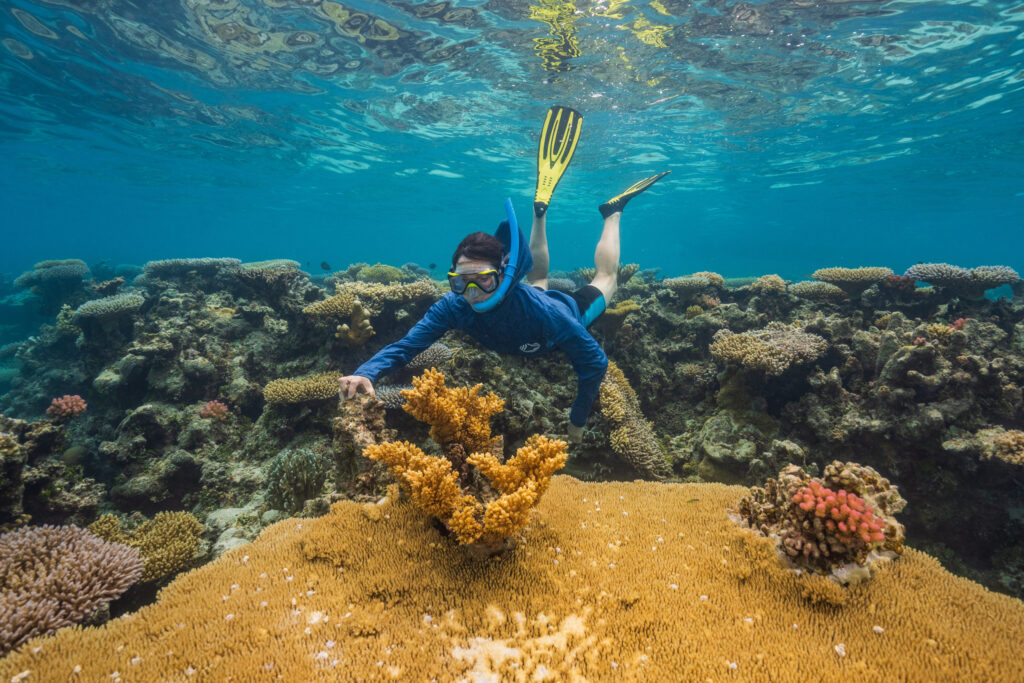
MAJURO, Marshall Islands - Perched on the bow of an aluminum landing craft, Anne Cohen gazed a few yards ahead toward a yellow robot gliding across the emerald Majuro lagoon. The unmanned surface vehicle, Yellowfin, was quickly becoming the coral researcher's most dependable dive buddy. "She's the best dive buddy," said Cohen, a tenured scientist at the Woods Hole Oceanographic Institution. Programmed to navigate precise coordinates, the robot cut through small swells like a tiny sailboat without a mast, directing Cohen toward a destination she had traveled thousands of miles to revisit. When the robot paused, hovering in place, Cohen recognized her cue: somewhere below should be a patch of reef she'd been observing, and she was eager to see how it was faring. Each visit carried a growing weight of uncertainty.
Since 2023, record-breaking marine heat waves have swept through the tropics, fueling the most severe global coral bleaching event ever recorded. More than 80 percent of the world's reefs have been impacted in at least 83 countries and territories. Corals have been so stressed by the extreme temperatures, they've expelled the tiny algae living inside their tissues that provide them with food and their brilliant hues, leaving them pale, ghostly and struggling to survive. Many have not recovered. Cohen hoped the reef beneath her might be different.
She yanked on her black and yellow snorkel fins, spit into her mask so it wouldn't fog underwater and slid off the boat. Within seconds of peering into the blue, she let out a squeal muffled by her snorkel. Towering pinnacles of chestnut-colored tabletop corals rose from the sandy seafloor like trees, their broad plate-like canopies sheltering fish. Dense thickets of staghorn corals stretched in every direction, their golden antler-like branches twisting across a sprawling reef bursting with shades of mustard yellow, pink and lavender pastels. "It's like a wonderland," Cohen said, popping her head above the surface. "I feel like Alice."
In today's oceans, the scene felt almost surreal, said Cohen, 62, who has spent the last 30 years studying coral reefs and climate change impacts. But it confirmed something she had long believed: even as hotter temperatures devastate coral reefs, some still possess an extraordinary ability to endure. Over the last decade, a significant part of Cohen's research has focused on tracking down these reefs that are somehow defying the odds. In 2018, she started a project called Super Reefs, named after reefs she'd encountered that seemed to thrive while others bleached or died. Three years later she launched a joint global initiative with The Nature Conservancy and Stanford University aimed at finding and protecting heat-tolerant communities.
Even the hardiest of reefs are not invincible, she said. Coastal development, agricultural runoff, sewage, plastic pollution, bottom trawling and dynamite fishing all pose threats. "That would be like taking a sledgehammer to crush a hermit crab," Cohen said. Already, the world has lost more than half of its coral reefs to climate change and other human activity. Some scientists warn that without significant intervention, more than 90 percent of tropical reefs could disappear in the next 25 years.
The goal of the Super Reefs initiative was to identify coral strongholds in places where governments had already demonstrated interest in creating marine-protected areas. Belize, Hawaii and the Marshall Islands fit the bill. "There are so many potential super reefs out there that we don't even know exist. We have to go find them," Cohen said. By definition, super reefs must have scientifically proven capabilities of surviving hotter temperatures over time, either through genetic adaptation or local ocean conditions like cooler currents, and they must be able to potentially reseed other reefs.
In the Marshall Islands, Cohen hopes some of these reefs might become part of something larger: a vast network of protected super reefs spanning multiple Pacific island nations, linked by ocean currents so their offspring could replenish reefs throughout the region. "We want to create the first 'super reef blue corridor' across millions of square kilometers of ocean, connecting the Marshall Islands, Kiribati and Tuvalu," she said.
In April, Cohen visited the Marshall Islands to pitch her idea and test new technology to accelerate the search for super reefs. It was her seventh trip to the Pacific nation made up of 29 low-lying atolls and five islands. Each visit, she was struck by how intimately the Marshallese peoples' lives are connected to coral. "Everything that you see, all the sand, all the land, is all made of coral," Cohen said. "We wouldn't be here without it."
A 2021 World Bank analysis shows 40 percent of existing buildings in Majuro are endangered by rising sea levels driven by global warming. "We're the first to go with the sea level rise," said Anthony M. Muller, the Marshall Islands' minister of natural resources and commerce. For the Marshallese people, losing coral reefs is deeply unsettling, said Dua Rudolph, deputy director of the Marshall Islands Conservation Society. The majority rely on fishing for subsistence or livelihoods, and those fish depend on the reefs. "When the reef leaves, the fish leave also," Rudolph said. "People are going to start going hungry."
When Cohen first reached out about working together to find and protect coral refugia defying bleaching trends, Rudolph thought it sounded almost too good to be true - practically a "fairy tale." It felt like an opportunity to "fight back" the "one big enemy that we've all been facing." To begin searching for Majuro's super reefs, Cohen worked with Woods Hole oceanographers Weifeng Zhang and Yan Jia to build a computer model simulating a decade's worth of temperatures, currents and wave energy throughout the atoll's lagoon, pinpointing Majuro's hottest waters. To test the model, Rudolph's team deployed underwater temperature loggers and current sensors on reefs throughout the lagoon. One site stood out just offshore a community named Laura, where water temperature appeared to run nearly two degrees hotter than much of the rest of the capital. Then Rudolph's team collected samples from a variety of coral species at each site to test for heat tolerance.