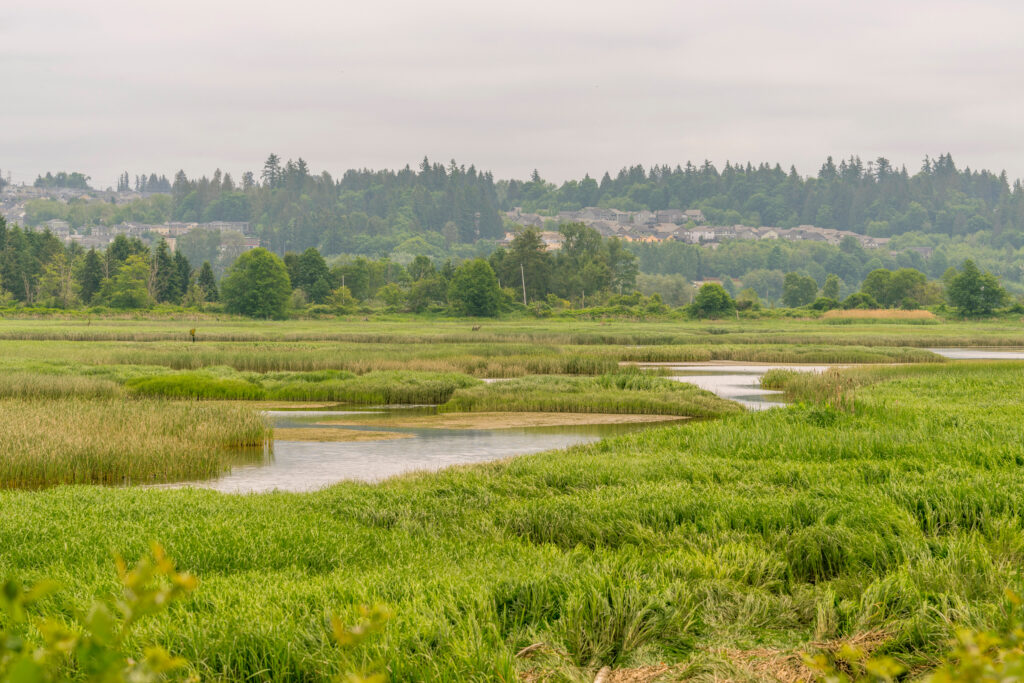
Washington State Scientists Deploy AI to Find Wetlands That Federal Government Has Decided Don't Exist
While federal protections shrink, Washington state uses AI to find the wetlands the government can't see - because apparently, if a wetland dries up in the summer and no one is around to regulate it, it doesn't exist.
As the United States continues its proud tradition of defining environmental protections out of existence, Washington state has decided to take matters into its own hands - or rather, into its algorithms. While federal courts and agencies have been busy making wetlands legally disappear, a coalition of scientists, academics, and local officials have developed an AI-powered tool to find the soggy spots that the government has decided aren't worth protecting.
The trouble started in earnest with the 2023 Supreme Court decision in Sackett v. EPA, which limited federal protections to wetlands with "continuous surface connections" to larger bodies of water. Then, in November 2025, the EPA under Administrator Lee Zeldin clarified that to mean wetlands that have surface water during the local "wet season" or that physically touch a year-round waterway. The result: tens of millions of acres of wetlands suddenly became legally invisible. "Democrat Administrations have weaponized the definition of navigable waters to seize more power from American farmers, landowners, entrepreneurs, and families," Zeldin said in a press release, apparently unaware that the weapon in question was a dictionary.
But in Washington state, many of the same stakeholders Zeldin described seem more interested in preserving wetlands than in fighting about what to call them. The problem, explained Amy Yahnke, senior wetlands scientist at the Washington Department of Ecology, is that you can't protect a wetland if you don't know it exists. "We needed a better way to identify wetlands in forested areas," she said, particularly in places where water bodies could lose federal protections before anyone even notices they're there.
Climate change isn't helping. In eastern Washington, said Meghan Halabisky, a University of Washington researcher and chief scientist at Tealwaters, "we expect to see wetter, warmer winters; hotter, drier summers." That means even the soggiest wetlands could dry up earlier in the summer, making them even harder to spot - and even less likely to meet the federal definition of a wetland.
Enter the Wetland Intrinsic Potential (WIP) tool, developed by Halabisky and Dan Miller, a geomorphologist at TerrainWorks. The tool uses machine learning trained on known wetland locations, combined with geospatial data about slope, concavity, and greenness, to calculate the probability - from zero to one hundred percent - that any given patch of ground is a wetland. It can even uncover "cryptic wetlands" hidden under dense tree canopies in western Washington or masquerading as dry dirt in the semi-arid east.
The WIP tool is already being put to use across the state. In the Puget Sound region, cities like Tukwila have discovered new wetlands and updated old boundaries. In agricultural eastern Washington, the Voluntary Stewardship Program helps farmers and ranchers use the tool to identify wetlands on their property without fear of regulatory punishment. Jacob Taylor, who coordinates the program near Spokane County, noted that the National Wetlands Inventory only contains wetlands larger than half an acre - too coarse to be helpful for small farmers. "If a farmer has got a 300-acre farm, one good thing this tool can be used for is it helps identify, maybe, places that could or should function as a wetland," he said.
The tool might also help with Washington's housing crisis - the state has the third-highest number of unsheltered people in America. In Snohomish County, housing advocates have considered filling or draining wetlands to make room for new homes. Halabisky warns this is a bad idea: removing wetland features doesn't make the water go away. Running the WIP tool without vegetation data shows where water is likely to pool, revealing areas that might flood even if they're not in official flood zones. "I wouldn't want to build a house there," she said. "You might have a flooded basement, or there's going to be water issues."
Of course, the WIP tool has its limits. It relies on lidar observations, which are updated every five years in western Washington but only every ten years in the east. Still, for now, it's giving Washington a fighting chance to protect wetlands that the federal government has decided aren't worth the paperwork.
The Good Times
News in your inbox.
One sardonic roundup, delivered on your schedule. Free. Unsubscribe whenever your tolerance for wit runs out.
Already subscribed but we never reach your inbox? Check your spam folder and hit 'Not spam' (or 'Remove from spam') to bust us out of junk-mail purgatory. You'll be helping everyone else too.
Don't open any of our emails for a month and you'll be automatically removed from the mailing list.
Rewrite Article
Select parts to regenerate with a fresh AI pass. Translations will be updated automatically.
Generate AI Image
Creates a sardonic version of the article image using OpenAI.