
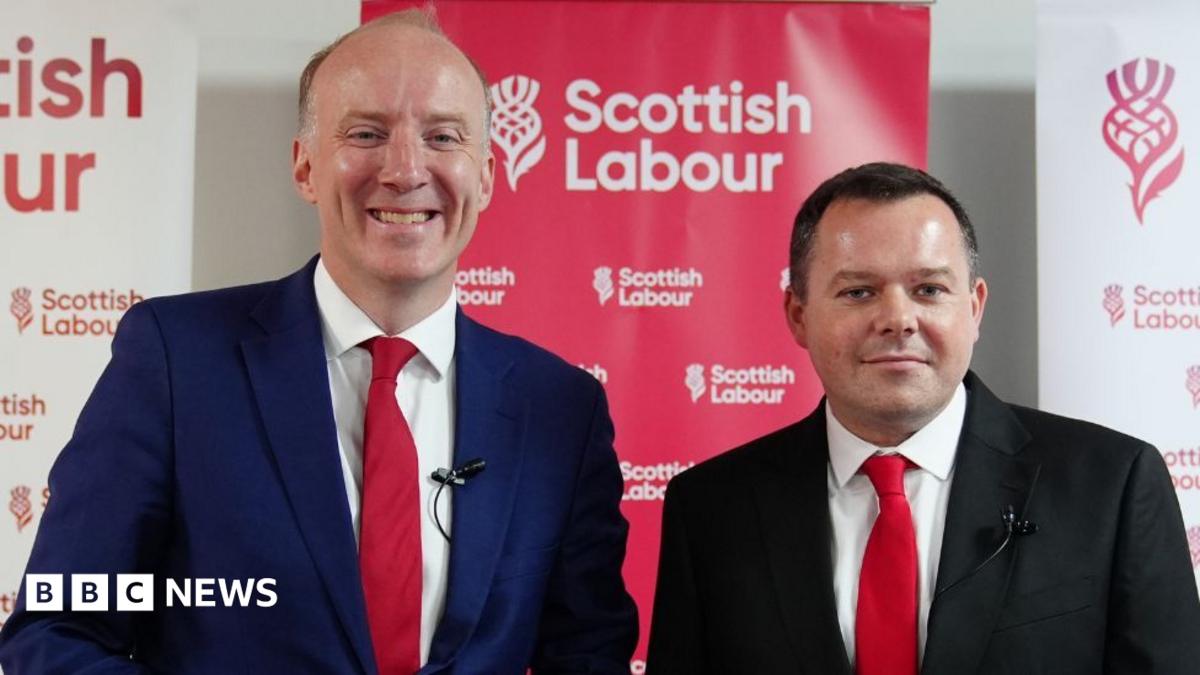
Wanted: one leader for Scottish Labour. Must enjoy long hours, complex trade-offs and difficult questions. That may not be the official job description for Scottish Labour leader, but it's perhaps not far from the truth. After all, Anas Sarwar described this gig as "the hardest job in British politics."
Despite this health warning, two candidates are on the ballot paper vying to take on the challenge: Michael Marra and Joe Fagan. I sat down with both of them for the Scotcast podcast to learn a bit about who they are, where they think Labour has gone wrong, and their prescription for fixing things.
We started with an ice-breaker: If they had to give a Ted Talk, what would their subject be? For Michael Marra, it was his beloved football team, Dundee United. Given they've just endured back-to-back 4-0 defeats, there's a joke here about the North East Labour MSP backing lost causes. Joe Fagan opted for a lecture on Cold War Berlin. And there was even a comparison about the "eerie resemblance" between Stasi HQ in East Germany and the office he occupied when he was the leader of South Lanarkshire Council.
But we weren't here to talk about DUFC's glory days or the fall of the wall. This was a conversation about everything that's been going on with Scottish Labour. The most newsworthy reflection probably came from Fagan, the South of Scotland MSP, who was critical of Sarwar's decision to leave Holyrood and take a place in the House of Lords. He wished Sarwar well on a personal level, but said it "wasn't a good look" for him to stop being a Glasgow MSP and head to Westminster's upper chamber. Fagan said that he would never personally take a seat in the Lords. And not just because he thinks the robes look "ridiculous." But he did concede that it would be difficult to turn down the offer of a ministerial post from the prime minister.
Michael Marra also had some criticisms of Anas Sarwar's approach as leader. He praised his work ethic and communication abilities, but said that the party had been too focused on Sarwar in the last five years. Privately other party figures have said that same - that the party's style was too "presidential" in recent years, rather than showcasing a team of spokespeople. Marra told me the party had "lost definition as to who the Labour Party is" and had become "too narrow in our leadership and the circle of influence around the leader."
A big question hanging over these interviews was what will the approach of these candidates be to independence? While Scottish Labour isn't going to support that sort of constitutional change any time soon (or perhaps ever), there are voices inside the party who argue it's time to engage with the debate around the grounds for a second referendum. But both Michael Marra and Joe Fagan don't have much time for this argument. Fagan said it would be "obvious" when the will of the Scottish people had changed, but we weren't at that point. He insisted that debates around the process for independence was a relic of the "Sturgeon era," and that that period was now "history." Marra told me he wasn't clear how a trigger for a second referendum would work, arguing that people are more concerned with issues like the cost of living and the NHS.
This leadership contest has - somewhat unexpectedly - focussed on the issue of gender in recent days. When Glasgow MSP Monica Lennon failed to make the ballot, she released an explosive statement suggesting the other two had been "punching down on trans people." Both Marra and Fagan have rejected that accusation. But they both have strong views on the issue of gender reform. Remember, MSPs passed a bill in 2022 that would have made it easier for someone to change their legally recognised sex - so-called "self-ID." It was ultimately blocked by the UK government, a decision upheld in the courts. Labour MSPs at the time were whipped to support it. Some gave up their spokesperson positions in order to vote against. Marra came to a deal with Sarwar - he was allowed to abstain. But he told Scotcast he felt so strongly about the issue that he would've been willing to resign over it. Fagan wasn't in Holyrood at the time, but his view watching from outside was that Labour MSPs shouldn't have backed it.
When it came to the economic side of Scottish politics, both candidates expressed the view that some Scots - especially middle earners - are paying too much tax. But that doesn't necessarily mean cuts across the board. Fagan argued that there's a case for "widening" the tax base through some new approaches, such as environmental taxes. And Marra - whose professional background is in economics - said that he was willing to consider looking at a wealth tax. And when it comes to oil and gas both wannabee leaders think the UK government should go ahead with extracting at the Rosebank and Jackdaw fields.
Some in Labour were unhappy when Lennon didn't make the ballot for this contest, lamenting a lack of breadth in the contest. And they maybe have a point. It doesn't feel like Scottish Labour members are choosing between two radically different candidates here. This pair broadly agree on a lot. That being said, both Marra and Fagan seem thoughtful, eloquent and capable politicians. But the trajectory of Scottish Labour's Holyrood results make for grim reading - they've lost MSPs at every election since 1999. A once mighty political force in Scotland has just 17 MSPs now. It's a movement that requires a massive shot of adrenaline. It needs something that can win back its once natural voters, who seem to have found political homes elsewhere. It doesn't feel like either Fagan or Marra have outlined that recovery plan yet. And, to be fair, they have a bit of time until they face the public again. But they will need to outline that grand idea at some point. Or the winner risks simply being the latest captain of a political ship that's sinking in the rough seas of Scottish politics.