Terry Tempest Williams Wants You to Stop and Watch the Ants (It’s a Glorian Thing)
Terry Tempest Williams explains that Glorians are everywhere - in ants carrying flowers, burned crystals, and a three-dimensional Milky Way - if you just slow down and look.
At first glance, a desert may appear barren. But actually, it’s teeming with life - coyotes, wind in the cottonwoods, a never-ending night sky, and occasional water that arrives with all the subtlety of a wrecking ball. The Utah desert has long been a muse for writer Terry Tempest Williams, who lives in Castle Valley. Her environmental classic "Refuge: An Unnatural History of Family and Place" famously wove together ecological crisis and her mother’s cancer battle. Now, in her 2026 book "The Glorians: Visitations from the Holy Ordinary," she’s asking us to notice the miraculous in the mundane - like an ant hauling a flower petal across a patio for half an hour while backup ants appear to steady it against the wind and ferry it over cactus spines. Yes, that’s a Glorian. A Glorian, Williams explains, is an encounter with élan vital - a moment of grace that demands your attention, even when you’d rather be scrolling.
In a recent Living on Earth book club event, Williams read a passage describing one such encounter: a May morning in Castle Valley when fierce winds swept coyote willow flowers across her stone patio. She went to gather them, only to realize the “blossom” was actually an ant carrying a petal. She followed it for nearly half an hour as it navigated wind gusts, cracks between stones, and a patch of prickly pear - with helper ants materializing at each obstacle, then vanishing. When the ant finally reached its colony, dozens of workers cut the flower into pieces and carried it underground, presumably to line a path to the queen. Williams calls this a Glorian. She’s not kidding.
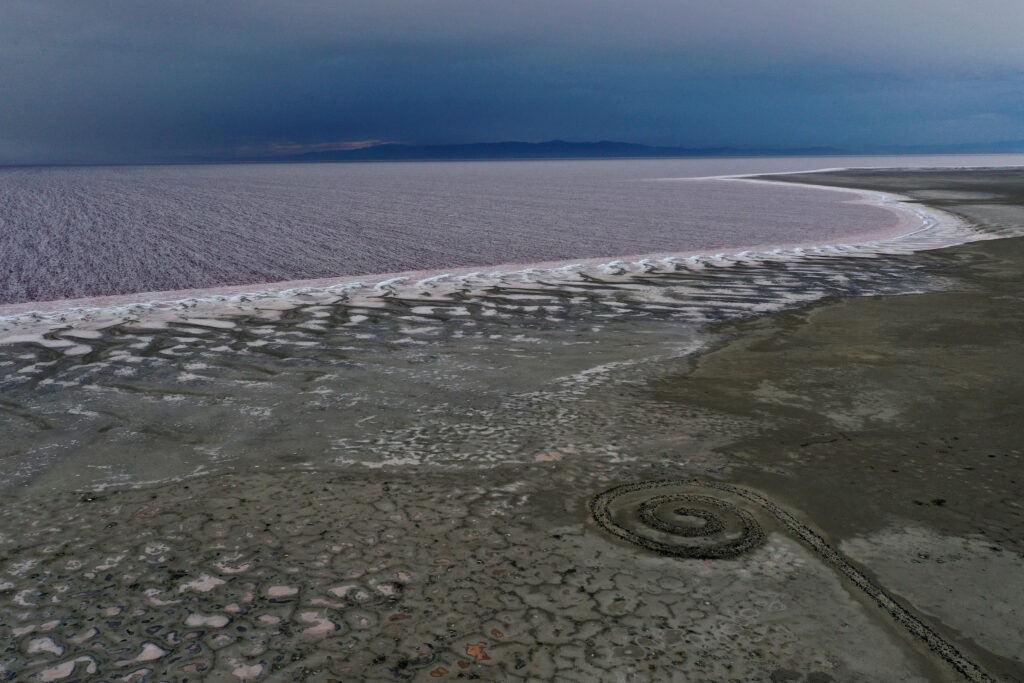
Host Steve Curwood caught up with Williams to discuss what’s happened since their last chat before the pandemic. Williams weathered COVID, lost loved ones like millions of others, taught at Harvard Divinity School, and brought 20 students to Great Salt Lake as it retreats. They visited Nancy Holt’s "Sun Tunnels" and Robert Smithson’s "Spiral Jetty," but the real point was to feel the lake’s power - what the Ute Nation calls our sacred mother. Williams also notes we now have a president “beyond politics,” alongside extraordinary cruelty and compassion. Her advice? Stand steady, even though change is all around us. Living in an erosional landscape shaped by wind, water, and time, she says, there’s no expectation things won’t change. That might make it easier.
Williams also describes her pandemic-era night walks in the desert, when daytime temperatures hit 116°F. She learned that eyes adapt to darkness: red rocks turn blue, deer eyes shine, coyote eyes glow red, and jackrabbit eyes blaze like flames. The Milky Way became three-dimensional. She had a night-walking partner in Vermont, Bianca, and they exchanged audio letters about what they saw - deer versus cows, dimensional galaxies versus imagined ones. Williams says we can find Glorians everywhere if we slow down and pay attention to our senses, our grief, our compassion. In this book, she didn’t hold back, because she thinks we can’t afford to. She tells a story she normally wouldn’t: during a global pandemic prayer, she held an amethyst crystal her grandmother gave her, felt a flame from Round Mountain enter her heart, and opened her hand to find the crystal burned. That, she says, is also a Glorian - a moment where collective focus can change everything. It’s not about hope; it’s about engagement. Be present where you call home, and you’ll know what to do.
The Good Times
News in your inbox.
One sardonic roundup, delivered on your schedule. Free. Unsubscribe whenever your tolerance for wit runs out.
Already subscribed but we never reach your inbox? Check your spam folder and hit 'Not spam' (or 'Remove from spam') to bust us out of junk-mail purgatory. You'll be helping everyone else too.
Don't open any of our emails for a month and you'll be automatically removed from the mailing list.
Rewrite Article
Select parts to regenerate with a fresh AI pass. Translations will be updated automatically.
Generate AI Image
Creates a sardonic version of the article image using OpenAI.