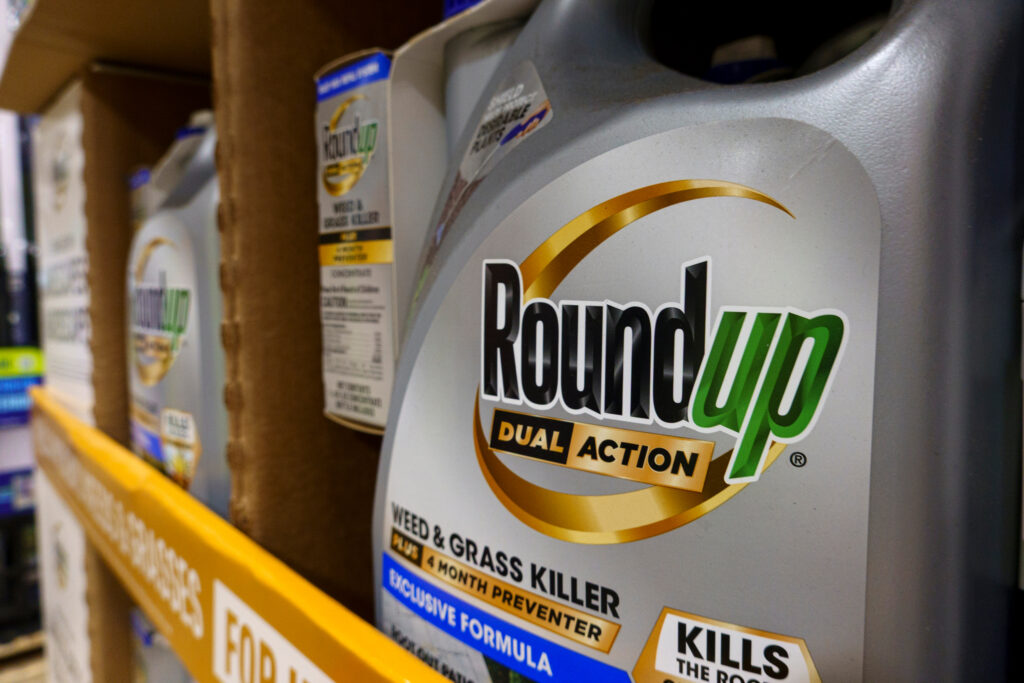
Supreme Court Hears Case That Could Let Weed Killer Off the Hook, Because of Course
Supreme Court hears Monsanto's appeal to block state lawsuits over Roundup's cancer risk, potentially ending thousands of cases with a wave of the federal-law wand.
John Durnell just wanted his St. Louis neighborhood to look a little nicer. So he sprayed some Roundup. Decades and multiple rounds of chemotherapy later, a Missouri jury in 2023 decided his blood cancer was indeed caused by the herbicide manufactured by Monsanto, ordering the company to pay him $1.25 million in damages. Now, the U.S. Supreme Court is considering whether that victory - and hundreds of similar lawsuits - should essentially be erased.
On Monday, the justices heard Monsanto’s appeal, with the company arguing that federal law prohibits states like Missouri from allowing lawsuits over failure to warn consumers about cancer risks. Paul Clement, a well-respected appellate lawyer representing Monsanto, warned that allowing such state suits would impose “crippling liability” on companies. The relevant federal law, the Federal Insecticide, Fungicide, and Rodenticide Act (FIFRA), he argued, exclusively governs pesticide labeling - not states.
Departing from the Biden administration’s previous stance, a lawyer for the Trump administration backed Monsanto, asking the justices to limit citizens’ ability to bring state law tort claims against chemical manufacturers. Chief Justice John Roberts seemed concerned about the scope of this argument, asking, “The states cannot do anything?” Clement conceded states might not require cancer warnings but could theoretically ban a pesticide entirely. Justice Neil Gorsuch found that outcome absurd - states can’t require a warning label but can ban the product outright? Clement suggested that is indeed the current state of the law.
Most justices appeared comfortable with the idea that federal law supersedes state labeling requirements, especially since the Environmental Protection Agency (EPA) has long deemed glyphosate safe and declined to require cancer warnings. But Ashley Keller, Durnell’s attorney, told the court that “things slip through the cracks with that agency.” J.W. Glass, senior EPA policy specialist at the Center for Biological Diversity, noted that the EPA has declined to require cancer labels on 99 percent of pesticide products containing probable carcinogens. “Why would anyone believe that Americans’ health is being looked out for by the EPA or the pesticide industry?” he asked.
A March letter signed by 70 public health experts called for immediate regulation of glyphosate, stating the evidence of harm is “so strong that no additional delays in regulation…can be justified.” Tarah Heinzen, legal director at Food & Water Legal Watch, warned that a Supreme Court win for Monsanto would close courthouse doors to tens of thousands of sick Americans. Bayer, which now owns Monsanto, has already spent nearly $11 billion settling glyphosate-related claims and secured a February executive order from the Trump administration classifying glyphosate production as a national security interest.
The Good Times
News in your inbox.
One sardonic roundup, delivered on your schedule. Free. Unsubscribe whenever your tolerance for wit runs out.
Already subscribed but we never reach your inbox? Check your spam folder and hit 'Not spam' (or 'Remove from spam') to bust us out of junk-mail purgatory. You'll be helping everyone else too.
Don't open any of our emails for a month and you'll be automatically removed from the mailing list.
Rewrite Article
Select parts to regenerate with a fresh AI pass. Translations will be updated automatically.
Generate AI Image
Creates a sardonic version of the article image using OpenAI.