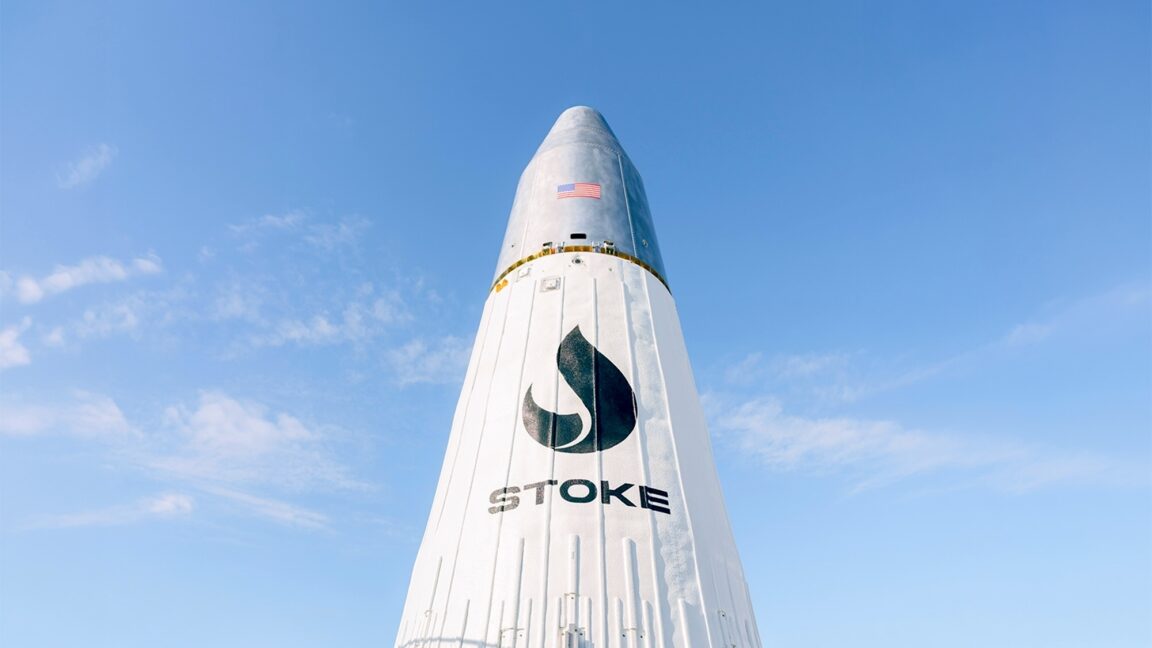
Stoke Space, the Washington-based launch company that has yet to actually orbit anything, announced Tuesday it has raised an additional $1 billion in a Series E round co-led by Point72 Ventures and Spark Capital. This brings the company's total funding to a jaw-dropping $2.3 billion - a staggering sum for a venture that hasn't even attempted an orbital launch yet. But hey, who needs a track record when you have a vision?
CEO Andy Lapsa revealed that the new cash will accelerate development of a larger 'Block 2' version of the Nova rocket, capable of lifting 15 metric tons to low-Earth orbit in a fully reusable configuration. 'We have already started development on a larger vehicle, and we felt like now is the time to pour gas on that fire,' Lapsa said, presumably while holding a flamethrower labeled 'investor dollars.'
The initial Nova Pathfinder is planned to lift 3 metric tons in reusable mode, up to 7 tons expendable, with a first stage powered by seven Zenith engines generating 700,000 pounds of thrust. The upper stage features a novel ring of 24 thrusters surrounding a regeneratively cooled heat shield - because why not make reentry as complicated as possible? After completing structural tests on the first stage this summer, Stoke will ship it to Cape Canaveral, Florida, for more testing, a static fire, and eventual mating with the upper stage. The upper stage will head to Moses Lake, Washington, for its own structural and hot fire tests before joining the party in Florida.
Lapsa finally put a target date on Nova's debut: 'early' 2027. He's optimistic, but realistic: 'I feel good about that launch date. But as you know, in our industry, we'll go when we're ready.' Translation: don't hold your breath, but also maybe start holding it around 2027.
During a visit to Stoke's Kent, Washington factory last fall, Ars Technica saw advanced assembly of flight hardware. The Nova Pathfinder, at 12.5 feet in diameter, is slightly wider than SpaceX's Falcon 9 but considerably shorter. The Block 2 version will have a 15-foot diameter and, like Pathfinder, use methane-liquid-oxygen-fueled Zenith engines - just more of them. The upper stage will also switch to a cylindrical shape, ditching the conical taper that constrained payload volume. Lapsa says they've found 'a pretty slick approach' to deleting the taper, which sounds like a euphemism for something involving a very large can opener. Block 2's debut is targeted for 2029.
With satellite operators in 'panic mode' over launch availability, Stoke aims to address some demand with Nova Pathfinder, but to truly compete with SpaceX's reusable rockets, Blue Origin's New Glenn, Relativity Space's Terran R, and Rocket Lab's Neutron, it needs the bigger Block 2. Lapsa believes there's room for everyone: 'The space economy will grow exactly as fast as we can launch rockets. It will not grow faster. It cannot grow faster. And there is a lot of pent-up demand for rockets flying.' Indeed, the mismatch between launch supply and demand is enormous - and so is Stoke's bank account.
The Good Times
News in your inbox.
One sardonic roundup, delivered on your schedule. Free. Unsubscribe whenever your tolerance for wit runs out.
Already subscribed but we never reach your inbox? Check your spam folder and hit 'Not spam' (or 'Remove from spam') to bust us out of junk-mail purgatory. You'll be helping everyone else too.
Don't open any of our emails for a month and you'll be automatically removed from the mailing list.
Rewrite Article
Select parts to regenerate with a fresh AI pass. Translations will be updated automatically.
Generate AI Image
Creates a sardonic version of the article image using OpenAI.