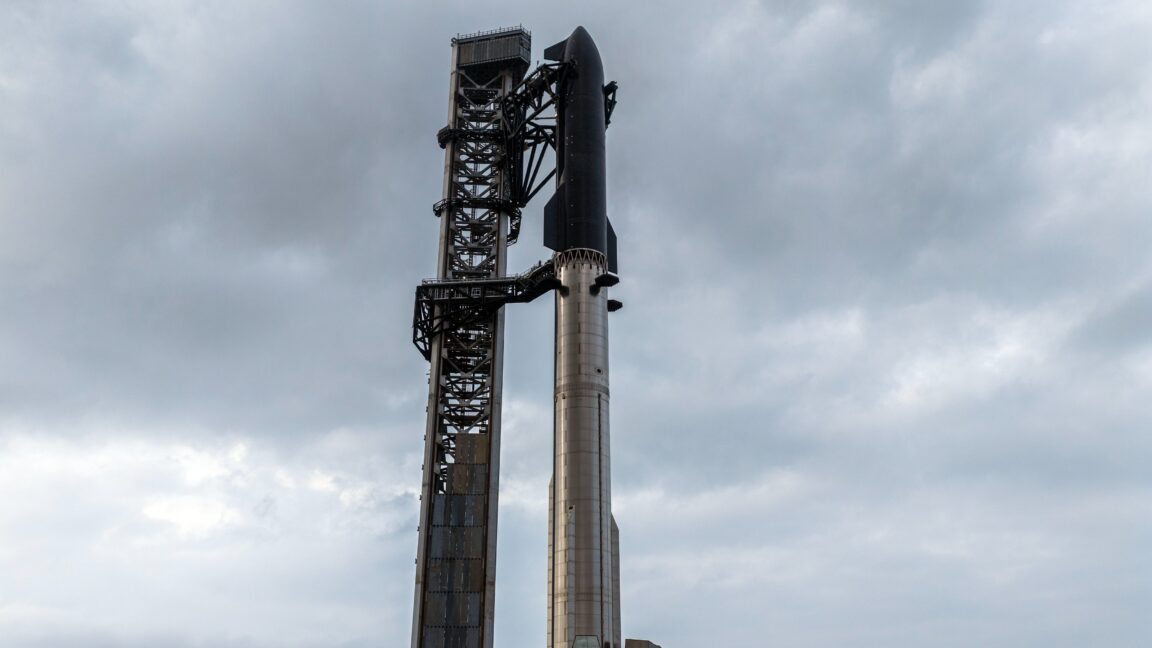
SpaceX announced today that it intends to launch its 14th Starship mission as early as September 22, pending regulatory approval. This flight is notable because it will be the first time the company attempts to launch the experimental vehicle into orbit - a milestone that has taken a few tries, a few explosions, and a few hard splashdowns to reach.
The target liftoff time is 7:15 am local in Texas (12:15 UTC), with a 75-minute launch window. Sunrise in Brownsville, Texas, is 7:17 am CT, meaning the launch could produce some striking imagery - assuming the rocket cooperates and the sky doesn't mind being upstaged.
The super heavy lift rocket will carry 26 of the larger V3 Starlink satellites into an orbit 275 km above the Earth. In an update on its website, SpaceX said the Starship upper stage will seek to complete six orbits around the Earth before completing its mission after about 10 hours. That's roughly the length of a transatlantic flight, but with more satellites and fewer peanuts.
Reaching orbit would mark a significant milestone in the company's Starship development campaign, which conducted its first test flight on April 20, 2023, and has since made progress in fits and starts. With the upcoming mission, SpaceX continues to modify the Starship vehicle as it seeks to improve the third iteration of the Super Heavy booster and Starship upper stage. After recent successes, the company appears to be closer to developing a fully reusable, super heavy lift rocket - a goal that has been described as "the holy grail" by people who enjoy both spaceflight and medieval metaphors.
During the most recent Starship test flight on July 24, the vehicle's first stage performed nominally during ascent. However, after a successful boostback burn, the vehicle experienced problems during the return through Earth's atmosphere.
"In the terminal phase of the burn, the three center engines showed signs of ice clogging, which triggered an early end to the maneuver," SpaceX said in its update on Tuesday. "The booster went on to attempt a landing burn, with 8 of the 13 planned engines reigniting before the booster made a hard splashdown in the Gulf. The Super Heavy on this upcoming flight has hardware modifications to improve filtering to the engines and software changes to enhance relight reliability."
Accordingly, this first stage will not attempt to return to the launch site. Rather, it will attempt to make a controlled landing in the Gulf of Mexico. If successful, this could set up a first-stage catch on the subsequent flight of Starship - because catching a rocket with giant mechanical chopsticks is apparently the new standard for a good day at the office.
During the upcoming test flight, the upper stage will attempt to reach orbit for the first time and deploy operational payloads. These Starlink satellites, significantly more capable than V2 mini Starlink satellites launched on a Falcon 9 mission, will then use onboard propulsion to raise their orbits. Because why settle for one orbit when you can have a better one?
Despite a largely successful ocean landing of the Starship upper stage during the July test flight, this mission will not attempt a return of the upper stage to the launch site in Texas. Instead, SpaceX plans to gather more data about heat shield performance. The company said it had made several upgrades since the mission two months ago, based on data gleaned from the vehicle both in flight and once recovered in the Indian Ocean, largely intact.
"[The upgrades] include additional retention mechanisms added to tiles in areas deemed to be at highest risk of falling off during ascent, addressing recently discovered areas that offer flow paths behind tiles for plasma, and flying multiple areas with a curved tile design that has shown the ability to reduce heating in the gaps between tiles," the company said. In other words, they're glueing the heat shield on better and hoping for the best - which is basically the entire history of spaceflight in one sentence.
Additionally, two tiles recovered from Ship 40 are planned to be reflown on Ship 41, marking the first tile reuse for Starship. It's not much, but it's a start - and in the world of reusable rockets, every tile counts.
The Good Times
News in your inbox.
One sardonic roundup, delivered on your schedule. Free. Unsubscribe whenever your tolerance for wit runs out.
Already subscribed but we never reach your inbox? Check your spam folder and hit 'Not spam' (or 'Remove from spam') to bust us out of junk-mail purgatory. You'll be helping everyone else too.
Don't open any of our emails for a month and you'll be automatically removed from the mailing list.
Rewrite Article
Select parts to regenerate with a fresh AI pass. Translations will be updated automatically.
Generate AI Image
Creates a sardonic version of the article image using OpenAI.