
SANTA PAULA, Calif. - Ethan Higbee returned from a hardware store run six months ago to find that his driveway had been upgraded with an unexpected feature: the overwhelming smell of gasoline and a rushing sound that turned out to be crude oil, not water, flowing into a nearby creek.
“I was in my house, because I was like, I’m not going (out), that’s just gonna explode. I was terrified,” the 47-year-old filmmaker told reporters on the six-month anniversary of the spill. The oil came from an above-ground storage tank on a hill next to his home, which state crews later determined had breached due to overfilling and improper rainwater valve management by Carbon California, the oil and gas company responsible.
The incident - described by Carbon California as a “small crude oil spill” - contaminated at least three-quarters of a mile of a remote tributary of Sisar Creek near Ojai. The company’s official estimate: about 420 gallons. Locals, including Higbee, have raised a skeptical eyebrow at that number, suggesting the true volume may have been considerably larger. Carbon California did not respond to multiple requests for comment, which is never a good sign.
In December, state regulators issued a “notice of violation” to the company, hinting that enforcement action could follow. An email exchange between the state and Carbon California, obtained by Inside Climate News, included acknowledgment that the initial malfunction was fixed - though exactly what steps were taken since remains as clear as the creek before the oil arrived. California officials this week admitted they could not fully confirm how much crude oil spilled on Nov. 18.
Eric Laughlin, a spokesman for the Department of Fish and Wildlife’s Office of Spill Prevention and Response, said the department’s Law Enforcement Division conducted an investigation and submitted a report earlier this month to the Ventura County District Attorney’s Office. That office could not be immediately reached for comment, which is also never a good sign. “Final spill quantification is part of the case we submitted and we are unable to comment on pending litigation,” Laughlin said.
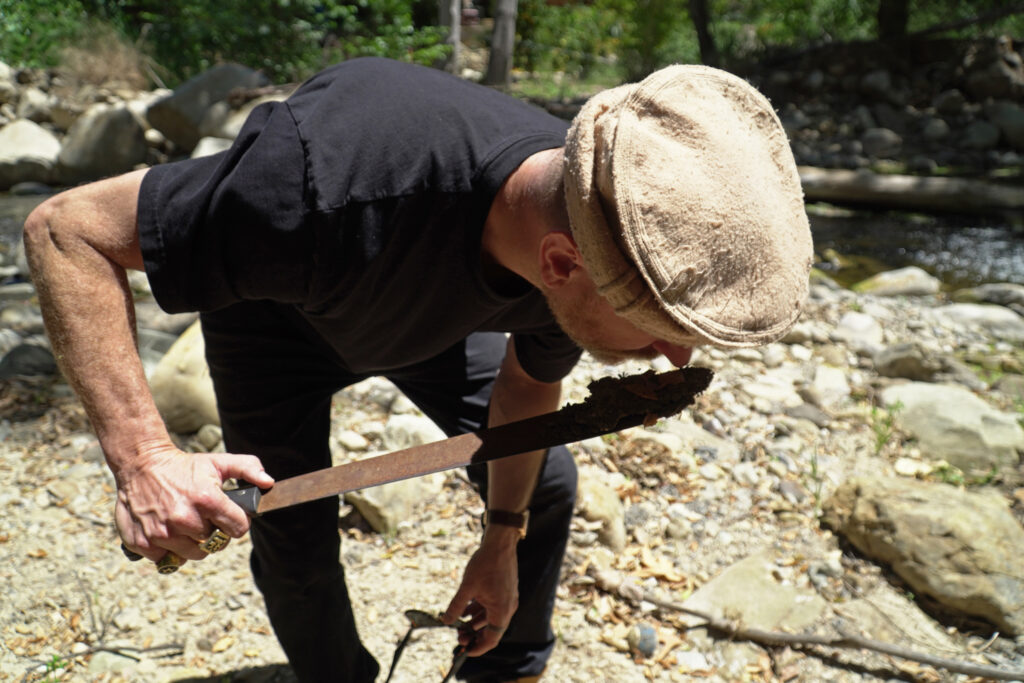
No oiled wildlife was observed after the incident, according to a Carbon California official, and no specific negative health outcomes have been reported among the roughly 20 homes surrounding the site. But that doesn’t mean people aren’t on edge. A new group called “Neighbors of Santa Paula Canyon” has formed to address local concerns. Higbee, armed with a machete, walked his property pointing to oil stains on rocks and digging for what he fears are oil remains caked beneath the soil - all while his 6-year-old son Noah played nearby with a baseball.
For Haley Ehlers, executive director of community advocacy group Climate First: Replacing Oil & Gas (CFROG), the scene is all too familiar. “This spill, and the incomplete response, is another acute example of the unacceptable harm the oil and gas industry poses for community and environmental health,” she said. Ehlers emphasized that “community members are still being left in the dark, with no indication that the operator has been held accountable for this disaster, even six months later.”
Between October 2025 and this month, more than 50 crude oil spills and other leaks have been reported to the state, according to data from the nonprofit Center for Biological Diversity. The spills ranged from 210 gallons in Ventura County this February to 22,000 gallons from a pipeline leak in December in Kern County. Just this week, a pipeline ruptured in East Los Angeles, releasing an undetermined amount of crude oil, while a storage tank in Kern County accidentally released at least 42,000 gallons of oil-related wastewater. So the region is essentially playing a very expensive, very toxic game of “how much can we spill before someone notices?”
Acute health effects from crude oil exposure can include respiratory, eye, and skin symptoms, as well as headache, nausea, dizziness, tiredness or fatigue - and that’s just the short list. Chronic effects include respiratory disorders, genotoxic effects, and endocrine abnormalities. Approximately 3 million Californians live within 3,200 feet of an active oil or gas development, said Jill Johnston, an associate professor at UC Irvine. Ventura County represented 4.2 percent of the state’s crude oil production in 2025, while Kern County dominated with 73 percent.
Although federal officials continue to investigate, Julia Giarmoleo of EPA Region 9 said the incident occurred when heavy rain caused a “slop tank” to overflow. A letter from California regulators noted “the operator’s failure to close and secure rainwater valves led to the unauthorized release of fluids.” Families want to know exactly how much oil spilled, what testing has been carried out, and in what ways Carbon California has been held accountable.
“It’s been six months,” Higbee said, sounding exasperated. “We want to know answers.”
Hollin Kretzmann, a senior attorney for the Center for Biological Diversity, added that the future of the Sisar Creek site is relevant for another reason: three days after the spill, the state approved the operator’s proposal for wastewater injection activity in the same oil field. “That means there (could) be oil production in the area until at least 2040,” he said. Because nothing says “we learned our lesson” like approving more drilling at the site of a recent spill.