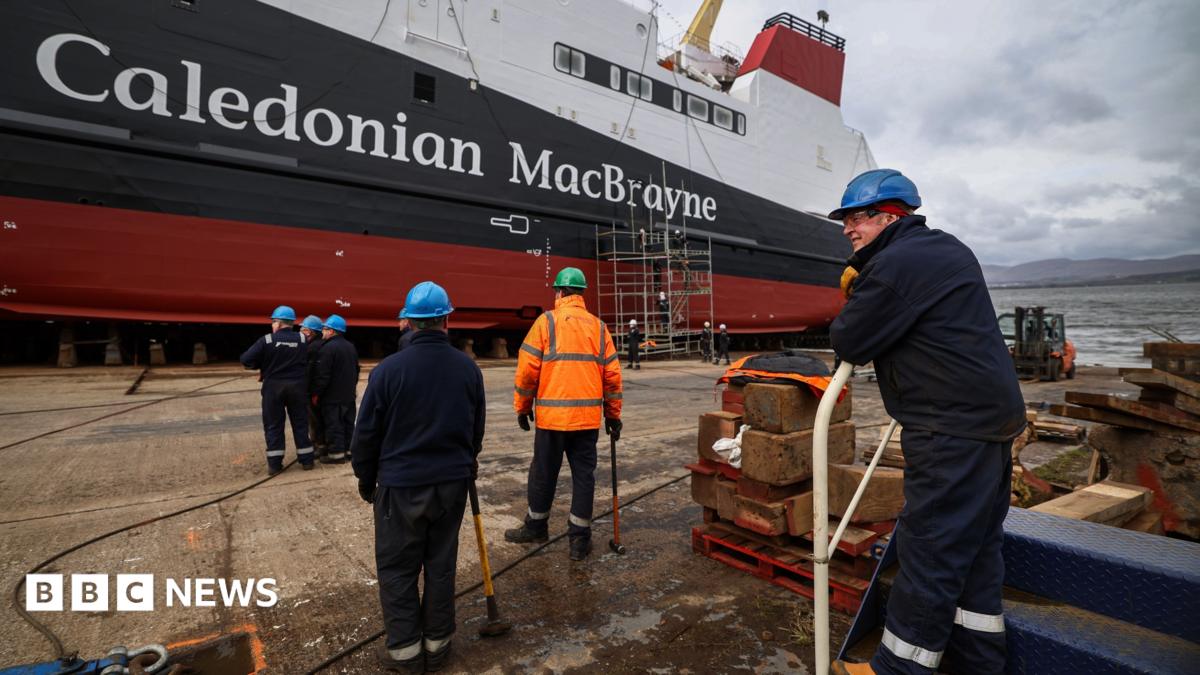
Scotland's Last Shipyard Announces Voluntary Redundancies, Blames 'Due Diligence' and General Shipbuilding Sadness
Scotland's last shipyard is shedding workers while the government does 'due diligence' on promised contracts, leaving everyone to wonder if the bridge to the future is actually a plank.
In a move that has unions reaching for the smelling salts and the rest of us reaching for a dictionary to look up 'betrayal', Ferguson Marine has announced it will cut nearly a quarter of its workforce. The state-owned shipyard, which is currently the last commercial shipyard on the Clyde, is inviting workers to apply for voluntary redundancy as it waits - rather impatiently, one imagines - for the Scottish government to confirm those promised new orders.
The Port Glasgow firm currently employs 247 core staff, 31 agency staff, and 32 apprentices, but expects to shed 70 posts. The Scottish government has pledged to directly award the yard contracts for four smaller ships, but is still conducting 'due diligence' - a phrase that has become the political equivalent of 'the cheque is in the post'.
Ferguson Marine claims the job losses will protect the long-term viability of the yard, but unions have described the move as 'a betrayal of a blameless workforce'. Those who choose to leave will receive £10,000 on top of their statutory redundancy entitlements, which is a bit like being given a gold watch before being shown the door - except the watch is cash and the door is metaphorical.
The shipyard was nationalised in 2019 after a long-running dispute over extra costs for two dual-fuel CalMac ferries. The first, MV Glen Sannox, was finally delivered in November 2024, while MV Glen Rosa is due for completion by the end of this year. The yard has no confirmed future orders, having recently completed sub-contracting work for BAE Systems on Type 26 frigates.
CEO Graeme Thomson said the immediate focus is the handover of Glen Rosa, but acknowledged an 'inevitable gap in workload' while negotiations continue. He emphasized that proactive action now would protect the yard's long-term viability and keep it 'lean, modern, and ready to cut steel on the new fleet as quickly as possible' - a sentiment that might sound more reassuring if the new fleet weren't still in the realm of 'due diligence'.
In March, the Scottish government announced plans to directly award contracts for four vessels: two small CalMac ferries, a fisheries research ship, and a marine protection vessel, promising a 'bridge to the future'. Then Economy Secretary Kate Forbes said a lot of upfront work had been done, but engagement with the Competition and Markets Authority would be required. Since then, nothing has been confirmed, and current Economy Secretary Stephen Flynn said the redundancy scheme is part of modernising the shipyard. He assured that the reduced workforce won't affect Glen Rosa's construction, and that the intention to directly award four vessels 'continues to undergo full due diligence' - which, at this rate, might outlast the shipyard itself.
Louise Gilmour of the GMB union was less diplomatic, accusing ministers of failing to deliver new contracts while sending work 'around the world'. She lamented that skilled shipbuilders are being encouraged to leave as contracts go 'everywhere but here', blaming 'hubris and incompetence' for failing a blameless workforce. Local MP Martin McCluskey called the news 'deeply concerning' and part of a 'jobs crisis' in Inverclyde, urging the Scottish government to 'step up, move faster, and do everything within its power' - presumably including actually signing some contracts.
Even if a new contract were awarded imminently, at least a year of design work would be needed before steel cutting could begin. The promised orders have allowed the firm to update its business plan, potentially unlocking £14.2m of modernisation money announced over two years ago. Ground investigation work is underway for new equipment and software to raise productivity. The apprentice programme remains unaffected in the short term, with 34 trainees in training and 10 new starters about to begin college - a small mercy in a sea of uncertainty.
Ferguson's has built over 360 ships since 1903, but its reputation has been battered by the long-delayed and over-budget ferries. The first LNG vessels of their kind built in the UK faced design challenges and cost disputes. While the workforce is widely considered blameless, the controversy has made potential customers nervous. The yard also faces competition from overseas, with foreign yards undercutting UK builders by 10-20% thanks to cheaper labour and better state support.
Two years ago, Ferguson's missed out on an order for seven small CalMac ships, losing to a Polish firm on price. Management has called for 'social value' to be factored into evaluations, but CMAL claims procurement rules restrict its ability to do so. Last summer, CEO Graeme Thomson called for a direct award for a replacement of MV Lord of the Isles, but was rejected, and the contract went to tender. Ferguson's couldn't even bid due to pre-qualification criteria that no UK-based commercial shipbuilder could meet. The winning bidder will be announced early next year, but until then, the shipyard will be holding its breath - and shedding staff.
The Good Times
News in your inbox.
One sardonic roundup, delivered on your schedule. Free. Unsubscribe whenever your tolerance for wit runs out.
Already subscribed but we never reach your inbox? Check your spam folder and hit 'Not spam' (or 'Remove from spam') to bust us out of junk-mail purgatory. You'll be helping everyone else too.
Don't open any of our emails for a month and you'll be automatically removed from the mailing list.
Rewrite Article
Select parts to regenerate with a fresh AI pass. Translations will be updated automatically.
Generate AI Image
Creates a sardonic version of the article image using OpenAI.